Category Archives: Other

What is a hyperscaler?

Published May 29, 2026

A hyperscaler is a massive cloud service provider that offers computing, storage, and networking infrastructure on an enormous, globally distributed scale.

The term comes from hyperscale computing, an IT architecture designed to seamlessly scale up to thousands (or millions) of servers to handle massive, fluctuating workloads without compromising performance or reliability.

If a traditional data center is a localized warehouse, a hyperscaler is a global logistics network.


Who are the Major Hyperscalers?

While many companies provide cloud hosting, only a handful have the capital and physical footprint to be considered true hyperscalers. The market is dominated by the “Big Three”:

  1. Amazon Web Services (AWS): The global market leader, holding the largest share of cloud infrastructure.
  2. Microsoft Azure: Heavily integrated into enterprise ecosystems and deeply tied to corporate IT environments.
  3. Google Cloud Platform (GCP): Known for its high-performance data analytics and native AI capabilities.

Other notable players include Meta (which operates at hyperscale primarily for its own family of apps), Alibaba Cloud (dominant in Asia), and Oracle Cloud Infrastructure (OCI).


Key Characteristics of a Hyperscaler

To be classified as a true hyperscaler by industry standards (like the International Data Corporation), a provider generally must meet several massive criteria:

  • Physical Footprint: They must operate facilities housing at least 5,000 servers (though the top players house hundreds of thousands of servers across millions of square feet).
  • Elasticity (Horizontal & Vertical Scaling): Hyperscalers can scale resources horizontally (adding more servers to a network) or vertically (adding more power to an existing server) in seconds via automated software orchestration.
  • Global Redundancy: They operate across dozens of geographic “Regions” and “Availability Zones.” If an entire data center facility loses power or suffers a natural disaster, workloads are automatically and seamlessly redirected to a backup facility halfway across the world without the end-user noticing.

Why Hyperscalers Matter (Especially in 2026)

Historically, hyperscalers were used to host massive websites, stream video content (like Netflix on AWS), or manage enterprise databases. However, the rise of the Artificial Intelligence boom has made them the literal backbone of the global economy.

1. The AI Powerhouse

Training and running Large Language Models (LLMs) requires an astronomical amount of computational power. Hyperscalers are the only entities capable of buying, cooling, and networking tens of thousands of specialized AI microchips (like NVIDIA GPUs) into unified “superclusters.”

2. Shifting CapEx to OpEx

Before hyperscalers, if a company wanted to launch a new software application, they had to spend millions buying physical servers, renting a building, and hiring technicians (Capital Expenditure, or CapEx). With a hyperscaler, they pay a monthly bill only for the exact computing seconds they use (Operational Expenditure, or OpEx).

3. The “Platform” Ecosystem

Hyperscalers no longer just rent out raw computer chips and digital storage space. They offer thousands of pre-built, managed services—including cybersecurity firewalls, automated data analytics, blockchain nodes, and out-of-the-box AI training modules—allowing businesses to innovate rapidly.


Summary: Traditional Data Center vs. Hyperscaler

FeatureTraditional Data CenterHyperscaler Cloud
SizeTypically under 10,000 sq. ft.Massive complexes, often the size of football fields.
Server CountHundreds to a few thousand.Hundreds of thousands to millions globally.
Scaling SpeedRequires manually ordering and installing hardware (weeks/months).Handled instantly via software APIs (seconds).
Pricing ModelHigh upfront infrastructure investment.Pay-as-you-go subscription model.

It’s obvious Mr. Trump is leveraging the presidency for immense financial gain

Published in The Globe and Mail on May 25, 2026

Here is an excerpt from the article.

His first year back in office was the most profitable of his life, bestowing US$3-billion in wealth on the family fortune, according to Forbes.

Mr. Trump’s self-enrichment campaign comes at a cost to us all. It rips off those on the other side of those trades. And it undermines the fairness of the public markets.

In March, more than US$800-million worth of oil futures changed hands just minutes before Mr. Trump announced on Truth Social that strikes on Iran’s infrastructure would be postponed, according to the Wall Street Journal.

Same thing a couple weeks ago, as detailed by the influential market commentator The Kobeissi Letter. In the early hours of May 6, someone bet nearly US$1-billion on crude oil shorts, which pay off if the price of oil drops. About an hour later, Axios reported that a deal to end the war in Iran was in the works. Oil prices quickly dove by 12 per cent, and those shorts netted a cool US$125-million.

Donald Trump cashes in on power, and investors pay the price – The Globe and Mail

The Canadian ETF industry has experienced an unprecedented boom

Published May 23, 2026

The Canadian ETF industry has experienced an unprecedented boom, with total Assets Under Management (AUM) officially crossing the $800 billion CAD milestone. A massive chunk of this capital is heavily concentrated among the “Big Three” issuers: BlackRock (iShares), Vanguard, and BMO.

The largest Canadian-listed ETFs, categorized by their distinct investment styles, dominate the retail and institutional landscape.


1. Core Broad-Market Equity (Passive Indexing)

These are the heavyweights of the Canadian financial system. They track massive, cap-weighted indices to give investors low-cost, bedrock exposure to Canadian and U.S. stock markets.

  • iShares Core S&P/TSX Capped Composite Index ETF (XIC): Standing as one of the single largest ETFs in Canada at ~$25.2 billion AUM, XIC tracks the entire Canadian stock market (large, mid, and small-cap).
  • iShares S&P/TSX 60 Index ETF (XIU): At ~$21.4 billion AUM, this is the evolution of the world’s very first ETF. It strips out smaller companies and holds just the 60 blue-chip giants of the TSX.
  • Vanguard S&P 500 Index ETF (VFV): This is the go-to vehicle for Canadians seeking unhedged exposure to the U.S. stock market. It has consistently been one of the fastest-growing funds in Canada due to its rock-bottom management fee (0.08%).
  • BMO S&P/TSX Capped Composite Index ETF (ZCN): BMO’s primary domestic heavy-hitter sitting at ~$14.7 billion AUM, mirroring XIC’s broad strategy with ultra-low costs.

2. Asset Allocation (“All-in-One” Portfolios)

This style represents a major shift in how Canadians build portfolios. These funds handle automatic rebalancing across global equities and fixed income within a single ticker. It is the fastest-growing investment style, drawing massive inflows.

  • iShares Core Equity ETF Portfolio (XEQT): Holding roughly $6.7 billion+ AUM, XEQT is an aggressive 100% equity portfolio holding over 9,000 global stocks (split across the U.S., Canada, International, and Emerging Markets).
  • Vanguard All-Equity ETF Portfolio (VEQT): Vanguard’s direct competitor to XEQT, also maintaining a pure 100% stock structure with slightly different regional weightings.
  • Vanguard Growth ETF Portfolio (VGRO): The quintessential “Growth Balanced” option, keeping a strict 80% equity / 20% fixed income split for investors who want a minor bond cushion.

3. Fixed Income & Aggregate Bonds

When equity markets see volatility or interest rate projections shift, capital floods back into these foundational bond packages.

  • BMO Aggregate Bond Index ETF (ZAG): Holding ~$10.04 billion AUM, ZAG is the giant of Canadian fixed income. It provides comprehensive exposure to investment-grade government, provincial, and corporate bonds.
  • iShares Core Canadian Universe Bond Index ETF (XBB): A close rival to ZAG, offering a nearly identical diversified bond mix to anchor traditional 60/40 balanced portfolios.

4. Dividend & Income-Focused (High Yield)

Canadian investors traditionally love cash flow, making dividend and specialty income styles incredibly lucrative.

  • Vanguard FTSE Canadian High Dividend Yield Index ETF (VDY): With ~$3.34 billion AUM, VDY tracks the highest-yielding blue chips in Canada. Because the TSX is top-heavy, it leans aggressively into the Big Banks and massive energy infrastructure providers (like Enbridge).
  • The Covered Call Phenomenon: While funds like VDY dominate traditional indexing, Enhanced/Covered Call ETFs (managed by firms like Global X and BMO) are surging. They overlay option-writing strategies onto equity baskets to manufacture yields north of 7–9% for income-starved retirees.

5. Cash & Liquid Money Market

When investors want to sideline cash while earning a risk-free yield, they look to High-Interest Savings Account (HISA) and Money Market ETFs.

  • Purpose High Interest Savings ETF (PSA): At ~$3.35 billion AUM, PSA pools investor capital to purchase high-interest cash accounts directly from Canada’s Tier-1 banks, paying out monthly interest.
  • BMO Money Market Fund (ZMMK): An ultra-short-term safety play that invests in corporate promissory notes and treasury bills, built for maximum capital preservation.

At-A-Glance structural Overview

Investment StyleTop RepresentativeTickerCore Exposure FocusTypical Cost (MER)
Broad Market DomesticiShares Core S&P/TSXXIC~200+ Canadian Stocks~0.06%
Broad Market USVanguard S&P 500VFV500 Largest US Stocks~0.09%
Fixed IncomeBMO Aggregate BondZAGGov & Corp Canadian Bonds~0.09%
All-in-One GlobaliShares Core EquityXEQT100% Global Stocks~0.20%
High DividendVanguard High Div YieldVDYCanadian Banks & Energy~0.22%
Cash / Capital Pres.Purpose High InterestPSACash Deposits at Big Banks~0.15%

The Current Landscape Trend

The overarching theme is a flight toward simplification. Instead of buying 5 or 6 regional ETFs, both retail investors and professional advisors are increasingly relying on All-in-One funds like XEQT or VEQT for their core equity weightings, and adding specific aggregate bond or high-dividend overlays to tilt toward their specific income needs.

Here is a good article from The Globe and Mail on ETFs.

————-

Technical Analysis is about trading with the trend

Note: This technical analysis is for educational purposes. Please conduct your own analysis or consult a financial advisor before making investment decisions. The author of this article may hold long or short positions in the featured stocks or indexes. The article was written with the help of AI and was reviewed by an editor.

© 2026 TradeOnline.ca InvestOnline.ca ChartAnalysis.ca

Canada produced the world’s very first Exchange-Traded Fund (ETF) for investors

Published May 23, 2026

While many people mistakenly assume the United States created the vehicle, Canada beat Wall Street to the punch by nearly three years.


The Birth of the ETF: TIPs 35

On March 9, 1990, the Toronto Stock Exchange (TSX) launched the Toronto 35 Index Participation Units (TIPs).

  • What it did: It allowed retail and institutional investors to buy a single basket of securities that tracked the 35 largest companies in Canada.
  • The Legacy: TIPs served as the global prototype for what we know as the modern ETF. Over the years, it evolved and is still traded today as the iShares S&P/TSX 60 Index ETF (XIU), making it the oldest existing ETF in the world.

The Common Misconception: The U.S. “Spider”

The reason most people think the U.S. invented the ETF is because of the massive popularity of the SPDR S&P 500 ETF Trust (SPY).

  • State Street and the American Stock Exchange (AMEX) launched SPY in January 1993.
  • While SPY didn’t come first, it revolutionized the global market structure because it was the first to successfully automate the creation/redemption mechanism at a massive scale. Today, it remains the largest ETF in the world.

Canada’s History of “Firsts”

Following the success of TIPs, Canada’s favorable regulatory environment turned Bay Street into a testing ground for investment innovation:

  • 1990: World’s first Equity ETF (TIPs)
  • 2000: World’s first Fixed-Income/Bond ETF (iShares Core Canadian Universe Bond Index ETF)
  • 2021: World’s first retail Bitcoin ETF (Purpose Bitcoin ETF)

The Big Picture: What started as a niche experiment in Toronto in 1990 completely transformed global investing, democratizing diversification for everyday retail investors.

In 2026, the AI industry has moved past the “hype” phase into a massive infrastructure and agentic era.

Published April 12, 2026

The market is dominated by a few “hyperscalers” and specialized frontier labs that control the primary compute and foundational models.

Here are the major players in AI, categorized by their role in the ecosystem:

1. The “Compute” Titans (Hardware & Infrastructure)

These companies provide the “shovels” for the AI gold rush.

  • NVIDIA: Remains the undisputed king with a ~90% market share in data center GPUs (Blackwell and Rubin architectures). NVIDIA software stack, CUDA, remains a formidable moat.
  • AMD: The primary challenger with its Instinct MI350/400 series. In early 2026, AMD secured a massive 6-gigawatt deal with OpenAI to power future training clusters.
  • The Custom Silicon Wave: Major cloud providers now design their own chips:
    • Google: Its TPU v6 (Tensor Processing Units) powers the Gemini ecosystem.
    • Amazon (AWS): Trainium 3 and Inferentia 3 chips offer high price-performance for startups.
    • Microsoft: Its Maia accelerators are now deeply integrated into Azure’s OpenAI services.

2. The Frontier Labs (Foundational Models)

These companies build the “brains” (LLMs and Multimodal models) that power everything else.

  • OpenAI: The most valuable private company in history (valued at $852B as of April 2026). Their flagship GPT-5.4 is the industry benchmark for reasoning and agentic capabilities.
  • Anthropic: Positioned as the “safety-first” alternative. Their Claude 4.6 (Opus, Sonnet, Haiku) is preferred by enterprises for its high context window and “Computer Use” features.
  • Google DeepMind: Recently released the Gemini 3 family, which is natively multimodal (processing video, audio, and code simultaneously) and powers 2 billion users via Google Search and Android.
  • Meta: The champion of “Open Weights” AI. Their Llama 4 series is the global standard for developers building local or sovereign AI applications.
  • xAI (Elon Musk): Utilizing the Colossus supercomputer (the world’s largest), xAI’s Grok 4 competes directly with OpenAI on raw reasoning power.

3. The “Agentic” & Enterprise Platforms

The shift in 2026 is away from “chatbots” and toward “agents” that do work autonomously.

  • Microsoft: Through Copilot, they have successfully integrated AI into the daily workflows of 400 million Office 365 users.
  • Salesforce (Agentforce): A major 2026 player that replaced traditional customer service with autonomous AI agents that can handle sales and support without human oversight.
  • Palantir: Dominates the defense and government sector with its AIP (AI Platform), used for battlefield intelligence and supply chain logistics.
  • Databricks & Snowflake: The “Data Giants” that allow companies to build custom AI models on top of their own private corporate data.

4. Specialized Vertical Leaders

  • AI Coding: Anysphere (Cursor) and Cognition (Devin) have revolutionized software engineering, with “autonomous coding” now handling 40% of routine enterprise code.
  • Physical AI & Robotics: Tesla (Optimus) and Figure AI are the leaders in humanoid robotics, while Waymo remains the dominant force in autonomous driving.
  • Creative Media: Runway (video), Suno/Udio (music), and Luma (3D/Video) have disrupted the film and music industries with studio-quality generative tools.

2026 Market Summary

CompanySectorKey Advantage
NVIDIAHardwareMonopoly on high-end AI chips.
OpenAIModelsFirst-mover advantage and massive Microsoft backing.
AppleEdge AIApple Intelligence runs private AI on 1B+ local devices.
Mistral AIEuropean AIThe leader in “Sovereign AI” for the EU.
Alibaba (Qwen)Asian AIDominates the Chinese market and open-source ecosystem.

The biggest trend of 2026 is the “ROI Gap”—investors are now pressuring these giants to prove that the trillions spent on chips are translating into actual corporate profits, not just cool demos.

Behind the algorithms and GPUs of 2026 are a handful of individuals whose decisions dictate the direction of global technology. The landscape has shifted recently, with several “Godfathers” of the field moving into advisory or risk-focused roles, while a new generation of “Agentic” leaders has taken over.

Here are the major players leading the AI revolution today:

1. The “Frontier” Visionaries (Lab Leaders)

These individuals lead the organizations building the world’s most powerful models.

  • Sam Altman (CEO, OpenAI): The most recognizable face in AI. In 2026, he oversees an OpenAI valued at over $850 billion. He has transitioned from simply building chatbots to focusing on “World Models” and the infrastructure required for AGI (Artificial General Intelligence).
  • Dario Amodei (CEO, Anthropic): A former OpenAI executive who now leads the primary competitor, Anthropic. Amodei is seen as the “conscience” of the industry, focusing heavily on AI Alignment and safety with their Claude models.
  • Demis Hassabis (CEO, Google DeepMind): A 2024 Nobel Prize winner, Hassabis has successfully merged Google’s massive compute power with DeepMind’s research. His focus in 2026 is “Scientific AI”—using models like AlphaFold to revolutionize medicine and material science.
  • Mustafa Suleyman (CEO, Microsoft AI): Formerly of Inflection and DeepMind, Suleyman now heads Microsoft’s consumer AI efforts. He is the primary architect of Copilot and the move toward personal AI “chiefs of staff.”

2. The “Infrastructure” Kings (The Power Brokers)

Without these individuals, the software labs would have no place to run their code.

  • Jensen Huang (CEO, NVIDIA): Often called the “Godfather of the AI Era,” Huang’s leadership has made NVIDIA the most valuable company in the world. His focus in 2026 is the Rubin GPU architecture and the creation of “AI Factories.”
  • Mira Murati (Founder, Thinking Machines Lab): After her high-profile departure from OpenAI as CTO, Murati launched her own venture in 2025. By April 2026, her “Thinking Machines Lab” has secured one of the largest hardware allocations in history to build specialized reasoning agents.
  • Lisa Su (CEO, AMD): Su has successfully positioned AMD as the only viable alternative to NVIDIA’s monopoly, specifically dominating the “Open Ecosystem” for AI hardware.

3. The “Academic & Safety” Guardians

These figures provide the intellectual and ethical framework for the industry.

  • Geoffrey Hinton (The Godfather of AI): Another 2024 Nobel Laureate. Since leaving Google, Hinton has become the leading voice warning against the existential risks of AI, frequently advising world governments on regulation.
  • Yann LeCun (Chief AI Scientist, Meta): Known for his “skeptical” but optimistic view, LeCun argues that current LLMs are not the path to true intelligence. He is leading the charge toward “World Models” that learn more like human babies do.
  • Fei-Fei Li (Stanford Professor / Founder, World Labs): The “Mother of Computer Vision.” In 2026, she leads the “Spatial Intelligence” movement, focusing on giving AI the ability to understand and interact with the 3D physical world.
  • Ilya Sutskever (Co-Founder, Safe Superintelligence Inc.): After leaving OpenAI, the legendary researcher founded SSI to focus purely on building a superintelligent system that is “provably safe” before it is ever deployed.

4. The “Sovereign & Alternative” Players

  • Elon Musk (Founder, xAI): Through xAI and the Grok models, Musk utilizes the massive data firehose of X (formerly Twitter) and the world’s largest supercomputing clusters (Colossus) to build “truth-seeking” AI.
  • Arthur Mensch (CEO, Mistral AI): The leader of Europe’s AI efforts. Mensch has become the champion of Open Source AI, ensuring that not all power resides in Silicon Valley.

Summary of Influence (April 2026)

IndividualPrimary InfluenceCurrent 2026 Project
Sam AltmanGlobal Policy & ScalingGPT-5.4 / “Stargate” Supercomputer
Jensen HuangHardware & ComputeRubin Architecture / Omniverse
Dario AmodeiSafety & EnterpriseClaude 4.6 / Scaling Laws
Yann LeCunResearch TheoryV-JEPA (Joint-Embedding Predictive Architecture)

The debate over AI is no longer just happening in research papers; in 2026, it is the primary driver of international law. The clash between Effective Accelerationism (e/acc) and AI Safety (Alignment) has created a fragmented regulatory map where a company’s “philosophy” can determine which borders it is allowed to cross.

The Great Philosophical Divide

1. Effective Accelerationism (e/acc)

  • The Philosophy: Influenced by figures like Marc Andreessen and Garry Tan, e/acc argues that any attempt to slow down AI is a “death sentence” for human progress. They believe the only way to solve AI risk is to build better AI faster.
  • Impact on Law: This philosophy has heavily influenced the U.S. Federal Framework released in March 2026. This framework aims to curb “regulatory overreach” by individual states, focusing on market competition and minimizing the compliance burden on startups to prevent “regulatory capture” by giants like OpenAI.

2. AI Safety & Alignment (The “Safety-First” Bloc)

  • The Philosophy: Led by Dario Amodei (Anthropic) and the “Godfathers” (Hinton and Sutskever), this group argues that frontier models pose existential risks (CBRN threats, autonomous cyberwarfare).
  • Impact on Law: Their fingerprints are all over California’s 2026 Safety Frameworks. Even though the famous SB 1047 failed in its original form, the new laws enacted in January 2026 require developers of large models ($100M+ training cost) to provide “certification of safety” and incident reporting.

How 2026 Global Laws Reflect These Clashes

The global regulatory landscape has split into three distinct “legal zones” based on these philosophies:

RegionPrimary PhilosophyCurrent Legal Status (April 2026)
United Statese/acc / Pro-GrowthA “tug-of-war” between the Federal pro-growth framework and California’s safety mandates. The Remote Access Security Act (RASA) also recently passed to control GPU access to foreign entities.
European UnionHuman-Centric / Risk-BasedThe EU AI Act is now in full force for “High-Risk” systems. The new Digital Omnibus proposal (late 2025) is currently being used to bridge the gap between AI innovation and strict GDPR privacy rights.
Global South (India/ASEAN)Sovereign AILed by the India AI Impact Summit (Feb 2026), these nations are rejecting “Western-centric” safety rules in favor of laws that prioritize domestic infrastructure and local language models.

The “Open Source” Wildcard

Yann LeCun (Meta) and Arthur Mensch (Mistral) have successfully lobbied for a “third way.” They argue that transparency through open-source is the only way to prevent a global AI monopoly.

By April 2026, this has resulted in “Transparency Shields” in several jurisdictions (including parts of the EU), where open-weight models receive certain liability exemptions as long as their training data and safety protocols are fully public. This is a direct challenge to OpenAI’s “closed-loop” safety model.

The Geopolitical Stall

The ultimate impact of these philosophies on global law was supposed to be codified at the Trump-Xi Summit in March 2026. However, due to the escalating Iran conflict, this summit has been pushed to May. For now, the world remains in a state of “Regulatory Arbitrage,” where companies choose their headquarters based on whether they prioritize raw speed (U.S. Federal) or verified safety (EU/California).

Some trades ahead of Trump policy moves raise questions

Published by Reuters April 9, 2026

My comments: This is most likely the tip of the iceberg. None will be prosecuted. The Trump team has undermined the integrity of the whole financial system.

By Utkarsh Shetti

April 9 (Reuters) – Some of U.S. President Donald Trump’s major policy decisions have been preceded by well-timed bets, leading some experts to raise questions about whether information had somehow leaked ahead of time. 

Here is a list.

April 7, 2026 – IRAN CEASEFIRE ANNOUNCEMENT:

Traders placed a roughly $950 million bet on oil prices falling just hours before the announcement of a ceasefire between the U.S. and Iran.

A combined 8,600 lots of Brent and U.S. crude futures were sold at 1945 GMT on Tuesday, according to LSEG data. At around 2230 GMT, Trump announced a two-week ceasefire with Iran, knocking crude futures down by some 15% to below $100 a barrel at the start of ​Wednesday’s official trading session.

Separately, the Associated Press reported that a group ‌of new accounts on prediction market platform Polymarket made timely bets on whether a ceasefire would be reached on April 7. Prediction ​markets offer tradable yes-or-no contracts that let users wager on a broad array of real-world events.

The news agency cited publicly available blockchain data from Polymarket using crypto analytics platform Dune, which showed at least 50 accounts, or wallets, placed “Yes” bets before Trump’s post.

One wallet, created around 10 am ET on the ‌same day, profited $200,000 after betting roughly $72,000, while another user joined the platform on April 6 and won $125,500. A third wallet ⁠was created just 12 minutes before Trump’s announcement, raking in an estimated $48,500 after betting $31,908.

Polymarket did ​not respond to a Reuters request for comment.

March 23, 2026 – IRAN ATTACK PAUSE:

An unidentified trader or traders bet $500 million on Brent and WTI crude futures in a one-minute period shortly before Trump announced a five-day delay to attacks on Iran’s energy infrastructure, after which oil prices crashed 15%, exchange data and Reuters calculations showed.

LSEG data shows 5,100 lots changed hands between 1049 and 1050 GMT, with selling dominating volume. When Trump’s social media post announcing the move hit at 1105 GMT, over 13,000 lots — equivalent to 13 million barrels — traded in 60 seconds, causing Brent to fall to $99 per barrel from $112 and sending WTI down to $86 per barrel from $99. 

February 28, 2026 – IRAN STRIKES THAT KILLED ‌SUPREME LEADER AYATOLLAH ALI KHAMENEI 

Wagers placed on platforms including Polymarket before the killing of Iranian Supreme Leader Ayatollah Ali Khamenei intensified scrutiny of prediction markets, with Democratic lawmakers calling for a ban on bets tied to military actions that could reward those with privileged information. Kalshi is facing a lawsuit for failing to pay $54 million to people who bet that Khamenei would leave office before March 1. ‌The company says it does not offer markets that settle on death.

According to a Reuters review of Polymarket’s website at the time, about $529 million ‌was wagered on a range of contracts tied to the timing of U.S.-Israeli strikes on Iran, while another $150 million was staked on Khamenei’s ‌removal as supreme leader.

Analytics firm Bubblemaps identified six accounts that made a combined $1.2 million profit from Polymarket bets that were funded in the hours immediately before the raids, which took place on February 28. U.S. Representative Mike Levin of California flagged one specific ‌Polymarket ‌bet placed shortly before the Iran strikes.

Separately, despite hotter-than-expected inflation data that would typically prompt investors to sell long-dated Treasuries, traders moved in the opposite direction on February 27, pushing yields on the benchmark 10-year note below 4%. Analysts said such a pronounced shift into the safe-haven asset would usually be driven by a negative macro event – or a strong expectation that one ⁠was imminent. 

Shares of U.S. airlines also fell that day as oil prices rose, with the Dow Jones U.S. Airlines Index slipping ‌5.13%.

January 3, 2026 – U.S. CAPTURE OF FORMER VENEZUELAN PRESIDENT NICOLAS MADURO:

An unknown trader pocketed a profit of roughly $410,000 after wagering on the ouster of Venezuelan President Nicolas Maduro in January. 

The trader’s account on Polymarket built up positions ‌in contracts tied to Maduro’s removal on terms that implied long odds before the weekend raid ⁠of Maduro’s compound in Caracas by U.S. special forces. Those wagers, worth about $34,000 prior to his capture, surged ‌in value after news of the U.S. military operation emerged on January 3.

April 9, 2025 – TARIFF PAUSE:

Unidentified options traders staked millions of dollars on a U.S. stock market rebound in the minutes before Trump’s tariff pause announcement triggered a massive rally in April last year, according to trading data.

Trump’s Truth Social post pausing tariffs came at 1:18 p.m. ET on April 9, setting off a 9.5% jump for the S&P 500. Market data shows certain options contracts logging a spike in trading activity ahead of it. Some 5,105 SPY call options traded at around 1 p.m. ET for an ‌average price of $4.20.

When stocks rallied, those calls soared as high as around $42, turning $2.14 million into about $21.44 million on paper. 

Similarly, other SPY calls betting on the ETF rising above $509 traded at around 1:10 p.m. ET; their value jumped to about $10 million by end of day, up from $624,000. 

Reuters could not determine whether the ‌calls were all purchased or sold by one trader or several and whether they closed the position for a gain.

White House ⁠spokesman Kush Desai said government ethics guidelines bar federal employees from profiting off nonpublic information. “Any implication that Administration officials are engaged in such activity without evidence is baseless and irresponsible,” he said in an email statement.

Some trades ahead of Trump policy moves raise questions By Reuters
In the world of fundamental analysis, “Total Debt” is often a bit of a moving target

Published April 5, 2026

Should you include lease liabilities?

For a standard Debt-to-Equity (D/E) calculation in 2026, the short answer is yes—you should generally include lease liabilities.

Since the implementation of accounting standards IFRS 16 (and ASC 842 in the U.S.), almost all leases are now recognized on the balance sheet. Because these represent a legal obligation to make future cash payments, most analysts treat them as a form of debt.

What is Included in “Total Debt”?

To calculate a robust D/E ratio, you aggregate all interest-bearing obligations and contractual payment liabilities. This typically includes:

  • Short-Term Debt: Bank overdrafts, commercial paper, and notes payable due within one year.
  • Current Portion of Long-Term Debt: The amount of principal on long-term loans that must be paid in the next 12 months.
  • Long-Term Debt: Bonds issued, term loans, and mortgages.
  • Lease Liabilities: Both the current and non-current portions of your lease obligations.

The Formula

The comprehensive formula for the ratio looks like this:

$$Debt-to-Equity = \frac{\text{Short-Term Debt} + \text{Long-Term Debt} + \text{Lease Liabilities}}{\text{Total Shareholders’ Equity}}$$


Why Including Leases Matters

Including lease liabilities can drastically change the profile of a company, especially in sectors that rely heavily on physical footprints.

  • Retail & Restaurants: Companies like Loblaw or Canadian Tire have massive lease liabilities for their storefronts. If you exclude these, their leverage looks artificially low.
  • Airlines: Most planes are leased. Excluding these liabilities would ignore the primary financial risk of the business.
  • The “Debt vs. Liabilities” Distinction: Be careful not to use Total Liabilities in the numerator. Total Liabilities include “Accounts Payable” and “Deferred Revenue,” which are operational obligations, not financial debt. Using Total Liabilities gives you the Total Liabilities-to-Equity ratio, which is a different (and much higher) metric.

Pro-Tip for Active Traders

If you are comparing a company’s current D/E to its historical levels from 10 years ago, remember that the “jump” in debt you might see around 2019–2020 is often just the accounting change (bringing leases onto the balance sheet), not necessarily a sudden spending spree.

When looking at TSX-listed stocks, most Canadian companies report under IFRS, so the lease liabilities will be clearly broken out in the “Liabilities” section of the balance sheet.

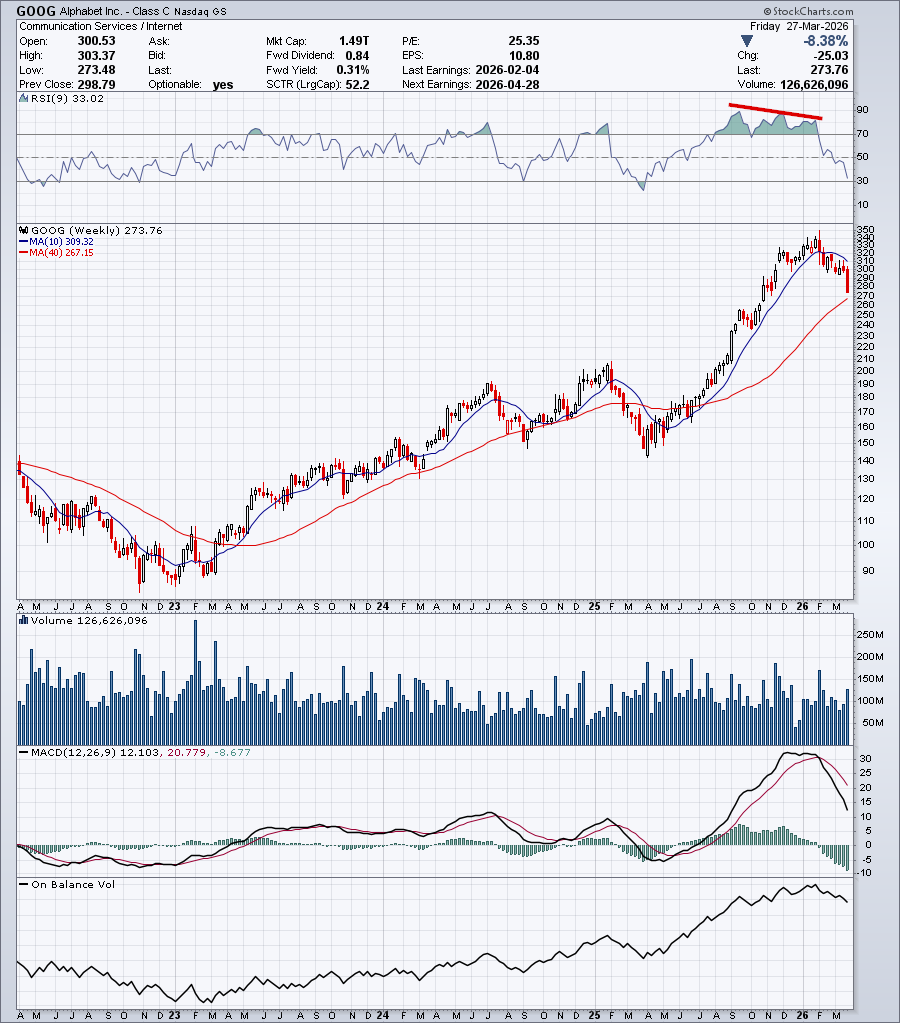
Alphabet (GOOG) will test 200-day simple moving average

Analysis: This is an educational rear-view mirror post. What was an early indicator of the impending short-term downtrend? You can see the negative divergence on the RSI indicator as a early warning of the short-term downtrend. Can Google hold major support around the 200-day moving average? I say yes, but the market will have the finale say. We can easily be trumped.

Google 4-year candlestick chart showing negative divergence on the RSI.

_____________

Technical Analysis is about trading with the trend

Note: This technical analysis is for educational purposes. Please conduct your own analysis or consult a financial advisor before making investment decisions. The author of this article may hold long or short positions in the featured stocks or indexes. The article was written with the help of AI and was reviewed by an editor.

© 2026 TradeOnline.ca InvestOnline.ca ChartAnalysis.ca

Canadian Phoenix pay system boondoggle

Published March 23, 2026

The Phoenix Pay System epitomizes Government incompetency and the hubris of so-called IT experts.

The Minister of Public Services and Procurement who authorized the final rollout and release of the Phoenix pay system was Judy Foote. She knew nothing about IT systems but neither did her advisors. They are all retired now on government pensions.

While the project was initiated under the previous Conservative government, the final decision to “go live” happened in early 2016 under the Liberal government.

Key Timeline of Authorization:

  • Initial Approval (2009–2015): The “Transformation of Pay Administration” initiative began under Prime Minister Stephen Harper. Ministers including Rona Ambrose and Diane Finley oversaw the earlier development and the move of the pay centre to Miramichi, New Brunswick.
  • The “Go-Live” Decision (February 2016): After the 2015 election, Judy Foote was appointed Minister of Public Services and Procurement. Despite warnings from unions and reports of technical “bugs,” the department proceeded with the release.
  • Two-Phase Rollout: * Phase 1: Launched in February 2016 for 120,000 employees.
    • Phase 2: Launched in April 2016 for the remaining 170,000 employees.

The Aftermath

Shortly after the second phase, it became clear that thousands of federal employees were being underpaid, overpaid, or not paid at all. In 2017, Judy Foote resigned from cabinet for personal reasons, and the file was eventually handed to Carla Qualtrough, who began the long process of attempting to stabilize the system and searching for a replacement (the “Dayforce” project).

As of 2026, the government is still in the process of transitioning away from Phoenix to the Dayforce system, a project currently overseen by Minister Joël Lightbound.

What companies were behind the Phoenix boondoggle?

The company primarily behind the Phoenix pay system is IBM Canada.

While IBM built and implemented the system, the project was a massive undertaking involving several different entities and software components. Here is the breakdown of the “who’s who” behind the system:

1. IBM Canada (The Prime Contractor)

IBM was awarded the contract in June 2011 to design, customize, and implement the system.

  • The Contract: What started as a $5.7 million contract famously ballooned. By 2026, the total paid to IBM for Phoenix-related work (including years of “stabilization” efforts) has exceeded $780 million.
  • The Defense: IBM has historically maintained that they were the “builders” following the government’s instructions. They testified in 2018 that they actually recommended the government delay the rollout in 2015 because the system wasn’t ready, but were overruled by government bureaucrats.

2. Oracle / PeopleSoft (The Software)

Phoenix was not built from scratch; it was based on PeopleSoft, a commercial “off-the-shelf” payroll software owned by Oracle Corporation.

  • The disaster wasn’t necessarily the software itself (which is used by many large corporations), but rather the heavy customization required to handle the federal government’s 80,000+ complex pay rules and dozens of different collective agreements.

3. Public Services and Procurement Canada (The Architect)

The government department (PSPC) acted as the project manager.

  • They made the critical decision to eliminate 700 experienced pay advisor jobs before the system was fully functional, moving operations to a centralized hub in Miramichi, New Brunswick. This “points of failure” move left the government without a safety net when the software began to glitch.

4. Other Consultants

Several other high-profile firms were brought in at various stages to audit, advise, or try to fix the mess:

  • PricewaterhouseCoopers (PwC): Conducted early studies that helped build the original business case for the system.
  • Gartner Consulting: Hired to perform a “readiness review” just before the 2016 launch (their warnings were largely downplayed).
  • McKinsey & Company: Later brought in to help with “pay transformation” and stabilization strategies.

The Current Shift: The government is now moving away from IBM’s Phoenix system toward a new provider, Dayforce (formerly Ceridian), as part of the “NextGen” pay initiative.

Read the following story: Replacing Phoenix pay system will cost at least $4.2-billion, Auditor-General report says – The Globe and Mail

What is the average annual return for the S&P 500 Index?

While “10%” is the common shorthand answer, the truth depends entirely on your timeframe and whether you count dividends.

As of February 25, 2026, the S&P 500 has just come off a historic “triple-peat,” finishing 2025 up 17.9%, following gains of 25% in 2024 and 26.3% in 2023.

Historical Average Annual Returns

TimeframeAverage Annual ReturnInflation-Adjusted (Real)
Last 10 Years (2016–2026)~12.2%~8.5%
Last 30 Years (1996–2026)~10.1%~7.2%
Since 1957 Inception~10.2%~6.5%
Since 1926 (Historical Data)~9.8%~6.2%

Three Essential Nuances for Investors

1. The “Dividend Engine”

Price appreciation is only half the story. Dividends have historically accounted for roughly 31% to 34% of the S&P 500’s total return.

  • Without reinvesting dividends, $10,000 invested in 1930 would have grown to roughly $278,000 today.
  • With dividends reinvested, that same $10,000 would be worth over $9.5 Million.

2. The “Average” Year is Rare

The stock market almost never actually returns exactly 10% in a single year. Since 1871, the annual return has landed between 8% and 12% in less than 10% of years. The market usually “overshoots” (up 20%+) or “undershoots” (down 10%+).

3. The 20-Year “Safety Net”

If you have a short-term horizon, your odds of a positive return are basically a coin toss (59% monthly). However, looking at every rolling 20-year period since 1928, the S&P 500 has produced a positive total return 100% of the time.

Current Context (Early 2026)

With the S&P 500 currently trading near record highs (approx. 6,915), many analysts are predicting a “valuation reset.” Goldman Sachs forecasts a 12% total return for the full year of 2026, driven more by earnings growth from AI adoption than by the “multiple expansion” (stocks getting more expensive) we saw in 2024.


Based on a 7% conservative “real” return (which accounts for inflation), here is how a $10,000 investment would grow over the next decade:

The 10-Year Projection

  • Initial Investment: $10,000.00
  • Time Horizon: 10 Years
  • Annual Return: 7%
  • Total Future Value: $19,671.51

Key Takeaways

  1. The “Double” Rule: At a 7% return, your money effectively doubles every 10 years. You will have gained $9,671.51 in pure profit without adding another cent to the account.
  2. The Power of Compounding: Notice that your gain in Year 1 is only $700, but by Year 10, your investment is growing by over $1,280 per year. This “snowball effect” is why time in the market is more important than timing the market.
  3. Real vs. Nominal: Because we used a 7% “real” rate, that $19,671 represents today’s purchasing power. In actual dollars (nominal), the number might look like $26,000 or more, but it would buy the same amount of “stuff” that ~$19.6k buys today.

What if you added a small monthly contribution?

If you invested just $200 a month on top of that initial $10,000, your 10-year total would jump to **$53,308.83**.


Here is a compound interest calculator:

https://www.thecalculatorsite.com/finance/calculators/compoundinterestcalculator.php