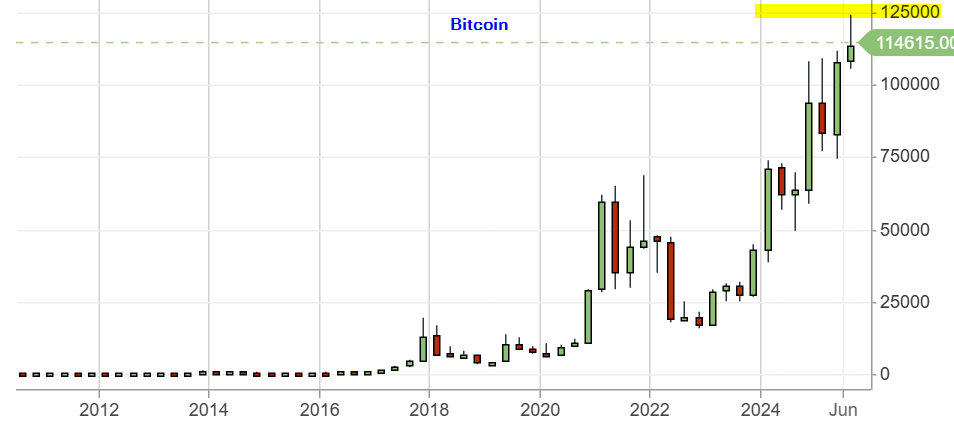
Here is the long-term chart showing the major uptrend
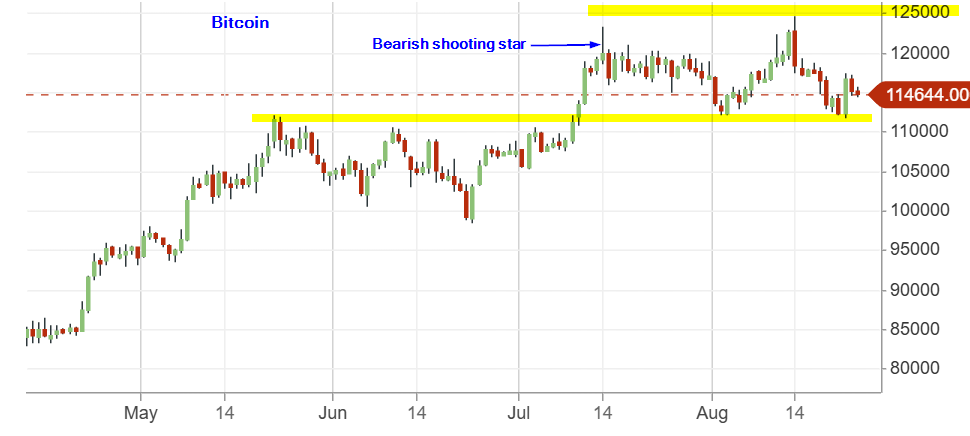
Here is a intermediate daily candlestick chart showing the consolidation zone
What is Bitcoin?
Bitcoin is a fascinating and complex topic that has become a major force in the global financial landscape. Here’s a breakdown of what it is, how it works, and its current state.
Bitcoin (BTC) is a decentralized digital currency, also known as a cryptocurrency. It was created in 2009 by an anonymous person or group of people using the pseudonym Satoshi Nakamoto. Unlike traditional currencies like the U.S. dollar or Canadian dollar, Bitcoin is not controlled by a central authority, such as a government or a bank.
Its core principles are:
Decentralization: The network is run by a global peer-to-peer network of computers, not a single entity.
Blockchain Technology: All transactions are recorded on a public, distributed ledger called the blockchain. This ledger is transparent, permanent, and secured by cryptography, making it nearly impossible to tamper with.
Limited Supply: There will only ever be 21 million Bitcoins created. This scarcity is a key part of its value proposition, making it a “digital gold” or a hedge against inflation.
How Does it Work?
Transactions: When you send Bitcoin to someone, the transaction is broadcast to the network.
Mining: Computers on the network, known as “miners,” compete to verify and add new “blocks” of transactions to the blockchain. This process, called “mining,” involves solving complex mathematical problems.
Security and Trust: Once a block is added, it is permanently linked to the previous blocks. This “chain” of blocks creates a secure and unchangeable record of all transactions.
Wallets: Users access their Bitcoin and interact with the network through a “digital wallet,” which holds the cryptographic “keys” that prove ownership of the Bitcoin.
Current State and Trends
Bitcoin has seen a volatile but generally upward trend in its price since its inception. After years of being a niche asset, it has gained significant mainstream attention, with both retail and institutional investors entering the market.
Key trends include:
Institutional Adoption: Major financial institutions, including investment banks and asset managers, are increasingly exploring Bitcoin. The approval of spot Bitcoin ETFs in various countries has made it easier for traditional investors to gain exposure to Bitcoin without directly holding the cryptocurrency.
Halving Events: The Bitcoin network undergoes a “halving” approximately every four years, which cuts the reward for mining a new block in half. This reduces the rate at which new Bitcoin is created, contributing to its scarcity. Historically, halvings have often been followed by significant price increases. The most recent halving occurred in April 2024.
Market Volatility: Bitcoin remains highly volatile and is subject to significant price swings. Factors such as macroeconomic events, regulatory changes, technological developments, and overall market sentiment can all influence its price.
Debate Over Utility: While some see Bitcoin as a potential alternative to traditional currencies for payments, its slow transaction times and high fees have led many to view it more as a store of value or a speculative asset. Other cryptocurrencies, often referred to as “altcoins,” have emerged to address some of Bitcoin’s scalability challenges.
Risks and Future Outlook
Investing in Bitcoin comes with significant risks:
Price Volatility: Its price can fluctuate dramatically, and there is no guarantee of returns.
Regulatory Uncertainty: Governments and financial regulators around the world are still developing their stances on cryptocurrency, and new regulations could impact its value.
Security: While the blockchain itself is secure, the private keys to a user’s wallet can be vulnerable to loss or theft, and once gone, the Bitcoin is gone forever.
Despite these risks, many analysts and investors remain bullish on Bitcoin’s long-term future. They believe that its limited supply, decentralized nature, and growing acceptance as a legitimate asset class will continue to drive its value. Bitcoin’s journey from a niche technology to a globally recognized asset has been remarkable, and its ongoing evolution will be a major story in the financial world for years to come.
How high can bitcoin go in the long run?
Predicting the future price of Bitcoin is impossible, and any specific figures are purely speculative. The cryptocurrency market is famously volatile and influenced by a wide array of unpredictable factors. However, we can analyze the key drivers that analysts and proponents believe could push Bitcoin’s price significantly higher in the long run.
The bullish arguments for Bitcoin reaching unprecedented highs are generally based on a few core principles:
Fixed and Scarce Supply: This is the most fundamental argument. There will only ever be 21 million Bitcoins created. This hard cap, combined with the “halving” events that reduce the rate of new Bitcoin creation every four years, creates a supply shock that could lead to significant price appreciation if demand continues to grow.
Growing Institutional Adoption: This is a major factor. The approval of spot Bitcoin ETFs in the U.S. and other countries has opened the floodgates for large-scale institutional investment. As pension funds, hedge funds, and other institutional players allocate a small percentage of their portfolios to Bitcoin, the sheer volume of capital could drive the price up dramatically.
Global Macroeconomic Trends: Proponents view Bitcoin as a hedge against inflation and a safe-haven asset in a world of geopolitical instability and currency debasement. As central banks continue to print money and national debts rise, some investors may look to a decentralized, non-sovereign asset like Bitcoin as a store of value.
Network Effects and Mainstream Acceptance: As more people and businesses adopt Bitcoin for transactions, holding, and investment, its value could increase exponentially. This “network effect” is a powerful driver of technology adoption and could lead to Bitcoin becoming a widely accepted global reserve asset.
Technological Development: While Bitcoin’s core blockchain is known for its stability, layers built on top of it, such as the Lightning Network, are designed to improve transaction speed and lower fees. These developments could increase Bitcoin’s utility as a medium of exchange, further boosting its value.
Potential Long-Term Price Targets
Due to the factors above, some analysts have put forward very ambitious long-term price targets, often looking to the next decade and beyond. These predictions are based on various models, including:
Stock-to-Flow Model: This model, though controversial, attempts to predict the price based on the scarcity of Bitcoin (its existing stock) relative to the rate at which new Bitcoin is produced (its flow).
Market Cap Comparison: Some models compare Bitcoin’s potential market capitalization to that of gold, major currencies, or other global asset classes. If Bitcoin were to capture even a fraction of the value of the global gold market, its price per coin would be in the hundreds of thousands of dollars.
For example, some analysts have publicly discussed targets in the range of $250,000 to over $1 million per Bitcoin in the coming years.
Important Caveats
It is crucial to understand that these are not guarantees. The future price of Bitcoin is subject to many risks, including:
Regulatory Crackdowns: Governments could impose strict regulations that hinder its adoption.
Competition from Other Cryptocurrencies: Other digital assets could emerge and compete for market share.
Technological Failures: A major security breach or vulnerability could undermine trust in the network.
Market Sentiment: Extreme volatility and sharp downturns remain a constant risk.
In conclusion, while no one can say for certain how high Bitcoin can go, the long-term bullish case rests on its unique combination of digital scarcity, growing institutional acceptance, and its potential role as a hedge against global financial instability. The price trajectory is likely to be a volatile ride, but proponents believe the foundational principles of the asset point to a potential for substantial long-term growth.
This article was generated with the help of AI and was reviewed by an editor
_____________
Technical Analysis is about trading with the trend
Note: This technical analysis is for educational purposes. Please conduct your own analysis or consult a financial advisor before making investment decisions. The author of this article may hold long or short positions in the featured stocks or indexes.
Technical Analysis is about trading with the trend
Note: This technical analysis is for educational purposes. Please conduct your own analysis or consult a financial advisor before making investment decisions. The author of this article may hold long or short positions in the featured stocks or indexes.
We use cookies to ensure that we give you the best experience on our website. If you continue to use this site we will assume that you are happy with it.