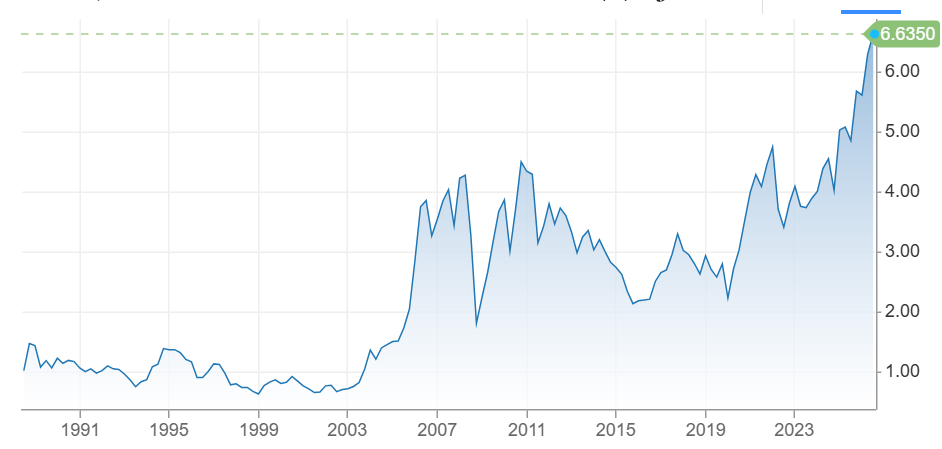
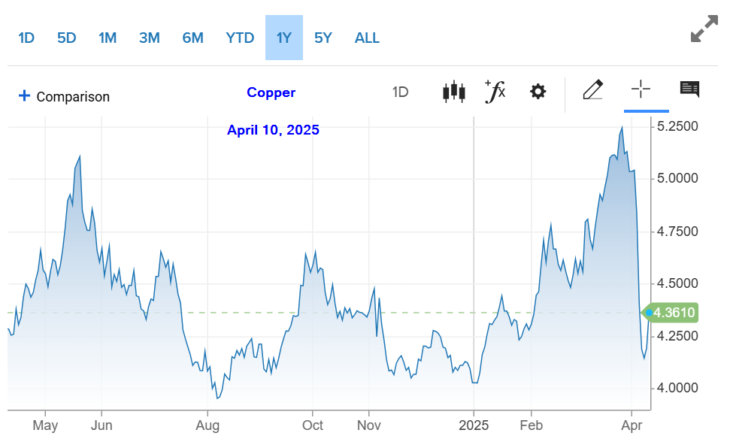
The rally is accelerating as speculative buyers and industrial hedgers scramble to secure physical supply.
COMEX Copper: Hit a new intraday all-time high of $6.58 per pound this morning, currently settling around $6.53/lb (+1.8%).
LME Copper: Trading near $13,950 per metric ton, holding the gains from yesterday’s record settlement of $13,943.
Performance: The metal is now up approximately 15% year-to-date, with nearly 8% of those gains occurring since the intensification of the conflict in the Middle East.
Why the Rally Won’t Quit
Beyond the “Grasberg” supply shock from Freeport Indonesia, two new catalysts are dominating the tape today:
The “Strait of Hormuz” Premium: Analysts are now labeling copper a “geopolitical defensive asset.” With shipping routes through the Strait of Hormuz effectively suspended, the global refining market is facing a massive “sulphuric acid” shortage. Since sulphuric acid is critical for copper leaching, this is creating a secondary supply squeeze on top of the mining delays.
Tariff Front-Running: There is growing evidence that U.S. buyers are “front-running” anticipated 25% refined copper tariffs expected to be announced by the White House before June. This is causing a massive dislocation between US and London prices as stocks are hoarded on North American soil.
AI Data Center Demand: New reports suggest that global AI power infrastructure requirements for 2026 are 20% higher than initial projections, further tightening the structural deficit.
Just hours ago, news broke that Glencore and Rio Tinto are in preliminary merger talks. If this deal happens, it would create the largest mining company in history, valued at over $200 billion.
Here is the breakdown of Glencore’s situation and its massive footprint in Canada.
1. The Headline: The “Mega-Merger” Talks
The News (Jan 9, 2026): Glencore shares jumped roughly 10% today following reports that rival Rio Tinto is considering a bid to acquire the company.
The Logic:
Rio Tinto wants copper for the energy transition (EVs, Data Centers), and Glencore is one of the world’s largest copper producers.
The Problem: Rio Tinto exited the coal business years ago to be “green.” Glencore is the world’s biggest thermal coal shipper.
The Timeline: Under UK takeover rules, Rio Tinto has until February 5, 2026, to make a formal offer or walk away.
2. The Canadian “Coal Giant” (Elk Valley)
For your Canadian context, Glencore is now a dominant player in British Columbia.
The Acquisition: In mid-2024, Glencore completed the purchase of Teck Resources’ steelmaking coal business (Elk Valley Resources) for roughly $9 billion USD.
Current Status: Glencore now owns the massive Fording River, Elkview, and Greenhills mines in BC.
Why it matters: This is “Metallurgical Coal” (used to make steel), not “Thermal Coal” (burned for power). It is highly profitable and was a key reason Glencore wanted the assets.
The Spin-Off Question: Originally, Glencore planned to spin this coal business off into a separate company on the NYSE. That plan is currently in limbo. With the Rio Tinto talks happening, they may keep it or sell it to satisfy Rio’s ESG concerns.
3. Commodity Mix & Production
Copper (The Crown Jewel): This is the main attraction for investors. Glencore aims to produce 1.6 million tonnes of copper annually by 2035. However, production in late 2025 was softer than expected due to mine sequencing issues.
Cobalt: They remain the world’s largest producer of cobalt (essential for EV batteries), primarily from the Democratic Republic of Congo (DRC).
Zinc & Nickel: They are a top-tier global supplier, giving them immense leverage in the “Battery Metals” supply chain.
4. The “Old” Glencore Baggage
Legal/ESG: While the company settled its massive bribery investigations in 2022 (paying ~$1.5B in fines), individual accountability is still ongoing. In November 2025, several former executives entered “Not Guilty” pleas in a UK court regarding corruption charges. A trial is set for late 2027.
Reputation: This “legacy” issue is one of the reasons Glencore trades at a discount compared to BHP or Rio Tinto, making it an attractive takeover target.
Summary for Your Business
If the Merger Happens: Expect massive rebranding and contract reviews. Rio Tinto has stricter supplier standards than Glencore. If you service the old Teck mines in BC, a Rio takeover could change your procurement contacts.
If it Doesn’t: Glencore remains a cash-rich giant that is aggressively paying down debt and generating huge cash flow from its new Canadian coal mines.
Based on the most recent financial data available for the 2024–2025 fiscal year, here is the summary of the world’s largest metal producers by revenue.
The rankings are heavily skewed by business model. You have to separate the “Traders” (who sell other people’s metal) from the “Miners” (who dig it out of the ground) and the “Steelmakers” (who refine it).
1. The “Hybrid” Giant (Trading + Mining)
Glencore sits in a category of its own because its revenue includes its massive “Marketing” division (buying and selling commodities produced by third parties).
Rank
Company
Country
Revenue (USD)
Primary Metals
#1
Glencore
🇨🇭 Swiss / 🇬🇧 UK
~$231 Billion
Copper, Coal, Zinc, Cobalt
Context: While Glencore has huge revenue, its profit margins are much thinner than the pure miners because trading is a high-volume, low-margin game.
2. The “Pure” Mining Giants
These companies have lower revenue than Glencore but often higher profits because they own the assets (mines) and sell what they dig.
Rank
Company
Country
Revenue (USD)
Primary Metals
#1
BHP Group
🇦🇺 Australia
~$55.7 Billion
Iron Ore, Copper, Coal
#2
Rio Tinto
🇬🇧 UK / 🇦🇺 Australia
~$53.7 Billion
Iron Ore, Aluminum, Copper
#3
Vale S.A.
🇧🇷 Brazil
~$38.1 Billion
Iron Ore, Nickel
#4
Freeport-McMoRan
🇺🇸 USA
~$26.0 Billion
Copper, Gold
Merger Impact: If Rio Tinto ($53.7B) buys Glencore ($231B), the combined entity would have revenues exceeding $280 Billion, dwarfing every other competitor in the sector.
3. The State-Owned Powerhouses (China)
Western lists often ignore these, but they are technically the largest metal producers by volume and revenue.
Rank
Company
Country
Revenue (USD)
Primary Metals
#1
China Minmetals
🇨🇳 China
~$115 Billion
Diversified (Copper, Zinc, Lead)
#2
Jiangxi Copper
🇨🇳 China
~$72 Billion
Copper
#3
Zijin Mining
🇨🇳 China
~$41 Billion
Copper, Gold, Lithium
4. The Steel Giants
Steelmakers generate massive revenue due to the high value of the finished product, even if their margins are tight.
Rank
Company
Country
Revenue (USD)
Primary Metals
#1
China Baowu Group
🇨🇳 China
~$160 Billion
Steel
#2
ArcelorMittal
🇱🇺 Luxembourg
~$62.4 Billion
Steel
#3
Nippon Steel
🇯🇵 Japan
~$61.2 Billion
Steel
#4
POSCO Holdings
🇰🇷 South Korea
~$51.4 Billion
Steel, Battery Materials
Summary Trend for Your Business
The “Big Three” Iron Ore Players (BHP, Rio, Vale): They are cash cows, but their revenues are essentially flat or slightly down due to weaker Chinese construction demand.
The “Green Metal” Players (Glencore, Jiangxi, Freeport): These are the ones seeing revenue volatility (and growth potential) tied to the Copper boom for data centers and EVs.
If the Glencore-Rio Tinto merger proceeds, the combined entity would be a behemoth in the Canadian resource sector, but surprisingly, their assets do not overlap much. Instead, they fit together like puzzle pieces, creating massive regional dominance.
Here is the breakdown of what a “Rio-Glencore” map of Canada would look like, by province.
1. Quebec: The Industrial Fortress
This is where the merger would be most powerful. A combined company would effectively control the entire base metal processing capacity of the province.
Rio Tinto’s Assets (Aluminum & Titanium):
Alcan Operations: Owns the massive aluminum smelters in the Saguenay–Lac-Saint-Jean region (Alma, Arvida, Grande-Baie, Laterrière).
Sorel-Tracy: Owns Rio Tinto Fer et Titane, which mines titanium and iron ore at Havre-Saint-Pierre and processes it in Sorel-Tracy.
Glencore’s Assets (Copper & Zinc):
Rouyn-Noranda: Owns the Horne Smelter, the only copper smelter in Canada (critical for recycling electronics).
Montreal (East): Owns the CCR Refinery, which processes the copper from the Horne Smelter.
Valleyfield: Owns CEZinc, the second-largest zinc refinery in North America.
Raglan Mine: Massive nickel mine in Nunavik (far north Quebec).
The Impact: If you print for industrial safety, training, or logistics in Quebec, this single company would control the Aluminum, Copper, Zinc, Titanium, and Nickel supply chains. They would be the province’s largest industrial employer by far.
2. British Columbia: The “Green vs. Black” Conflict
This is where the merger gets messy politically.
Rio Tinto (The “Green” Giant):
Kitimat: Owns the massive “BC Works” aluminum smelter, powered by its own hydroelectric dam (Kemano). It markets this as “low carbon aluminum.”
Glencore (The “Black” Giant):
Elk Valley: As of 2024, owns the massive steelmaking coal mines (formerly Teck Resources) in the southeast Rockies (Fording River, Elkview, Greenhills).
The Conflict: Rio Tinto spent years exiting coal to polish its ESG image. Buying Glencore brings them right back into the coal business in BC. Analysts speculate Rio might spin these coal mines off again to keep their “green” investors happy.
3. Ontario: The Sudbury/Timmins Split
Glencore’s Turf:
Sudbury: Owns “Sudbury INO” (Integrated Nickel Operations) – a major nickel/copper miner and smelter.
Timmins: Owns the Kidd Creek mine (Copper/Zinc). Note: This mine is nearing the end of its life (scheduled closure ~2026/2027), so it’s less of a long-term factor.
Rio Tinto’s Turf:
Rio has effectively no presence in Ontario mining. That is Vale (Brazilian) territory.
The Impact: This is good for regulators. Since there is no overlap in Sudbury, the Competition Bureau likely won’t block the deal on Ontario grounds.
4. Newfoundland & Labrador: The Iron King
Rio Tinto:
Owns the majority stake (~59%) in the Iron Ore Company of Canada (IOC).
Assets: Massive mines in Labrador City and the railway/port in Sept-Îles, Quebec.
Glencore:
Has no major operational footprint here, though they trade iron ore globally.
Summary for Your Business (The “Client List” Shift)
If this merger happens, the “Procurement Department” for half of Canada’s mining industry consolidates.
The Opportunity: If you are already a vendor for Rio Tinto, you essentially get a “hunting license” to pitch your services to the Glencore sites (Sudbury Nickel, Quebec Copper) that might adopt Rio’s standards.
The Risk: If you are a vendor for Glencore, get ready for a paperwork headache. Rio Tinto is known for having more rigid, bureaucratic supplier compliance standards than Glencore.
We use cookies to ensure that we give you the best experience on our website. If you continue to use this site we will assume that you are happy with it.