Category Archives: Economy

Deficit and total debt as a percent of GDP for major world economies

Posted April 20, 2026

As of April 2026, the global fiscal landscape is defined by a push-and-pull between high defense spending, massive AI infrastructure investment, and impact of elevated energy prices.

The following table ranks the G20 major economies by their projected general government budget balance (net lending/borrowing) as a percentage of GDP for the 2026 fiscal year. Countries with the highest negative percentages represent the largest deficits.

Fiscal Deficit Ranking: Major World Economies (2026 Projection)

RankEconomyDeficit/Surplus (% of GDP)Primary Fiscal Drivers
1China-8.2%Infrastructure stimulus and property sector support.
2Brazil-7.7%Social spending and high debt-servicing costs.
3India-7.4%Continued heavy capital expenditure on infrastructure.
4United States-5.8%Rising mandatory spending and net interest outlays.
5France-4.9%Energy transition subsidies and defense modernization.
6South Africa-4.9%Support for state-owned enterprises and power grid.
7United Kingdom-3.9%Public service funding and debt interest volatility.
8Germany-3.8%Defense “Zeitenwende” and industrial energy support.
9Saudi Arabia-3.5%Vision 2030 mega-projects and oil price volatility.
10Mexico-3.5%Social programs and Pemex financial support.
11Turkey-3.4%Earthquake reconstruction and inflation mitigation.
12Indonesia-2.9%New capital city (Nusantara) development.
13Italy-2.8%Phasing out of “Superbonus” construction incentives.
14Canada-2.7%Provincial healthcare transfers and housing initiatives.
15Australia-2.4%Transitioning back to deficit as commodity prices ease.
16Japan-2.0%Demographic-driven social costs vs. tax revenue growth.
17Russia-2.0%Sustained military expenditures.
18South Korea-1.5%Semiconductor subsidies and aging population costs.
19Argentina+0.5% (Surplus)Strict fiscal austerity and subsidy removals.
20Singapore+3.3% (Surplus)High corporate tax revenue and prudent reserve policy.

Key Macro Trends for 2026

  • The Interest Burden: For advanced economies like the United States and France, net interest payments are consuming an increasing share of GDP. Projections show US interest costs reaching 3.5% of GDP this year, nearly equal to its defense budget.
  • Defense & Technology: In Europe, the -3.8% to -4.9% deficits are increasingly driven by a permanent shift in defense spending targets (approaching 2.5% to 3.0% of GDP). Globally, fiscal incentives for AI and semi-conductors have become a “baseline” expenditure for major economies.
  • The Austerity Exception: Argentina remains a notable outlier, shifting from a deep deficit to a marginal surplus following radical fiscal restructuring, though this has come at the cost of significantly suppressed domestic consumption.

Following the fiscal deficit projections, the general government gross debt-to-GDP ratio provides a clearer picture of the total accumulated debt relative to each country’s economic output.

As of April 2026, debt levels remain elevated across advanced economies due to high interest rates and the expansion of industrial and defense subsidies. The following table ranks the G20 major economies by their projected debt-to-GDP ratios for the 2026 fiscal year, based on the latest IMF World Economic Outlook data.

Public Debt-to-GDP Ranking: Major World Economies (2026)

RankEconomyDebt-to-GDP (%)Context & Fiscal Drivers
1Japan230.1%Decades of stimulus and an aging population.
2Singapore172.5%High, but primarily used for sovereign investment.
3Italy137.4%Persistent structural debt and high servicing costs.
4United States125.8%Rising interest outlays and mandatory spending.
5France118.4%Post-pandemic recovery spending and defense.
6Canada114.2%High household and provincial-level debt.
7United Kingdom103.6%Elevated public service spending vs. slow growth.
8Spain98.2%Gradual deleveraging from pandemic-era peaks.
9China96.3%Rapid rise due to local government and property support.
10Euro Area (Avg)87.8%Broad regional average across EU member states.
11Brazil84.5%High social expenditure and borrowing costs.
12India81.9%Heavy infrastructure spending to fuel 6.5% growth.
13Argentina78.4%Down from previous highs due to strict austerity.
14South Africa77.1%State-owned enterprise support (Energy/Transport).
15Germany64.0%Constrained by the constitutional “debt brake.”
16South Korea54.4%Increasing support for semiconductor and tech R&D.
17Australia51.3%Strong commodity exports helping offset debt.
18Mexico45.4%Disciplined fiscal policy relative to regional peers.
19Saudi Arabia32.1%Low debt, but rising due to “Vision 2030” projects.
20Russia19.1%Heavily sanctioned and isolated from global markets.

Critical Observations

  • The $100% Threshold: A majority of the G7 nations (Japan, Italy, US, France, Canada, UK) are now operating with debt levels exceeding 100% of their GDP. This creates a “fiscal squeeze” where a growing portion of tax revenue must be diverted to pay interest rather than funding infrastructure or services.
  • The “Investment” Outlier: Singapore remains the exception to the rule. Unlike other nations, its debt is not used to fund budget deficits but is instead issued to provide a pool of assets for the Central Provident Fund and for reinvestment by its sovereign wealth funds (GIC/Temasek).
  • China’s Trajectory: China has seen one of the fastest debt increases in the G20, rising from roughly 60% in 2019 to over 96% today, as the central government absorbs the liabilities of local governments and the struggling property sector.

Note: Published with the assistance of AI and reviewed by an editor.
What is inflation psychology?

Published April 11, 2026

Inflation psychology is the collective belief among consumers and businesses that prices will continue to rise indefinitely. It is often described as a “self-fulfilling prophecy” because when people expect inflation, they change their behavior in ways that actually cause it.

As of April 2026, this concept has returned to the forefront of economic discussion due to a sharp divergence in global markets and renewed geopolitical shocks.


1. How the “Vicious Cycle” Works

Inflation psychology turns a temporary price spike into a permanent trend through three primary behaviors:

  • Forward-Buying: Consumers rush to buy goods now (like cars, appliances, or even non-perishable groceries) to “beat” the price increases they expect next month. This surge in demand pushes prices even higher.
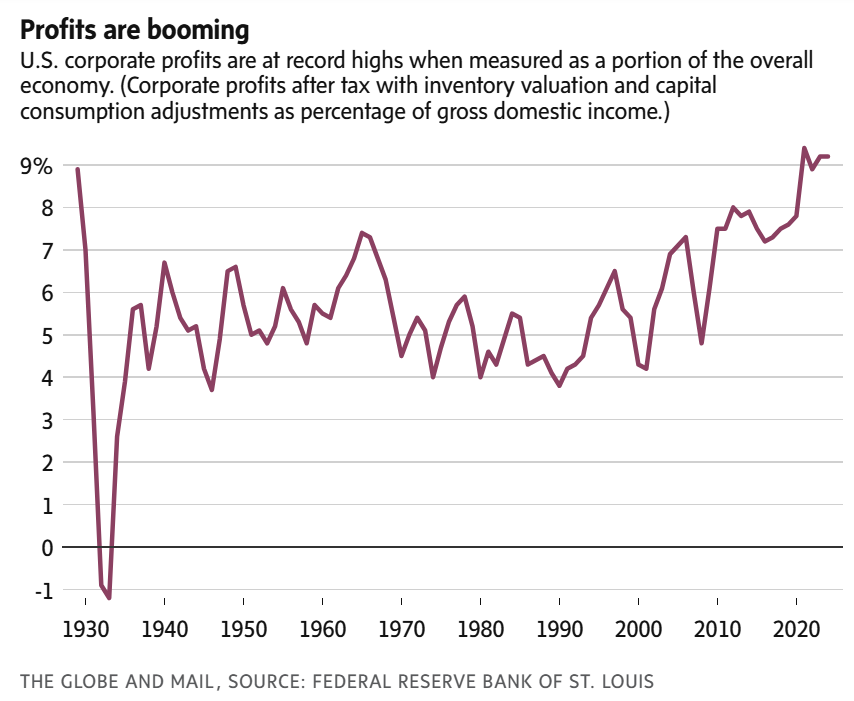
  • The Wage-Price-Profit Spiral: Workers demand higher wages to maintain their purchasing power. To cover these labor costs, businesses raise their prices. If businesses also raise prices to protect profit margins (a “profit spiral”), inflation becomes “sticky.”
  • Reduced Price Sensitivity: When prices for everything are rising, consumers stop “shopping around” or resisting higher costs because they assume every retailer is equally expensive. This gives businesses more “pricing power” to pass on costs.

2. The Current “Sentiment Plunge” (April 2026)

The psychological landscape shifted dramatically this month. On April 10, 2026, the U.S. Consumer Sentiment Index plunged to a record low of 47.6, down from 53.3 in March.

DriverPsychological Impact in 2026
Geopolitical TensionConcerns over the Iran conflict have spiked energy expectations, making consumers feel that “the worst is yet to come.”
Tariff LagMany businesses are only now passing on the costs of 2025 tariffs as their old inventories run out, creating a “second wave” of price shocks.
“Salient” PricesHouseholds are ignoring aggregate stats (CPI) and focusing on “salient” items—eggs, gas, and home repairs—which remain highly volatile.

3. The Cognitive Biases Involved

Economics isn’t just math; it’s brain chemistry. Two main biases are driving the 2026 outlook:

  • Anchoring: Consumers are still “anchored” to the lower prices of the early 2020s. Every trip to the grocery store feels like a “loss” compared to that mental anchor, leading to Uncertainty Fatigue.
  • Loss Aversion: Research from early 2026 shows that the “pain” of a price increase is felt twice as intensely as the “joy” of a price drop. This makes consumers more likely to hoard goods or demand aggressive raises to avoid the feeling of falling behind.

4. Regional Cross-Currents

Inflation psychology is currently diverging by region:

  • The U.S.: Expectations are becoming “unanchored.” Core inflation is projected to accelerate toward 4% as the “buy now” mentality takes hold again.
  • Canada & Europe: Sentiment is more “cautious” than “panicked.” In Canada, consumers have shifted to Intentional Spending—prioritizing value and loyalty programs rather than mass forward-buying.

The Central Bank Dilemma

Central banks, like the Bank of Canada and the Fed, are terrified of “unanchoring.” Once people believe 4% inflation is the new normal, it is incredibly difficult to bring it back to the 2% target without causing a severe recession. Their main tool right now isn’t just interest rates—it’s communication, trying to convince the public that these shocks are temporary to break the psychological loop.

For the 2025–26 fiscal year, the Canadian federal budget projects total spending of $585.9 billion

Published April 2, 2026

This represents a significant increase from previous years, driven largely by new military outlays, housing initiatives, and rising debt-servicing costs.

The following table breaks down the major spending categories by dollar amount and their approximate percentage of the total budget.

Federal Spending Breakdown (FY 2025–26)

CategoryAmount ($ Billions)% of Total Budget
Direct Program Expenses$257.043.9%
Major Transfers to Persons$158.027.0%
Major Transfers to Provinces & Territories$110.318.8%
Public Debt Charges (Interest)$55.69.5%
Net Actuarial Losses$5.00.8%
Total Federal Spending$585.9100%

Key Line Items and Sub-Categories

To provide a more granular view, here are the specific costs for the most significant programs within those major categories:

1. Major Transfers to Persons ($158.0B)

  • Elderly Benefits (OAS/GIS): $85.5 billion (14.6%). This remains the largest single program expense due to Canada’s aging demographic.
  • Canada Child Benefit (CCB): $31.2 billion (5.3%).
  • Employment Insurance (EI): $27.8 billion (4.7%).
  • Canada Disability Benefit: $13.5 billion (2.3%).

2. Major Transfers to Other Levels of Government ($110.3B)

  • Canada Health Transfer (CHT): $54.7 billion (9.3%).
  • Fiscal Equalization: $27.3 billion (4.7%).
  • Canada Social Transfer (CST): $17.1 billion (2.9%).

3. Direct Program Expenses ($257.0B)

This category covers the operations of all federal departments and new strategic investments.

  • National Defence: $35.2 billion (6.0%). Spending has ramped up following the 2025 Arctic Sovereignty mandate.
  • Indigenous Services: $25.2 billion (4.3%).
  • Build Canada Homes Initiative: $13.0 billion (2.2%). A key pillar of the 2025-26 fiscal strategy to address housing supply.

Fiscal Health Indicators (2026 Context)

As an active participant in the Canadian markets, you may find the following “bottom-line” figures relevant to the current trading environment:

  • Budgetary Revenues: $507.5 billion.
  • Annual Deficit: $78.3 billion (restated at 2.5% of GDP).
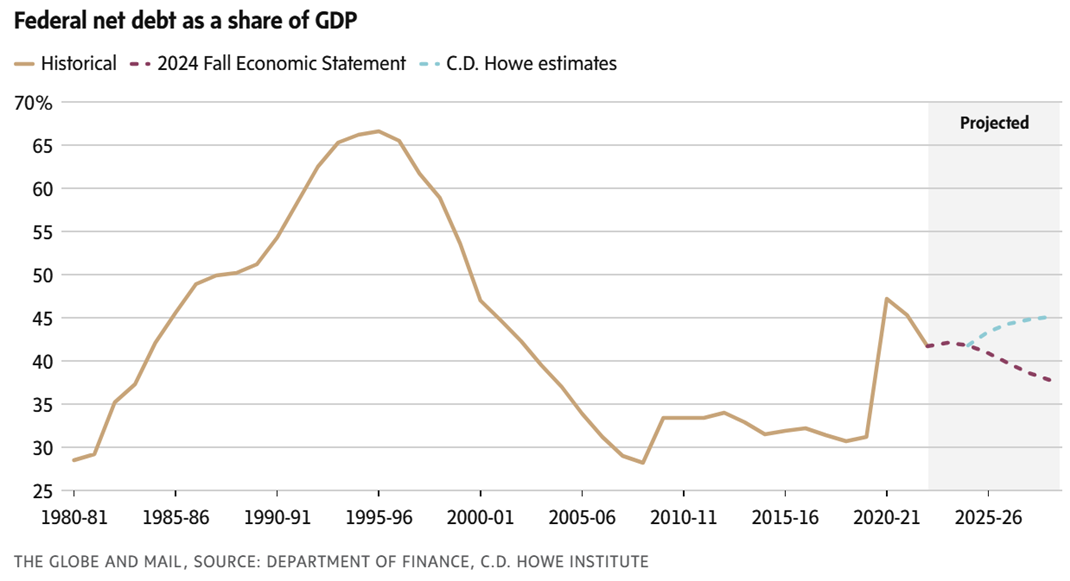
  • Federal Debt-to-GDP: 42.4%.
  • Interest Outlook: Public debt charges are now consuming nearly 10 cents of every dollar the government collects, which is a major factor in the current “hard-nosed” approach to departmental budget cuts (targeting a 10% reduction in the federal workforce by 2028).

Canadian GDP update by sector

Published March 30, 2026

As of early 2026, Canada’s economy is navigating a period of modest growth, with real GDP expanding by 1.6% in 2025 and projected to grow by approximately 0.7% to 1.1% in 2026.

The economy is currently characterized by a “two-speed” performance: strong growth in energy and commodities-producing provinces, contrasted by significant headwinds in manufacturing-heavy regions like Ontario and Quebec due to trade friction and tariffs.

Canadian GDP Breakdown by Sector (2025–2026)

The following table outlines the approximate contribution of major industrial sectors to the Canadian economy and their recent performance trends.

SectorApprox. % of GDP2025–2026 Performance Trend
Real Estate, Rental & Leasing~13.5%Stable at record highs; residential cooling in ON/BC.
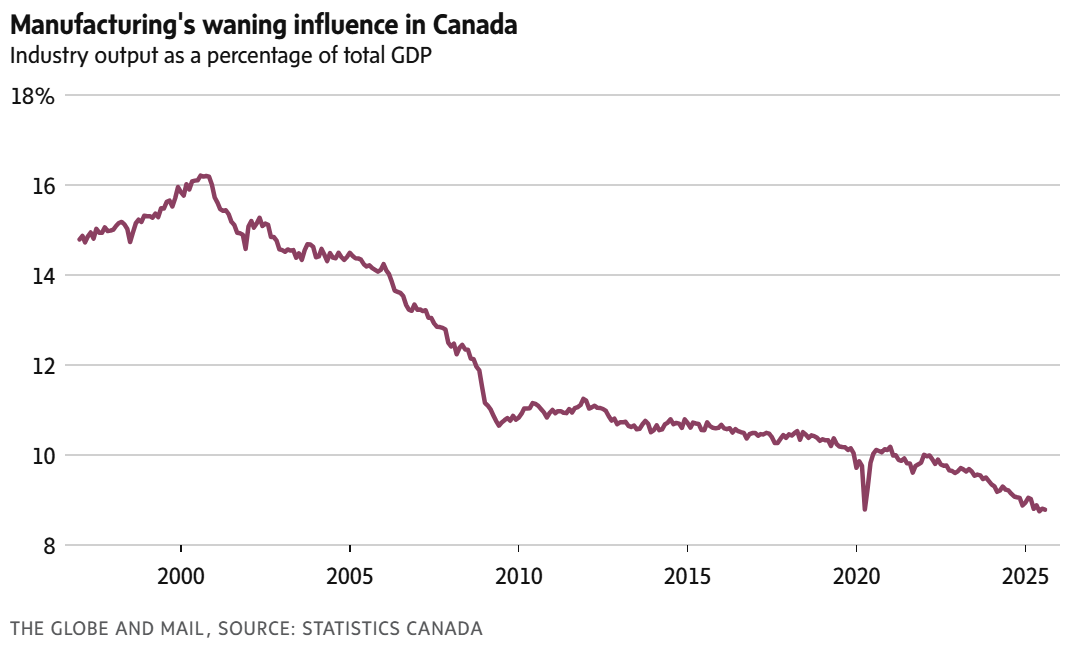
Manufacturing~10.0%Contracting (-2.6% in 2025); facing U.S. trade tariffs.
Mining, Oil & Gas Extraction~9.0%Strong Growth (+4.0% in 2025); upside from oil price shocks.
Finance & Insurance~7.5%Growing (+4.0% in 2025); supported by interest margins.
Healthcare & Social Assistance~7.5%Consistent growth (+2.6% in 2025); driven by demographics.
Construction~7.0%Rebounding in engineering/infra; weak residential starts.
Public Administration~6.5%Modest growth (+1.1%); strong federal spending.
Professional & Tech Services~6.0%Resilient; tech remains a significant $120B+ industry.
Wholesale & Retail Trade~10.5%Volatile; impacted by shifting consumer confidence.

Key Economic Drivers in 2026

1. The Energy Surge

Energy-producing provinces—Alberta, Saskatchewan, and Newfoundland and Labrador—are outperforming the national average. Recent supply disruptions in the Middle East have pushed oil price forecasts up significantly. Combined with the expanded capacity of the Trans Mountain and Enbridge systems, the sector is seeing material upside in production and revenue.+1

2. Manufacturing and Trade Headwinds

The manufacturing sector remains the largest detractor from national growth. Trade uncertainty and tariffs (particularly on steel, aluminum, and lumber) have led to a third consecutive year of contraction in some sub-sectors. While a U.S. Supreme Court ruling recently struck down some broad 2025 tariffs, specialized duties on automotive and metal products continue to weigh on Central Canada.

3. Housing and Construction Bifurcation

The construction sector is seeing a split in performance:

  • Engineering & Infrastructure: GDP reached roughly $170 billion in late 2025, driven by massive government projects in clean energy and transit.
  • Residential Construction: High borrowing costs and inventory backlogs have slowed new housing starts to near two-decade lows in markets like Toronto and Vancouver.

4. Services-Producing Industries

The services sector (accounting for roughly 70% of total GDP) remains the economy’s anchor. Finance, healthcare, and education have provided steady gains that helped Canada avoid a technical recession in 2025, even as the goods-producing side of the economy struggled.

The service sector, also known as the tertiary sector, includes all economic activities that produce “intangible” value rather than physical goods. Instead of extracting raw materials (primary sector) or manufacturing products (secondary sector), the service sector focuses on providing specialized skills, experiences, and logistical support to consumers and businesses.

In modern developed economies, the service sector typically accounts for 70% to 80% of total GDP.

Major Categories of the Service Sector

The sector is incredibly broad, ranging from a neighborhood coffee shop to a global data analytics firm. It is generally divided into several key categories:

CategoryDescriptionIndustry Examples
Trade & DistributionThe movement and sale of physical goods.Retail, Wholesale, Warehousing, e-commerce.
Consumer ServicesServices provided directly to individuals.Restaurants, Hotels, Tourism, Hair salons, Gyms.
Financial ActivitiesManaging, investing, and protecting money.Banking, Insurance, Real Estate, FinTech.
Professional ServicesSpecialized expertise for businesses.Legal, Accounting, Management consulting, Marketing.
Information & TechManaging data and digital communication.Software (SaaS), Telecommunications, AI services.
Public & SocialServices essential for society’s functioning.Healthcare, Education, Public safety, Government.

The Evolution: Quaternary and Quinary Sectors

As economies become more advanced, the service sector is often subdivided into two “knowledge-based” extensions:

1. The Quaternary Sector (The Knowledge Economy)

This involves the gathering, processing, and distribution of information. It is the “brain” of the economy.

  • Examples: Research and Development (R&D), Data Analytics, Scientific Research, and Advanced IT.
  • 2026 Trend: A major driver here is Agentic AI—autonomous systems that perform complex business processes without constant human oversight.

2. The Quinary Sector (High-Level Decision Making)

This represents the highest levels of organization and decision-making in society.

  • Examples: Government leaders, CEOs of multinational corporations, and top-tier scientific innovators.
  • Non-Profit: This also includes non-profit organizations and unpaid domestic labor (caregiving) which provide immense social value but are often excluded from traditional GDP calculations.

Key Characteristics of Services

To distinguish a service from a good, economists look for four specific traits:

  • Intangibility: You cannot touch or store a service. You are buying the result (e.g., a clean house or a legal defense).
  • Perishability: Services cannot be saved for later. An empty seat on a flight or an unbooked hotel room is “lost” revenue that can never be recovered.
  • Inseparability: The service is often produced and consumed at the same time (e.g., a haircut or a live concert).
  • Inconsistency: Unlike a factory-made phone, the quality of a service can vary based on who provides it and when.

Update for March 31, 2025: The Canadian gross domestic product expanded by 0.2% from the previous month in February of 2026, according to a flash estimate. This was supported by higher output in manufacturing, mining, and quarrying, and financial services, which offset contractions for agriculture and forestry. The expansion is set to extend the 0.1% growth rate from January, which was upwardly revised from the initial estimate of a stall. Growth was carried by goods producing industries (0.2%) as higher construction (2.2%) and mining and quarrying (1.2%) offset the drop for manufacturing (-1.4%). In turn, services producing industries stalled. Output increased in finance and insurance (0.5%), and retail trade (0.8%), offsetting the contraction for wholesale trade (-1.2%) and transportation and warehousing (-0.7%), which was pressured by extreme weather conditions that prevented logistics. source: Statistics Canada

As of early 2026, the U.S. Dollar remains the overwhelming “King” of global trade, despite high-profile efforts by nations like China and Russia to use their own currencies.

Published January 15, 2026

Here is the breakdown of exactly how much of the world’s business is conducted in Dollars versus other currencies.

1. The “Invoicing” Number: ~50%

Approximately 50% of all global trade invoices are written in US Dollars.

  • The Disconnect: This is staggering because the United States itself only accounts for about 10–11% of global trade volumes.
  • The Reality: If Brazil sells coffee to Vietnam, or if Saudi Arabia sells oil to India, they almost always write the contract in US Dollars, not Reals, Dongs, or Rupees. This is known as “Vehicle Currency” status.
  • Total Value: With global trade estimated at roughly $35 Trillion in 2025, this means roughly $17.5 Trillion worth of goods annually are priced and sold in USD.

2. The “Payments” Number (SWIFT): ~59%

When it comes to actually transferring the money between banks (via the SWIFT messaging system), the Dollar’s dominance is even higher because it is the “middleman” currency for smaller nations.

  • USD Share: ~59% (Recent data shows it widening its lead).
  • Euro Share: ~13% (Has declined significantly; historically it was often >30%).
  • Chinese Yuan (RMB): ~5–6% (This has doubled in recent years but remains a distant third).

3. The “Reserves” Number: ~58%

This represents the “savings accounts” of Central Banks (like the Bank of Canada or People’s Bank of China).

  • USD: ~58% of all global official reserves.5
  • Euro: ~20%.6
  • The Shift: While the percentage of USD has slowly drifted down from ~70% (20 years ago) to ~58% today, the money hasn’t gone to other currencies—it has mostly gone into Gold.

Summary Table: The Dollar vs. The World

MetricUS Dollar ShareNext Competitor
Trade Invoicing~50%Euro (~20%)
Global Payments (SWIFT)~59%Euro (~13%)
Central Bank Reserves~58%Euro (~20%)
Oil Markets~90%+Yuan (growing in Russian/Iranian trade)

Why this matters for your Canadian business

Because 50% of trade is invoiced in USD, the CAD/USD exchange rate (currently ~$1.38) impacts your input costs even if you aren’t buying from America.

  • If you buy paper from a mill in Brazil or Indonesia, they likely set their price in USD.
  • When the Canadian Dollar weakens, all of your global imports get more expensive, not just the ones from the U.S.

As of early 2026, the United States debt-to-GDP ratio sits at approximately 125.4%

As of early 2026, the United States debt-to-GDP ratio sits at approximately 125.4%, meaning the national debt is now roughly 25% larger than the entire annual economic output of the country.

For the first time in history, the US government is now spending over $1 trillion annually just on interest payments—more than the entire budget for the Department of Defense.

Here is the breakdown of how the U.S. compares to other major economies and the details on the interest costs.

1. Debt-to-GDP Ratio Comparison (2025–2026 Estimates)

The U.S. has one of the highest debt ratios in the developed world, surpassed significantly only by Japan and arguably Italy.

CountryDebt-to-GDP RatioContext
Japan~235%The world leader in debt, but unique because most of it is held domestically by Japanese citizens/banks, making a crisis less likely.
Italy~138%Perennially high debt; a major concern for the Eurozone.
United States~125%High & Rising. The U.S. benefits from the dollar being the world reserve currency, allowing it to borrow cheaper than others.
France~116%Struggling with budget deficits similar to the U.S.
United Kingdom~103%Has risen sharply post-pandemic and energy crisis.
China~88%**Official government debt is lower, but if you include “Local Government Financing Vehicles” (shadow debt), estimates often exceed 110%.
Canada~69%Relatively healthy compared to G7 peers (Federal & Provincial combined).
Germany~63%The “fiscal hawk” of Europe; constitutionally limits new debt.

2. The Interest Payments: A New “Trillion Dollar” Line Item

The cost to service the U.S. debt has exploded due to the combination of a massive debt pile (~$36 Trillion+) and higher interest rates (averaging 4-5% on new Treasury bonds).1

  • Current Annual Cost: ~$1.05 Trillion (Annualized Rate as of late 2025).
  • The Milestone: In FY2025, interest payments officially exceeded the Defense Budget (~$850B) and Medicare spending for the first time.
  • Why it matters: This money buys nothing—no roads, no tanks, no healthcare. It is simply the cost of renting money.2 It crowds out other government priorities; every dollar spent on interest is a dollar that cannot be spent on tax cuts or new programs.3+1

3. Why isn’t the U.S. in a crisis like Greece?

You might wonder why a 125% ratio caused a collapse in Greece (2010) but not in the U.S.

  1. Reserve Currency: The world trades in Dollars. Foreign nations need U.S. debt (Treasury bonds) to facilitate trade, creating permanent demand for U.S. debt that other countries don’t have.
  2. Control of Currency: The U.S. borrows in its own currency (Dollars). It can technically never “run out” of money to pay debts, though printing money to pay debt leads to high inflation.
  3. Economic Engine: Despite the debt, the U.S. economy (GDP) grows faster than Europe or Japan, convincing investors it can handle the load—for now.

Overview of the MAGA Movement

Published September 20, 2025

The MAGA movement, short for “Make America Great Again,” is a political movement in the United States that emerged during Donald Trump’s 2016 presidential campaign. It is characterized by a right-wing populist ideology that emphasizes American nationalism and traditional values.

Key Features

  • Origin: The slogan “Make America Great Again” was first popularized by Ronald Reagan in 1980 but was rebranded by Trump in 2012 for his political campaigns.
  • Core Beliefs: The movement advocates for:
    • Economic protectionism
    • Reduced immigration
    • “America First” policies
    • A return to what supporters view as traditional American values
  • Cultural Impact: The MAGA slogan became a cultural phenomenon, leading to various merchandise, including the iconic red hats. It has also inspired numerous parodies and derivative slogans.

Political Influence

  • Elections: The MAGA movement played a crucial role in Trump’s victories in the 2016 and 2020 elections, energizing a significant base of supporters.
  • Controversies: The movement has faced criticism for its perceived exclusionary rhetoric and has been labeled by some as extremist. It has also been associated with events like the January 6 Capitol attack, which some members initially downplayed.

Recent Developments

  • Continued Relevance: The MAGA movement remains influential in American politics, with ongoing discussions about its future and impact on the Republican Party. Variants like “Dark MAGA” have emerged, advocating for a more aggressive approach to Trumpism.

The MAGA movement continues to shape political discourse in the U.S., reflecting deep divisions in contemporary American society.

Published with the help of AI and reviewed by an editor

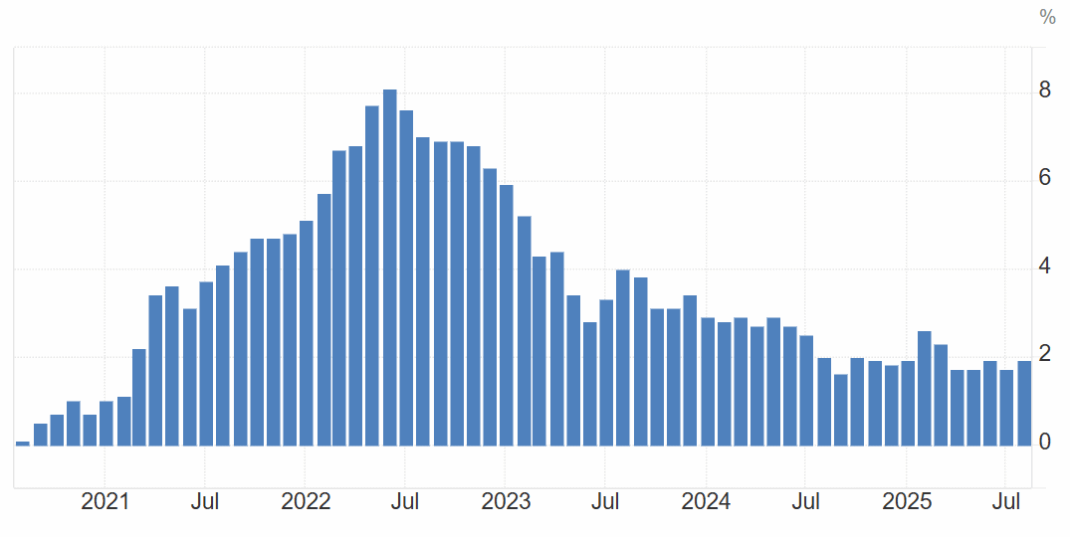
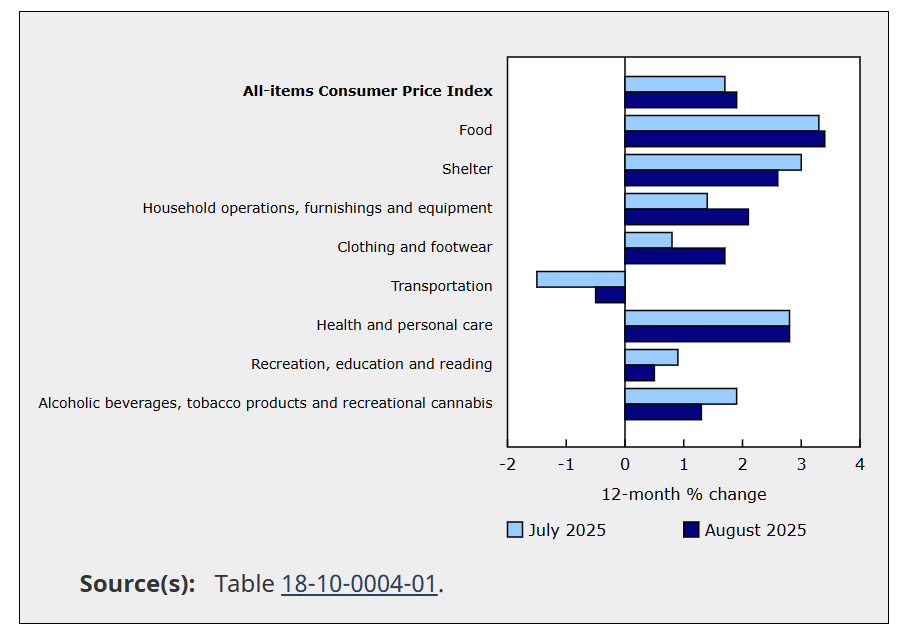
Canadian Consumer Price Index (CPI) rose 1.9% on a year-over-year basis in August, up from a 1.7% increase in July

Published September 16, 2025

Analysis: Excluding gasoline, the CPI rose 2.4% in August, after increasing 2.5% in each of the previous three months. In August, prices for meat rose 7.2% year over year, following a 4.7% increase in July. Higher prices for fresh or frozen beef (+12.7%) and processed meat (+5.3%) put upward pressure on the index in August. Inflation is smoldering in the background and will get worst.

Here is a 5-year chart:

Canadian inflation chart

Canadian inflation by product group

The Daily — Consumer Price Index, August 2025