Tag Archives: Canada

The Canadian ETF industry has experienced an unprecedented boom

Published May 23, 2026

The Canadian ETF industry has experienced an unprecedented boom, with total Assets Under Management (AUM) officially crossing the $800 billion CAD milestone. A massive chunk of this capital is heavily concentrated among the “Big Three” issuers: BlackRock (iShares), Vanguard, and BMO.

The largest Canadian-listed ETFs, categorized by their distinct investment styles, dominate the retail and institutional landscape.


1. Core Broad-Market Equity (Passive Indexing)

These are the heavyweights of the Canadian financial system. They track massive, cap-weighted indices to give investors low-cost, bedrock exposure to Canadian and U.S. stock markets.

  • iShares Core S&P/TSX Capped Composite Index ETF (XIC): Standing as one of the single largest ETFs in Canada at ~$25.2 billion AUM, XIC tracks the entire Canadian stock market (large, mid, and small-cap).
  • iShares S&P/TSX 60 Index ETF (XIU): At ~$21.4 billion AUM, this is the evolution of the world’s very first ETF. It strips out smaller companies and holds just the 60 blue-chip giants of the TSX.
  • Vanguard S&P 500 Index ETF (VFV): This is the go-to vehicle for Canadians seeking unhedged exposure to the U.S. stock market. It has consistently been one of the fastest-growing funds in Canada due to its rock-bottom management fee (0.08%).
  • BMO S&P/TSX Capped Composite Index ETF (ZCN): BMO’s primary domestic heavy-hitter sitting at ~$14.7 billion AUM, mirroring XIC’s broad strategy with ultra-low costs.

2. Asset Allocation (“All-in-One” Portfolios)

This style represents a major shift in how Canadians build portfolios. These funds handle automatic rebalancing across global equities and fixed income within a single ticker. It is the fastest-growing investment style, drawing massive inflows.

  • iShares Core Equity ETF Portfolio (XEQT): Holding roughly $6.7 billion+ AUM, XEQT is an aggressive 100% equity portfolio holding over 9,000 global stocks (split across the U.S., Canada, International, and Emerging Markets).
  • Vanguard All-Equity ETF Portfolio (VEQT): Vanguard’s direct competitor to XEQT, also maintaining a pure 100% stock structure with slightly different regional weightings.
  • Vanguard Growth ETF Portfolio (VGRO): The quintessential “Growth Balanced” option, keeping a strict 80% equity / 20% fixed income split for investors who want a minor bond cushion.

3. Fixed Income & Aggregate Bonds

When equity markets see volatility or interest rate projections shift, capital floods back into these foundational bond packages.

  • BMO Aggregate Bond Index ETF (ZAG): Holding ~$10.04 billion AUM, ZAG is the giant of Canadian fixed income. It provides comprehensive exposure to investment-grade government, provincial, and corporate bonds.
  • iShares Core Canadian Universe Bond Index ETF (XBB): A close rival to ZAG, offering a nearly identical diversified bond mix to anchor traditional 60/40 balanced portfolios.

4. Dividend & Income-Focused (High Yield)

Canadian investors traditionally love cash flow, making dividend and specialty income styles incredibly lucrative.

  • Vanguard FTSE Canadian High Dividend Yield Index ETF (VDY): With ~$3.34 billion AUM, VDY tracks the highest-yielding blue chips in Canada. Because the TSX is top-heavy, it leans aggressively into the Big Banks and massive energy infrastructure providers (like Enbridge).
  • The Covered Call Phenomenon: While funds like VDY dominate traditional indexing, Enhanced/Covered Call ETFs (managed by firms like Global X and BMO) are surging. They overlay option-writing strategies onto equity baskets to manufacture yields north of 7–9% for income-starved retirees.

5. Cash & Liquid Money Market

When investors want to sideline cash while earning a risk-free yield, they look to High-Interest Savings Account (HISA) and Money Market ETFs.

  • Purpose High Interest Savings ETF (PSA): At ~$3.35 billion AUM, PSA pools investor capital to purchase high-interest cash accounts directly from Canada’s Tier-1 banks, paying out monthly interest.
  • BMO Money Market Fund (ZMMK): An ultra-short-term safety play that invests in corporate promissory notes and treasury bills, built for maximum capital preservation.

At-A-Glance structural Overview

Investment StyleTop RepresentativeTickerCore Exposure FocusTypical Cost (MER)
Broad Market DomesticiShares Core S&P/TSXXIC~200+ Canadian Stocks~0.06%
Broad Market USVanguard S&P 500VFV500 Largest US Stocks~0.09%
Fixed IncomeBMO Aggregate BondZAGGov & Corp Canadian Bonds~0.09%
All-in-One GlobaliShares Core EquityXEQT100% Global Stocks~0.20%
High DividendVanguard High Div YieldVDYCanadian Banks & Energy~0.22%
Cash / Capital Pres.Purpose High InterestPSACash Deposits at Big Banks~0.15%

The Current Landscape Trend

The overarching theme is a flight toward simplification. Instead of buying 5 or 6 regional ETFs, both retail investors and professional advisors are increasingly relying on All-in-One funds like XEQT or VEQT for their core equity weightings, and adding specific aggregate bond or high-dividend overlays to tilt toward their specific income needs.

Here is a good article from The Globe and Mail on ETFs.

————-

Technical Analysis is about trading with the trend

Note: This technical analysis is for educational purposes. Please conduct your own analysis or consult a financial advisor before making investment decisions. The author of this article may hold long or short positions in the featured stocks or indexes. The article was written with the help of AI and was reviewed by an editor.

© 2026 TradeOnline.ca InvestOnline.ca ChartAnalysis.ca
Canada produced the world’s very first Exchange-Traded Fund (ETF) for investors

Published May 23, 2026

While many people mistakenly assume the United States created the vehicle, Canada beat Wall Street to the punch by nearly three years.


The Birth of the ETF: TIPs 35

On March 9, 1990, the Toronto Stock Exchange (TSX) launched the Toronto 35 Index Participation Units (TIPs).

  • What it did: It allowed retail and institutional investors to buy a single basket of securities that tracked the 35 largest companies in Canada.
  • The Legacy: TIPs served as the global prototype for what we know as the modern ETF. Over the years, it evolved and is still traded today as the iShares S&P/TSX 60 Index ETF (XIU), making it the oldest existing ETF in the world.

The Common Misconception: The U.S. “Spider”

The reason most people think the U.S. invented the ETF is because of the massive popularity of the SPDR S&P 500 ETF Trust (SPY).

  • State Street and the American Stock Exchange (AMEX) launched SPY in January 1993.
  • While SPY didn’t come first, it revolutionized the global market structure because it was the first to successfully automate the creation/redemption mechanism at a massive scale. Today, it remains the largest ETF in the world.

Canada’s History of “Firsts”

Following the success of TIPs, Canada’s favorable regulatory environment turned Bay Street into a testing ground for investment innovation:

  • 1990: World’s first Equity ETF (TIPs)
  • 2000: World’s first Fixed-Income/Bond ETF (iShares Core Canadian Universe Bond Index ETF)
  • 2021: World’s first retail Bitcoin ETF (Purpose Bitcoin ETF)

The Big Picture: What started as a niche experiment in Toronto in 1990 completely transformed global investing, democratizing diversification for everyday retail investors.

Deficit and total debt as a percent of GDP for major world economies

Posted April 20, 2026

As of April 2026, the global fiscal landscape is defined by a push-and-pull between high defense spending, massive AI infrastructure investment, and impact of elevated energy prices.

The following table ranks the G20 major economies by their projected general government budget balance (net lending/borrowing) as a percentage of GDP for the 2026 fiscal year. Countries with the highest negative percentages represent the largest deficits.

Fiscal Deficit Ranking: Major World Economies (2026 Projection)

RankEconomyDeficit/Surplus (% of GDP)Primary Fiscal Drivers
1China-8.2%Infrastructure stimulus and property sector support.
2Brazil-7.7%Social spending and high debt-servicing costs.
3India-7.4%Continued heavy capital expenditure on infrastructure.
4United States-5.8%Rising mandatory spending and net interest outlays.
5France-4.9%Energy transition subsidies and defense modernization.
6South Africa-4.9%Support for state-owned enterprises and power grid.
7United Kingdom-3.9%Public service funding and debt interest volatility.
8Germany-3.8%Defense “Zeitenwende” and industrial energy support.
9Saudi Arabia-3.5%Vision 2030 mega-projects and oil price volatility.
10Mexico-3.5%Social programs and Pemex financial support.
11Turkey-3.4%Earthquake reconstruction and inflation mitigation.
12Indonesia-2.9%New capital city (Nusantara) development.
13Italy-2.8%Phasing out of “Superbonus” construction incentives.
14Canada-2.7%Provincial healthcare transfers and housing initiatives.
15Australia-2.4%Transitioning back to deficit as commodity prices ease.
16Japan-2.0%Demographic-driven social costs vs. tax revenue growth.
17Russia-2.0%Sustained military expenditures.
18South Korea-1.5%Semiconductor subsidies and aging population costs.
19Argentina+0.5% (Surplus)Strict fiscal austerity and subsidy removals.
20Singapore+3.3% (Surplus)High corporate tax revenue and prudent reserve policy.

Key Macro Trends for 2026

  • The Interest Burden: For advanced economies like the United States and France, net interest payments are consuming an increasing share of GDP. Projections show US interest costs reaching 3.5% of GDP this year, nearly equal to its defense budget.
  • Defense & Technology: In Europe, the -3.8% to -4.9% deficits are increasingly driven by a permanent shift in defense spending targets (approaching 2.5% to 3.0% of GDP). Globally, fiscal incentives for AI and semi-conductors have become a “baseline” expenditure for major economies.
  • The Austerity Exception: Argentina remains a notable outlier, shifting from a deep deficit to a marginal surplus following radical fiscal restructuring, though this has come at the cost of significantly suppressed domestic consumption.

Following the fiscal deficit projections, the general government gross debt-to-GDP ratio provides a clearer picture of the total accumulated debt relative to each country’s economic output.

As of April 2026, debt levels remain elevated across advanced economies due to high interest rates and the expansion of industrial and defense subsidies. The following table ranks the G20 major economies by their projected debt-to-GDP ratios for the 2026 fiscal year, based on the latest IMF World Economic Outlook data.

Public Debt-to-GDP Ranking: Major World Economies (2026)

RankEconomyDebt-to-GDP (%)Context & Fiscal Drivers
1Japan230.1%Decades of stimulus and an aging population.
2Singapore172.5%High, but primarily used for sovereign investment.
3Italy137.4%Persistent structural debt and high servicing costs.
4United States125.8%Rising interest outlays and mandatory spending.
5France118.4%Post-pandemic recovery spending and defense.
6Canada114.2%High household and provincial-level debt.
7United Kingdom103.6%Elevated public service spending vs. slow growth.
8Spain98.2%Gradual deleveraging from pandemic-era peaks.
9China96.3%Rapid rise due to local government and property support.
10Euro Area (Avg)87.8%Broad regional average across EU member states.
11Brazil84.5%High social expenditure and borrowing costs.
12India81.9%Heavy infrastructure spending to fuel 6.5% growth.
13Argentina78.4%Down from previous highs due to strict austerity.
14South Africa77.1%State-owned enterprise support (Energy/Transport).
15Germany64.0%Constrained by the constitutional “debt brake.”
16South Korea54.4%Increasing support for semiconductor and tech R&D.
17Australia51.3%Strong commodity exports helping offset debt.
18Mexico45.4%Disciplined fiscal policy relative to regional peers.
19Saudi Arabia32.1%Low debt, but rising due to “Vision 2030” projects.
20Russia19.1%Heavily sanctioned and isolated from global markets.

Critical Observations

  • The $100% Threshold: A majority of the G7 nations (Japan, Italy, US, France, Canada, UK) are now operating with debt levels exceeding 100% of their GDP. This creates a “fiscal squeeze” where a growing portion of tax revenue must be diverted to pay interest rather than funding infrastructure or services.
  • The “Investment” Outlier: Singapore remains the exception to the rule. Unlike other nations, its debt is not used to fund budget deficits but is instead issued to provide a pool of assets for the Central Provident Fund and for reinvestment by its sovereign wealth funds (GIC/Temasek).
  • China’s Trajectory: China has seen one of the fastest debt increases in the G20, rising from roughly 60% in 2019 to over 96% today, as the central government absorbs the liabilities of local governments and the struggling property sector.

Note: Published with the assistance of AI and reviewed by an editor.

What is inflation psychology?

Published April 11, 2026

Inflation psychology is the collective belief among consumers and businesses that prices will continue to rise indefinitely. It is often described as a “self-fulfilling prophecy” because when people expect inflation, they change their behavior in ways that actually cause it.

As of April 2026, this concept has returned to the forefront of economic discussion due to a sharp divergence in global markets and renewed geopolitical shocks.


1. How the “Vicious Cycle” Works

Inflation psychology turns a temporary price spike into a permanent trend through three primary behaviors:

  • Forward-Buying: Consumers rush to buy goods now (like cars, appliances, or even non-perishable groceries) to “beat” the price increases they expect next month. This surge in demand pushes prices even higher.
  • The Wage-Price-Profit Spiral: Workers demand higher wages to maintain their purchasing power. To cover these labor costs, businesses raise their prices. If businesses also raise prices to protect profit margins (a “profit spiral”), inflation becomes “sticky.”
  • Reduced Price Sensitivity: When prices for everything are rising, consumers stop “shopping around” or resisting higher costs because they assume every retailer is equally expensive. This gives businesses more “pricing power” to pass on costs.

2. The Current “Sentiment Plunge” (April 2026)

The psychological landscape shifted dramatically this month. On April 10, 2026, the U.S. Consumer Sentiment Index plunged to a record low of 47.6, down from 53.3 in March.

DriverPsychological Impact in 2026
Geopolitical TensionConcerns over the Iran conflict have spiked energy expectations, making consumers feel that “the worst is yet to come.”
Tariff LagMany businesses are only now passing on the costs of 2025 tariffs as their old inventories run out, creating a “second wave” of price shocks.
“Salient” PricesHouseholds are ignoring aggregate stats (CPI) and focusing on “salient” items—eggs, gas, and home repairs—which remain highly volatile.

3. The Cognitive Biases Involved

Economics isn’t just math; it’s brain chemistry. Two main biases are driving the 2026 outlook:

  • Anchoring: Consumers are still “anchored” to the lower prices of the early 2020s. Every trip to the grocery store feels like a “loss” compared to that mental anchor, leading to Uncertainty Fatigue.
  • Loss Aversion: Research from early 2026 shows that the “pain” of a price increase is felt twice as intensely as the “joy” of a price drop. This makes consumers more likely to hoard goods or demand aggressive raises to avoid the feeling of falling behind.

4. Regional Cross-Currents

Inflation psychology is currently diverging by region:

  • The U.S.: Expectations are becoming “unanchored.” Core inflation is projected to accelerate toward 4% as the “buy now” mentality takes hold again.
  • Canada & Europe: Sentiment is more “cautious” than “panicked.” In Canada, consumers have shifted to Intentional Spending—prioritizing value and loyalty programs rather than mass forward-buying.

The Central Bank Dilemma

Central banks, like the Bank of Canada and the Fed, are terrified of “unanchoring.” Once people believe 4% inflation is the new normal, it is incredibly difficult to bring it back to the 2% target without causing a severe recession. Their main tool right now isn’t just interest rates—it’s communication, trying to convince the public that these shocks are temporary to break the psychological loop.

For the 2025–26 fiscal year, the Canadian federal budget projects total spending of $585.9 billion

Published April 2, 2026

This represents a significant increase from previous years, driven largely by new military outlays, housing initiatives, and rising debt-servicing costs.

The following table breaks down the major spending categories by dollar amount and their approximate percentage of the total budget.

Federal Spending Breakdown (FY 2025–26)

CategoryAmount ($ Billions)% of Total Budget
Direct Program Expenses$257.043.9%
Major Transfers to Persons$158.027.0%
Major Transfers to Provinces & Territories$110.318.8%
Public Debt Charges (Interest)$55.69.5%
Net Actuarial Losses$5.00.8%
Total Federal Spending$585.9100%

Key Line Items and Sub-Categories

To provide a more granular view, here are the specific costs for the most significant programs within those major categories:

1. Major Transfers to Persons ($158.0B)

  • Elderly Benefits (OAS/GIS): $85.5 billion (14.6%). This remains the largest single program expense due to Canada’s aging demographic.
  • Canada Child Benefit (CCB): $31.2 billion (5.3%).
  • Employment Insurance (EI): $27.8 billion (4.7%).
  • Canada Disability Benefit: $13.5 billion (2.3%).

2. Major Transfers to Other Levels of Government ($110.3B)

  • Canada Health Transfer (CHT): $54.7 billion (9.3%).
  • Fiscal Equalization: $27.3 billion (4.7%).
  • Canada Social Transfer (CST): $17.1 billion (2.9%).

3. Direct Program Expenses ($257.0B)

This category covers the operations of all federal departments and new strategic investments.

  • National Defence: $35.2 billion (6.0%). Spending has ramped up following the 2025 Arctic Sovereignty mandate.
  • Indigenous Services: $25.2 billion (4.3%).
  • Build Canada Homes Initiative: $13.0 billion (2.2%). A key pillar of the 2025-26 fiscal strategy to address housing supply.

Fiscal Health Indicators (2026 Context)

As an active participant in the Canadian markets, you may find the following “bottom-line” figures relevant to the current trading environment:

  • Budgetary Revenues: $507.5 billion.
  • Annual Deficit: $78.3 billion (restated at 2.5% of GDP).
  • Federal Debt-to-GDP: 42.4%.
  • Interest Outlook: Public debt charges are now consuming nearly 10 cents of every dollar the government collects, which is a major factor in the current “hard-nosed” approach to departmental budget cuts (targeting a 10% reduction in the federal workforce by 2028).

Canadian GDP update by sector

Published March 30, 2026

As of early 2026, Canada’s economy is navigating a period of modest growth, with real GDP expanding by 1.6% in 2025 and projected to grow by approximately 0.7% to 1.1% in 2026.

The economy is currently characterized by a “two-speed” performance: strong growth in energy and commodities-producing provinces, contrasted by significant headwinds in manufacturing-heavy regions like Ontario and Quebec due to trade friction and tariffs.

Canadian GDP Breakdown by Sector (2025–2026)

The following table outlines the approximate contribution of major industrial sectors to the Canadian economy and their recent performance trends.

SectorApprox. % of GDP2025–2026 Performance Trend
Real Estate, Rental & Leasing~13.5%Stable at record highs; residential cooling in ON/BC.
Manufacturing~10.0%Contracting (-2.6% in 2025); facing U.S. trade tariffs.
Mining, Oil & Gas Extraction~9.0%Strong Growth (+4.0% in 2025); upside from oil price shocks.
Finance & Insurance~7.5%Growing (+4.0% in 2025); supported by interest margins.
Healthcare & Social Assistance~7.5%Consistent growth (+2.6% in 2025); driven by demographics.
Construction~7.0%Rebounding in engineering/infra; weak residential starts.
Public Administration~6.5%Modest growth (+1.1%); strong federal spending.
Professional & Tech Services~6.0%Resilient; tech remains a significant $120B+ industry.
Wholesale & Retail Trade~10.5%Volatile; impacted by shifting consumer confidence.

Key Economic Drivers in 2026

1. The Energy Surge

Energy-producing provinces—Alberta, Saskatchewan, and Newfoundland and Labrador—are outperforming the national average. Recent supply disruptions in the Middle East have pushed oil price forecasts up significantly. Combined with the expanded capacity of the Trans Mountain and Enbridge systems, the sector is seeing material upside in production and revenue.+1

2. Manufacturing and Trade Headwinds

The manufacturing sector remains the largest detractor from national growth. Trade uncertainty and tariffs (particularly on steel, aluminum, and lumber) have led to a third consecutive year of contraction in some sub-sectors. While a U.S. Supreme Court ruling recently struck down some broad 2025 tariffs, specialized duties on automotive and metal products continue to weigh on Central Canada.

3. Housing and Construction Bifurcation

The construction sector is seeing a split in performance:

  • Engineering & Infrastructure: GDP reached roughly $170 billion in late 2025, driven by massive government projects in clean energy and transit.
  • Residential Construction: High borrowing costs and inventory backlogs have slowed new housing starts to near two-decade lows in markets like Toronto and Vancouver.

4. Services-Producing Industries

The services sector (accounting for roughly 70% of total GDP) remains the economy’s anchor. Finance, healthcare, and education have provided steady gains that helped Canada avoid a technical recession in 2025, even as the goods-producing side of the economy struggled.

The service sector, also known as the tertiary sector, includes all economic activities that produce “intangible” value rather than physical goods. Instead of extracting raw materials (primary sector) or manufacturing products (secondary sector), the service sector focuses on providing specialized skills, experiences, and logistical support to consumers and businesses.

In modern developed economies, the service sector typically accounts for 70% to 80% of total GDP.

Major Categories of the Service Sector

The sector is incredibly broad, ranging from a neighborhood coffee shop to a global data analytics firm. It is generally divided into several key categories:

CategoryDescriptionIndustry Examples
Trade & DistributionThe movement and sale of physical goods.Retail, Wholesale, Warehousing, e-commerce.
Consumer ServicesServices provided directly to individuals.Restaurants, Hotels, Tourism, Hair salons, Gyms.
Financial ActivitiesManaging, investing, and protecting money.Banking, Insurance, Real Estate, FinTech.
Professional ServicesSpecialized expertise for businesses.Legal, Accounting, Management consulting, Marketing.
Information & TechManaging data and digital communication.Software (SaaS), Telecommunications, AI services.
Public & SocialServices essential for society’s functioning.Healthcare, Education, Public safety, Government.

The Evolution: Quaternary and Quinary Sectors

As economies become more advanced, the service sector is often subdivided into two “knowledge-based” extensions:

1. The Quaternary Sector (The Knowledge Economy)

This involves the gathering, processing, and distribution of information. It is the “brain” of the economy.

  • Examples: Research and Development (R&D), Data Analytics, Scientific Research, and Advanced IT.
  • 2026 Trend: A major driver here is Agentic AI—autonomous systems that perform complex business processes without constant human oversight.

2. The Quinary Sector (High-Level Decision Making)

This represents the highest levels of organization and decision-making in society.

  • Examples: Government leaders, CEOs of multinational corporations, and top-tier scientific innovators.
  • Non-Profit: This also includes non-profit organizations and unpaid domestic labor (caregiving) which provide immense social value but are often excluded from traditional GDP calculations.

Key Characteristics of Services

To distinguish a service from a good, economists look for four specific traits:

  • Intangibility: You cannot touch or store a service. You are buying the result (e.g., a clean house or a legal defense).
  • Perishability: Services cannot be saved for later. An empty seat on a flight or an unbooked hotel room is “lost” revenue that can never be recovered.
  • Inseparability: The service is often produced and consumed at the same time (e.g., a haircut or a live concert).
  • Inconsistency: Unlike a factory-made phone, the quality of a service can vary based on who provides it and when.

Update for March 31, 2025: The Canadian gross domestic product expanded by 0.2% from the previous month in February of 2026, according to a flash estimate. This was supported by higher output in manufacturing, mining, and quarrying, and financial services, which offset contractions for agriculture and forestry. The expansion is set to extend the 0.1% growth rate from January, which was upwardly revised from the initial estimate of a stall. Growth was carried by goods producing industries (0.2%) as higher construction (2.2%) and mining and quarrying (1.2%) offset the drop for manufacturing (-1.4%). In turn, services producing industries stalled. Output increased in finance and insurance (0.5%), and retail trade (0.8%), offsetting the contraction for wholesale trade (-1.2%) and transportation and warehousing (-0.7%), which was pressured by extreme weather conditions that prevented logistics. source: Statistics Canada

Canadian Phoenix pay system boondoggle

Published March 23, 2026

The Phoenix Pay System epitomizes Government incompetency and the hubris of so-called IT experts.

The Minister of Public Services and Procurement who authorized the final rollout and release of the Phoenix pay system was Judy Foote. She knew nothing about IT systems but neither did her advisors. They are all retired now on government pensions.

While the project was initiated under the previous Conservative government, the final decision to “go live” happened in early 2016 under the Liberal government.

Key Timeline of Authorization:

  • Initial Approval (2009–2015): The “Transformation of Pay Administration” initiative began under Prime Minister Stephen Harper. Ministers including Rona Ambrose and Diane Finley oversaw the earlier development and the move of the pay centre to Miramichi, New Brunswick.
  • The “Go-Live” Decision (February 2016): After the 2015 election, Judy Foote was appointed Minister of Public Services and Procurement. Despite warnings from unions and reports of technical “bugs,” the department proceeded with the release.
  • Two-Phase Rollout: * Phase 1: Launched in February 2016 for 120,000 employees.
    • Phase 2: Launched in April 2016 for the remaining 170,000 employees.

The Aftermath

Shortly after the second phase, it became clear that thousands of federal employees were being underpaid, overpaid, or not paid at all. In 2017, Judy Foote resigned from cabinet for personal reasons, and the file was eventually handed to Carla Qualtrough, who began the long process of attempting to stabilize the system and searching for a replacement (the “Dayforce” project).

As of 2026, the government is still in the process of transitioning away from Phoenix to the Dayforce system, a project currently overseen by Minister Joël Lightbound.

What companies were behind the Phoenix boondoggle?

The company primarily behind the Phoenix pay system is IBM Canada.

While IBM built and implemented the system, the project was a massive undertaking involving several different entities and software components. Here is the breakdown of the “who’s who” behind the system:

1. IBM Canada (The Prime Contractor)

IBM was awarded the contract in June 2011 to design, customize, and implement the system.

  • The Contract: What started as a $5.7 million contract famously ballooned. By 2026, the total paid to IBM for Phoenix-related work (including years of “stabilization” efforts) has exceeded $780 million.
  • The Defense: IBM has historically maintained that they were the “builders” following the government’s instructions. They testified in 2018 that they actually recommended the government delay the rollout in 2015 because the system wasn’t ready, but were overruled by government bureaucrats.

2. Oracle / PeopleSoft (The Software)

Phoenix was not built from scratch; it was based on PeopleSoft, a commercial “off-the-shelf” payroll software owned by Oracle Corporation.

  • The disaster wasn’t necessarily the software itself (which is used by many large corporations), but rather the heavy customization required to handle the federal government’s 80,000+ complex pay rules and dozens of different collective agreements.

3. Public Services and Procurement Canada (The Architect)

The government department (PSPC) acted as the project manager.

  • They made the critical decision to eliminate 700 experienced pay advisor jobs before the system was fully functional, moving operations to a centralized hub in Miramichi, New Brunswick. This “points of failure” move left the government without a safety net when the software began to glitch.

4. Other Consultants

Several other high-profile firms were brought in at various stages to audit, advise, or try to fix the mess:

  • PricewaterhouseCoopers (PwC): Conducted early studies that helped build the original business case for the system.
  • Gartner Consulting: Hired to perform a “readiness review” just before the 2016 launch (their warnings were largely downplayed).
  • McKinsey & Company: Later brought in to help with “pay transformation” and stabilization strategies.

The Current Shift: The government is now moving away from IBM’s Phoenix system toward a new provider, Dayforce (formerly Ceridian), as part of the “NextGen” pay initiative.

Read the following story: Replacing Phoenix pay system will cost at least $4.2-billion, Auditor-General report says – The Globe and Mail

Ontario is proposing a new class of mutual funds. Investor advocates warn the risk may not be worth the reward.

Published February 7, 2026

The following article was published in The Globe and Mail on February 7, 2026. It is well written and worth the read.


Ontario’s securities market regulator has faced pressure from Premier Doug Ford’s government to authorize a new class of mutual funds aimed at retail investors that can hold higher-risk private assets such as real estate.

The initiative is being touted as a way to give ordinary investors access to the burgeoning world of privately owned companies and assets, which are mostly only directly available to institutions and sophisticated, wealthy accredited investors.

But investor advocates say private asset investing is riskier and typically more expensive than traditional mutual funds – especially for small investors – and the advocates warn that the plan to create new private asset mutual funds could lead to investors’ money being locked up for years in long-term real estate or infrastructure projects that have extremely complex fee structures.

Doug Ford’s government is pushing regulators to authorize a new class of mutual funds aimed at retail investors that can hold higher-risk private assets such as real estate.Chris Young/The Canadian Press

Three people familiar with the process said the Ford government pushed the Ontario Securities Commission to launch the proposal as a way of raising money for big infrastructure projects. The OSC was urged to prepare a consultation paper unusually quickly, the people said, with the published result containing very little research or industry input.

The Globe and Mail has agreed not to identify the people as they are not authorized to discuss the matter publicly.

Scott Blodgett, a spokesperson for Ontario’s Ministry of Finance, said in an e-mail that while the government discusses capital‑formation initiatives with the OSC and receives updates, it “does not direct or expedite regulatory work.”

“Decisions about long‑term asset fund design, timing and investor safeguards rest solely with the OSC,” Mr. Blodgett said.

OSC spokesperson Julia Mackenzie said the commission’s proposal to launch retail private assets “dates back” to a 2021 report published by the Capital Markets Modernization Taskforce – another regulatory initiative by the Ford government.

At that time, the task force recommended the OSC write a formal proposal on retail private equity investment funds, and then seek public input. The task force said the funds could help close a “funding gap” for smaller companies. Three years later, in the fall of 2024, the OSC launched a consultation paper on retail investors’ access to long-term assets that mentioned the funds could also increase opportunities for additional funding for government infrastructure projects.

“The OSC believes it is important to be open to new and innovative financial products that can enable capital formation and provide new opportunities for investors, with appropriate oversight, disclosure and investor protections,” Ms. Mackenzie told The Globe in an e-mail.


Here is the link to read the rest of this article: Ontario is proposing a new class of mutual funds. Investor advocates warn the risk may not be worth the reward – The Globe and Mail

As of early 2026, here is an overview of the CBC (Canadian Broadcasting Corporation), including its funding, headcount, and revenue model

Published January 24, 2026

Executive Summary

The CBC is a federal Crown corporation that operates as Canada’s national public broadcaster. While it generates some of its own money, it is heavily dependent on public subsidies, which cover approximately 70-75% of its operating costs.

1. Headcount: How many people work there?

  • Total Employees: Approximately 7,500 to 8,000 permanent, full-time equivalent employees.
  • Recent Stability: In late 2023, the CBC announced plans to cut roughly 600–800 jobs (about 10% of its workforce) due to a projected budget shortfall. However, in the April 2024 Federal Budget, the government injected an additional $42 million specifically to prevent these layoffs. As of 2025/2026, the workforce has stabilized near historical levels, though attrition (not replacing people who retire) remains a tool for managing costs.

2. Public Subsidy: How much tax money do they get?

The CBC receives an annual “Parliamentary Appropriation” (taxpayer funding) voted on by the federal government.

  • Annual Public Subsidy: Approximately $1.4 Billion CAD per year.
    • Breakdown: This works out to roughly $33–$35 per Canadian per year.
    • Trend: The funding has increased slightly in nominal terms to cover inflation and salary increases, but the broadcaster argues that in “real dollars” (inflation-adjusted), its funding has declined over the last decade.
  • Recent Top-Up: The $42 million added in 2024 was a “stop-gap” measure to handle rising production costs and declining ad revenue, signalling the government’s intent to keep the current size of the organization intact for now.

3. Revenue Streams: Do they make their own money?

Yes. The CBC is not 100% publicly funded. It operates a “hybrid” model where it competes for advertising dollars against private companies (like Bell/CTV, Rogers/Citytv) and tech giants (Google/Meta).

  • Self-Generated Revenue: Approximately $400 Million – $500 Million per year.
    • This accounts for roughly 25–30% of their total budget.
  • Where the money comes from:
    1. Advertising (TV & Digital): This is the largest chunk. They run commercials on CBC Television, CBC News Network, and their websites. Note: CBC Radio does not run commercial advertisements (except for limited sponsorships).
    2. Subscription Fees: Revenue from discretionary channels (like CBC News Network) that are part of cable packages, as well as monthly subscriptions for the premium version of CBC Gem (their streaming service).
    3. Content Licensing: Selling shows (like Schitt’s Creek or Murdoch Mysteries) to other broadcasters or streamers internationally.
  • The Problem: Their “self-generated” revenue is shrinking. Traditional TV advertising is collapsing across the entire industry as money moves to digital platforms (Google/Facebook), and the CBC is struggling to replace those lost TV ad dollars with digital ones.

Summary Table (2025/2026 Estimates)

CategoryApproximate AmountNotes
Public Funding (Subsidy)~$1.4 BillionThe core grant from Parliament.
Self-Generated Revenue~$450 MillionAds, subscriptions, licensing.
Total Annual Budget~$1.85 BillionCombined operating power.
Headcount~7,800Stabilized after 2024 funding injection.

Why is this controversial?

The “Revenue Stream” is a major point of friction. Private broadcasters (like Global and CTV) argue that it is unfair for the CBC to receive $1.4 billion in tax money and compete against them for scarce advertising dollars. They argue this subsidized competition makes it harder for private Canadian news outlets to survive. The CBC counters that ad revenue is essential because the public subsidy alone is not enough to maintain its current level of services across TV, Radio, and Digital in both English and French.

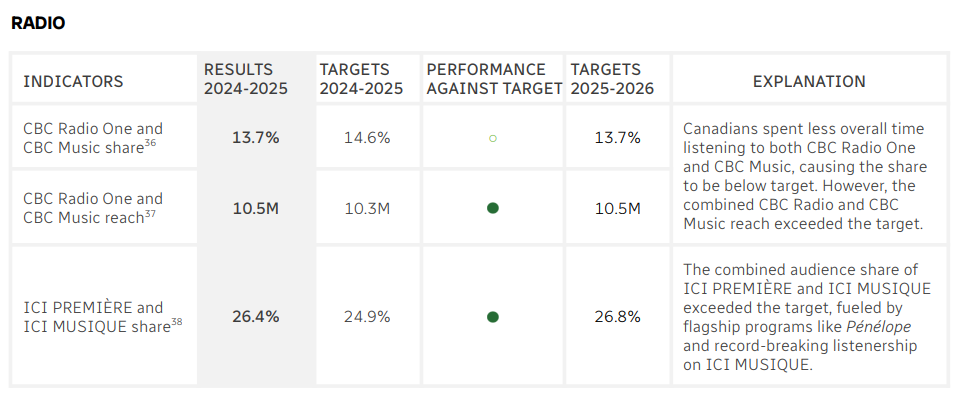
CBC audience
CBC television market share
CBC radio market share
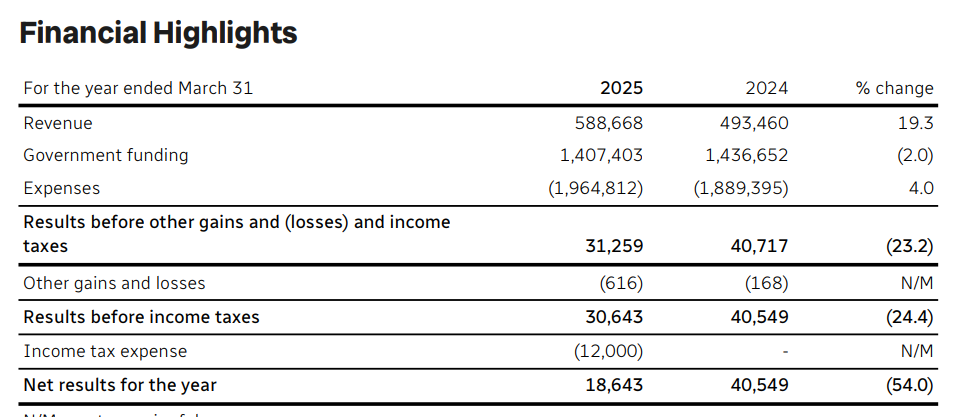
CBC financial summary
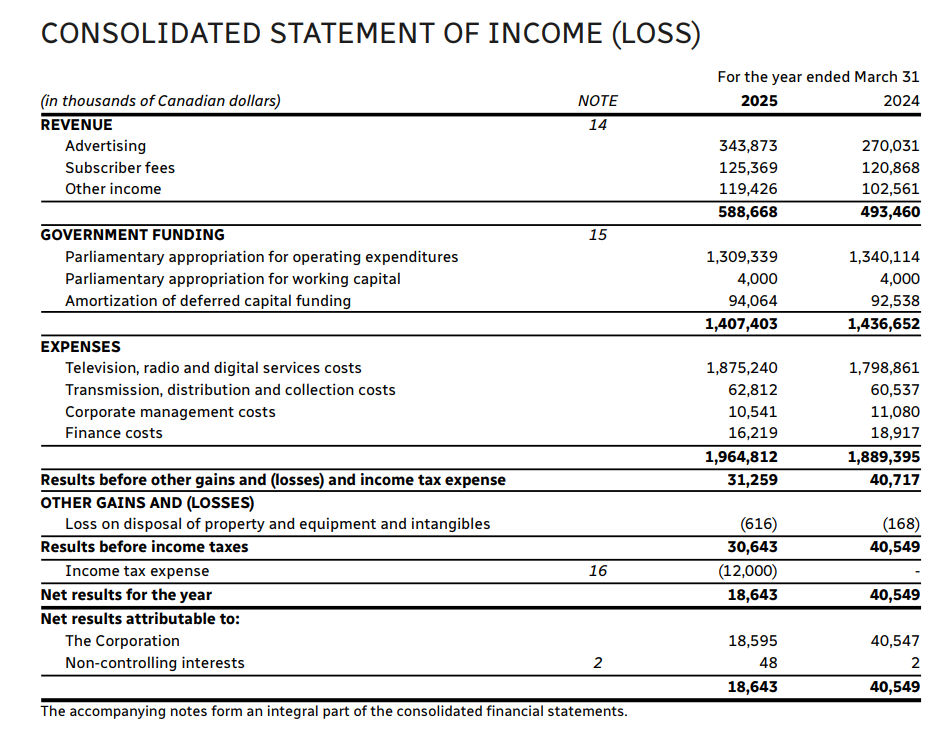
CBC income statement 2025-2024

https://cbc.radio-canada.ca/en/impact-and-accountability

https://site-cbc.radio-canada.ca/documents/impact-and-accountability/finances/2025/2024-2025-annual-report.pdf

Updated link February 11, 2026: I agree that the amount and placement of advertising was awful and disrespectable to the opening ceremonies CBC shouldn’t brush off the over 1,000 complaints it received about ads during Olympics opening ceremony – The Globe and Mail

As of January 2026, the landscape for “Inverse ETFs” in Canada has changed significantly due to the massive rebranding of Horizons ETFs to Global X

Published January 13, 2026

If you are looking for the famous “H-Series” tickers (like HXD, HIX, or HQD), many of them have been renamed and given new ticker symbols.

Here are the most popular Inverse Canadian ETFs, organized by sector and updated with their new 2026 tickers.

1. Betting Against the Canadian Market (TSX 60)

These are the standard tools for shorting the broad Canadian economy (Banks, Energy, Rail).

StrategyNew TickerOld TickerFund Name
-1x InverseCNDI(HIX)BetaPro S&P/TSX 60 Daily Inverse ETF
-2x BearCNDD(HXD)BetaPro S&P/TSX 60 -2x Daily Bear ETF
  • Use Case: You believe the general Canadian economy is entering a recession.
  • Note: CNDD provides double leverage (if TSX falls 1%, CNDD rises 2%).

2. Betting Against Canadian Energy

You have two distinct options here: betting against the Oil Companies (Stocks) or betting against the Price of Oil (Commodity).

StrategyNew TickerOld TickerFund Name
Short Oil STOCKSNRGD(HED)BetaPro S&P/TSX Capped Energy -2x Daily Bear
Short Oil PRICEHOD(Kept Ticker)BetaPro Crude Oil Inverse Leveraged Daily Bear
Short Nat GasHND(Kept Ticker)BetaPro Natural Gas Inverse Leveraged Daily Bear
  • Crucial Distinction:
    • Buy NRGD if you think Suncor/CNQ stocks will fall.
    • Buy HOD if you think the WTI Oil Price will fall. (HOD is extremely volatile and suffers from “decay” if held long-term).

3. Betting Against Canadian Banks

With the mortgage renewal cliff in 2026, this is a popular trade for those bearish on the housing market.

StrategyNew TickerOld TickerFund Name
-2x Bank BearCFOD(HFD)BetaPro S&P/TSX Capped Financials -2x Daily Bear

4. Betting Against US Tech (TSX Listed)

Many Canadians use their CAD accounts to short the US market without converting currency.

StrategyNew TickerOld TickerFund Name
Short S&P 500SPXD(HSD)BetaPro S&P 500 -2x Daily Bear ETF
Short NASDAQQQD(HQD)BetaPro NASDAQ-100 -2x Daily Bear ETF

⚠️ Critical Warning: The “Daily Reset” Trap

These ETFs are not long-term investments.1 They are designed for 1-day trades.

  • The Decay: Because they reset their leverage every single day, holding them for weeks or months will erode your value, even if the market goes in your direction.2
  • Example: If the market is flat but volatile (up 2% one day, down 2% the next), you will lose money in both the Bull (+2x) and Bear (-2x) funds over time.
  • Rule of Thumb: Do not hold these tickers (especially the -2x ones like CNDD or HOD) for longer than a few days unless you are actively managing the position.

Yes, CNDI (BetaPro S&P/TSX 60 Daily Inverse ETF) does decay.

Even though it is only -1x (Single Inverse) and not -2x like the riskier funds, it still suffers from “Volatility Drag” because of its daily reset mechanism.

If you hold CNDI for more than one day in a choppy market, you are mathematically guaranteed to lose value over time, even if the TSX 60 ends up flat.

The Math: How the “Daily Reset” Eats Your Money

To understand why it decays, look at this simple 2-day scenario where the market goes Up one day and Down the next, ending back where it started.

Scenario: The “Choppy” Market

Imagine the TSX 60 Index starts at $100.

  • Day 1: The Market goes UP 10%.
  • Day 2: The Market goes DOWN 9.09% (this brings it exactly back to $100).

Here is what happens to your CNDI shares:

DayMarket ActionCNDI Action (Inverse)Your CNDI Value
StartIndex at $100Buy at $100$100.00
Day 1Market +10% (to $110)CNDI -10%$90.00
Day 2Market -9.09% (back to $100)CNDI +9.09%$98.18
ResultMarket is FLAT ($0 change)You LOST ~$1.82-1.8% Loss

The Decay: The market did nothing (returned to zero), but you lost nearly 2% of your money. This is because losing 10% hurts you more than gaining 9% helps you. You are trying to recover from a smaller base ($90 instead of $100).

Why CNDI Decays Slower than CNDD (-2x)

While CNDI decays, it is much safer than the -2x leveraged version (CNDD). Decay essentially “squares” with leverage.

  • CNDI (-1x): Moderate Decay (Dangerous over months).
  • CNDD (-2x): Rapid Decay (Dangerous over weeks).

Summary Rule

  • Use CNDI for: A trade lasting 1 day to 2 weeks when you are confident the market will drop in a straight line.
  • Do NOT use CNDI for: A long-term “hedge” against a recession. If the market grinds sideways for 6 months before crashing, your CNDI shares will have already decayed significantly, and you won’t get the full protection you expected.

Better Hedge: If you need protection for 6+ months, it is often cheaper to buy Put Options on the TSX 60 (XIU) rather than holding an inverse ETF that bleeds value daily.

_____________

Technical Analysis is about trading with the trend

Note: This technical analysis is for educational purposes. Please conduct your own analysis or consult a financial advisor before making investment decisions. The author of this article may hold long or short positions in the featured stocks or indexes. The article was written with the help of AI and was reviewed by an editor.

© 2026 TradeOnline.ca InvestOnline.ca ChartAnalysis.ca

Contact[email protected]