Tag Archives: oil

Some trades ahead of Trump policy moves raise questions

Published by Reuters April 9, 2026

My comments: This is most likely the tip of the iceberg. None will be prosecuted. The Trump team has undermined the integrity of the whole financial system.

By Utkarsh Shetti

April 9 (Reuters) – Some of U.S. President Donald Trump’s major policy decisions have been preceded by well-timed bets, leading some experts to raise questions about whether information had somehow leaked ahead of time. 

Here is a list.

April 7, 2026 – IRAN CEASEFIRE ANNOUNCEMENT:

Traders placed a roughly $950 million bet on oil prices falling just hours before the announcement of a ceasefire between the U.S. and Iran.

A combined 8,600 lots of Brent and U.S. crude futures were sold at 1945 GMT on Tuesday, according to LSEG data. At around 2230 GMT, Trump announced a two-week ceasefire with Iran, knocking crude futures down by some 15% to below $100 a barrel at the start of ​Wednesday’s official trading session.

Separately, the Associated Press reported that a group ‌of new accounts on prediction market platform Polymarket made timely bets on whether a ceasefire would be reached on April 7. Prediction ​markets offer tradable yes-or-no contracts that let users wager on a broad array of real-world events.

The news agency cited publicly available blockchain data from Polymarket using crypto analytics platform Dune, which showed at least 50 accounts, or wallets, placed “Yes” bets before Trump’s post.

One wallet, created around 10 am ET on the ‌same day, profited $200,000 after betting roughly $72,000, while another user joined the platform on April 6 and won $125,500. A third wallet ⁠was created just 12 minutes before Trump’s announcement, raking in an estimated $48,500 after betting $31,908.

Polymarket did ​not respond to a Reuters request for comment.

March 23, 2026 – IRAN ATTACK PAUSE:

An unidentified trader or traders bet $500 million on Brent and WTI crude futures in a one-minute period shortly before Trump announced a five-day delay to attacks on Iran’s energy infrastructure, after which oil prices crashed 15%, exchange data and Reuters calculations showed.

LSEG data shows 5,100 lots changed hands between 1049 and 1050 GMT, with selling dominating volume. When Trump’s social media post announcing the move hit at 1105 GMT, over 13,000 lots — equivalent to 13 million barrels — traded in 60 seconds, causing Brent to fall to $99 per barrel from $112 and sending WTI down to $86 per barrel from $99. 

February 28, 2026 – IRAN STRIKES THAT KILLED ‌SUPREME LEADER AYATOLLAH ALI KHAMENEI 

Wagers placed on platforms including Polymarket before the killing of Iranian Supreme Leader Ayatollah Ali Khamenei intensified scrutiny of prediction markets, with Democratic lawmakers calling for a ban on bets tied to military actions that could reward those with privileged information. Kalshi is facing a lawsuit for failing to pay $54 million to people who bet that Khamenei would leave office before March 1. ‌The company says it does not offer markets that settle on death.

According to a Reuters review of Polymarket’s website at the time, about $529 million ‌was wagered on a range of contracts tied to the timing of U.S.-Israeli strikes on Iran, while another $150 million was staked on Khamenei’s ‌removal as supreme leader.

Analytics firm Bubblemaps identified six accounts that made a combined $1.2 million profit from Polymarket bets that were funded in the hours immediately before the raids, which took place on February 28. U.S. Representative Mike Levin of California flagged one specific ‌Polymarket ‌bet placed shortly before the Iran strikes.

Separately, despite hotter-than-expected inflation data that would typically prompt investors to sell long-dated Treasuries, traders moved in the opposite direction on February 27, pushing yields on the benchmark 10-year note below 4%. Analysts said such a pronounced shift into the safe-haven asset would usually be driven by a negative macro event – or a strong expectation that one ⁠was imminent. 

Shares of U.S. airlines also fell that day as oil prices rose, with the Dow Jones U.S. Airlines Index slipping ‌5.13%.

January 3, 2026 – U.S. CAPTURE OF FORMER VENEZUELAN PRESIDENT NICOLAS MADURO:

An unknown trader pocketed a profit of roughly $410,000 after wagering on the ouster of Venezuelan President Nicolas Maduro in January. 

The trader’s account on Polymarket built up positions ‌in contracts tied to Maduro’s removal on terms that implied long odds before the weekend raid ⁠of Maduro’s compound in Caracas by U.S. special forces. Those wagers, worth about $34,000 prior to his capture, surged ‌in value after news of the U.S. military operation emerged on January 3.

April 9, 2025 – TARIFF PAUSE:

Unidentified options traders staked millions of dollars on a U.S. stock market rebound in the minutes before Trump’s tariff pause announcement triggered a massive rally in April last year, according to trading data.

Trump’s Truth Social post pausing tariffs came at 1:18 p.m. ET on April 9, setting off a 9.5% jump for the S&P 500. Market data shows certain options contracts logging a spike in trading activity ahead of it. Some 5,105 SPY call options traded at around 1 p.m. ET for an ‌average price of $4.20.

When stocks rallied, those calls soared as high as around $42, turning $2.14 million into about $21.44 million on paper. 

Similarly, other SPY calls betting on the ETF rising above $509 traded at around 1:10 p.m. ET; their value jumped to about $10 million by end of day, up from $624,000. 

Reuters could not determine whether the ‌calls were all purchased or sold by one trader or several and whether they closed the position for a gain.

White House ⁠spokesman Kush Desai said government ethics guidelines bar federal employees from profiting off nonpublic information. “Any implication that Administration officials are engaged in such activity without evidence is baseless and irresponsible,” he said in an email statement.

Some trades ahead of Trump policy moves raise questions By Reuters
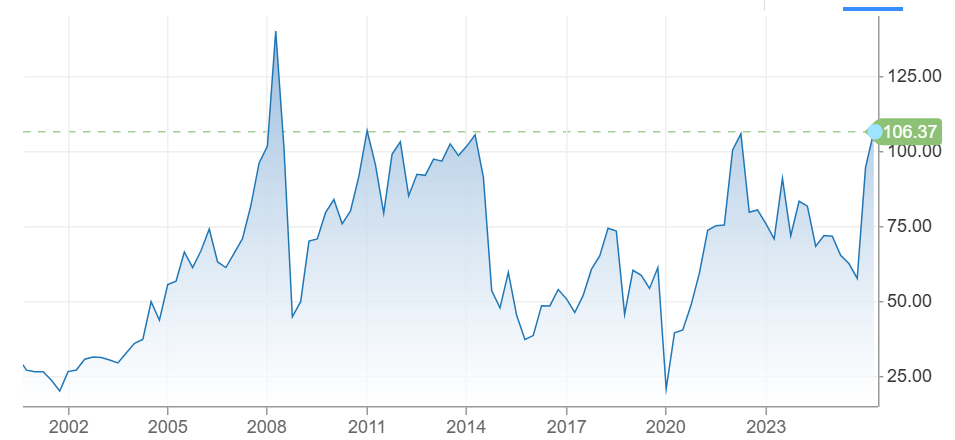
The 2008 oil spike was a perfect storm as WTI hit a record of $147.27

Published March 30, 2026

The 2008 oil price spike, which saw West Texas Intermediate (WTI) crude hit an all-time record of $147.27 per barrel in July, was a “perfect storm” of economic, geopolitical, and financial factors. It wasn’t caused by a single event, but rather a collision of supply and demand that many at the time called the “Third Oil Shock.”

WTI crude long-term chart back to the year 2000

Here is the breakdown of what drove prices into the stratosphere:

1. The “Demand Shock” (Emerging Giants)

The single biggest driver was the rapid industrialization of China and India.

  • The Awakening: These two nations were growing at nearly 10% GDP, shifting millions of people into the middle class who were buying cars and using electricity for the first time.
  • Inelasticity: Global demand was growing so fast that it didn’t matter if prices went up; these emerging economies needed the fuel to keep their factories running, creating a “bidding war” for every available barrel.

2. Stagnant Global Supply

While demand was skyrocketing, the world’s ability to pump more oil had hit a wall.

  • Spare Capacity: Historically, Saudi Arabia kept enough “spare capacity” to flood the market if prices got too high. By 2008, that cushion had dwindled to almost nothing.
  • Non-OPEC Struggles: Production in places like the North Sea and Mexico was in natural decline, and new projects (like deep-water drilling) were taking years longer than expected to come online.
  • Peak Oil Fears: This was the era where the “Peak Oil” theory went mainstream—the fear that the world had already reached its maximum physical production limit.

3. Geopolitical Risk Premium

Investors added a “fear tax” to the price of oil due to constant instability in key producing regions:

  • The Middle East: Continued fallout from the Iraq War and rising tensions with Iran over its nuclear program led to fears of a closure of the Strait of Hormuz.
  • Nigeria: Militant attacks on pipelines in the Niger Delta frequently knocked hundreds of thousands of barrels per day offline.
  • Venezuela: Political friction between the U.S. and Hugo Chávez’s government led to concerns about supply reliability from one of the U.S.’s biggest providers.

4. The Weakening U.S. Dollar

Oil is priced globally in U.S. Dollars ($USD$). In 2008, the dollar was losing value rapidly against the Euro and other currencies.

  • The Hedge: When the dollar weakens, oil prices usually rise to compensate.
  • Foreign Buyers: For a buyer in Europe using Euros, oil didn’t actually feel as “expensive” as it did to an American, because their currency was stronger. This kept global demand high even as prices in dollars soared.

5. Financial Speculation (“The Bubble”)

This is the most debated cause. Many analysts believe the “financialization” of commodities played a role.

  • Index Funds: Huge amounts of pension fund and hedge fund money flowed into “commodity index funds.” These investors weren’t buying oil to use it; they were buying it as a financial asset.
  • The Momentum: This created a feedback loop—as prices rose, more speculative money flowed in, pushing prices even higher until the bubble finally burst during the Great Financial Crisis later that year.

Comparison: 2008 vs. Today

Factor2008 Peak ($147)2026 Context
Main DriverChina’s IndustrializationGeopolitical Conflict (ME/Ukraine)
SupplyPhysical Scarcity FearsSufficient Supply (Shale/OPEC+)
US DollarRecord WeaknessGenerally Stronger
DemandRapidly RisingTransitioning (EVs/Renewables)

The spike ended abruptly in late 2008 when the global financial system collapsed. Demand vanished almost overnight, and oil plummeted from $147 to under $40 in just six months—one of the most violent “price destructions” in history.

Considering the recent spikes we’ve seen in WTI and HOU.TO, do you think today’s geopolitical tensions are creating a similar “fear premium” to what we saw in 2008?

_____________

Technical Analysis is about trading with the trend

Note: This technical analysis is for educational purposes. Please conduct your own analysis or consult a financial advisor before making investment decisions. The author of this article may hold long or short positions in the featured stocks or indexes. The article was written with the help of AI and was reviewed by an editor.

© 2026 TradeOnline.ca InvestOnline.ca ChartAnalysis.ca

The Hottest New Crypto Trade Is 24/7 Oil Futures

Published March 14, 2026

Analysis: This was published in WSJ today. It is worth the read.

While traditional energy investors spent the past weekend counting down the minutes until futures markets reopened on Sunday, overseas crypto traders were already placing their bets on the direction of oil prices.

The Hottest New Crypto Trade Is 24/7 Oil Futures – WSJ

Top 10 Countries by Oil Reserves

Published March 1, 2026

Based on data from the OPEC Annual Statistical Bulletin 2025 and the Energy Institute Statistical Review.

RankCountryReserves (Billion Barrels)World Share (%)
1Venezuela303.217.2%
2Saudi Arabia267.215.1%
3Iran208.611.8%
4Canada163.19.2%
5Iraq145.08.2%
6United Arab Emirates113.06.4%
7Kuwait101.55.8%
8Russia80.04.5%
9Libya48.42.7%
10United States45.02.5%

Key Market Observations

  • OPEC Dominance: Members of the Organization of the Petroleum Exporting Countries (OPEC) control roughly 79% of the world’s proven reserves.
  • The Venezuela Paradox: While Venezuela holds the largest reserves, much of its oil is “extra-heavy” crude, which is expensive to extract and refine. Consequently, its actual production often lags far behind countries like the U.S. or Saudi Arabia.
  • Canadian Oil Sands: Canada’s high ranking is largely due to the oil sands in Alberta. Like Venezuela, these are more difficult and costly to process than the “light sweet” crude found in the Middle East.
  • Production vs. Reserves: The United States is currently the world’s leading oil producer, yet it ranks 10th in reserves. This highlights how quickly a country can extract its resources versus how much it has left in the ground.

Emerging Regions

Keep an eye on Guyana, which has seen a meteoric rise in proven reserves (now over 11 billion barrels) following massive offshore discoveries. It is currently one of the fastest-growing oil provinces in the world.

Note: “Proven reserves” are those that can be recovered with “reasonable certainty” under current economic and operating conditions. These numbers change as new technology makes extraction cheaper or as new fields are discovered.


Canada’s oil reserves can be ranked by type and location. Here’s a breakdown of the major categories, along with their approximate reserves:


RankCategoryLocationEstimated Reserves
1Oil SandsAlbertaApprox. 167 billion barrels (over 97% of Canada’s total reserves)
2Conventional OilSaskatchewanApprox. 7 billion barrels
3Conventional OilNewfoundland and LabradorApprox. 1.6 billion barrels
4Tight Oil (Shale Oil)Alberta and SaskatchewanApprox. 1 billion barrels (estimates vary)

Additional Notes

  • Oil Sands: The vast majority of Canada’s oil is found in the oil sands of Alberta, where it is extracted using surface mining and in-situ techniques.
  • Conventional Oil: While smaller in comparison to oil sands, conventional oil reserves are significant in provinces like Saskatchewan and Newfoundland.
  • Tight Oil: Tight oil, extracted from shale formations, is increasingly becoming a part of Canada’s oil output, although it remains a smaller portion of total reserves.

Note: Published with the assistance of AI and reviewed by an editor

Price of West Texas Intermediate (WTI) from 1968

Published January 2, 2026

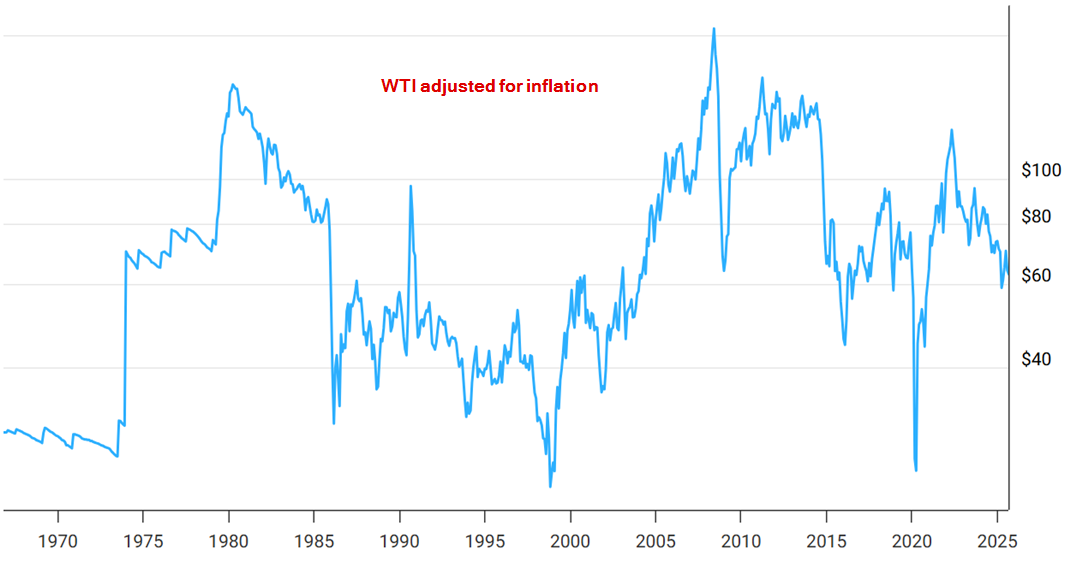
As of January 2, 2026, the price of WTI Crude Oil is approximately $57.50 USD per barrel. The price of oil shown in the chart is adjusted for inflation using the headline CPI and is shown by default on a logarithmic scale.

WTI chart adjusted for inflation

1. The Era of Cheap Oil (1968–1972)

Before the formation of OPEC as a political force, oil prices were remarkably stable and controlled largely by the “Seven Sisters” (major US/European oil companies).

  • 1968 Price: ~$3.00
  • Context: Oil was abundant and cheap. The US was the world’s swing producer, and prices rarely moved more than a few cents.

2. The Oil Shocks (1973–1985)

Everything changed in the 1970s when control of pricing shifted from Western companies to Middle Eastern nations.

  • 1973 (The First Shock): Prices tripled from $4 to $12 following the Arab Oil Embargo (Yom Kippur War).
  • 1979 (The Second Shock): Prices doubled from $15 to $39.50 following the Iranian Revolution.
  • 1980 Peak: Reached an inflation-adjusted high that wouldn’t be beaten until 2008.

3. The Great Collapse & The “Lost Decade” (1986–1999)

A massive oversupply (the “Glut”) caused prices to crash, leading to a long era of cheap energy.1

  • 1986 Crash: Saudi Arabia tired of cutting production and flooded the market.2 Prices collapsed from $30 to $10 in roughly four months.
  • 1990 Spike: Briefly hit $40 during the Gulf War (Iraq/Kuwait) but quickly fell back.3
  • 1998 Low: The Asian Financial Crisis crushed demand, sending oil down to $11.90 per barrel.

4. The “Supercycle” (2000–2014)

Driven by the industrialization of China and India, demand exploded.4

  • 2000-2007: steady climb from $25 to $90.
  • 2008 Peak: WTI hit its all-time record of $147.27 in July 2008.
  • 2008 Crash: The Global Financial Crisis sent it crashing down to $33 by December.
  • 2011–2014: The “Hundred Dollar Era.” Prices stabilized over $100 for nearly three years due to the Arab Spring.

5. The Shale Revolution & COVID (2015–2021)

US Fracking technology flooded the market with new supply, breaking OPEC’s grip.

  • 2014 Crash: Prices fell from $107 to $50 as OPEC refused to cut production to fight US shale.5
  • 2020 (The Anomaly): During the pandemic lockdowns, demand vanished. On April 20, 2020, WTI futures briefly traded at negative -$37.63 (traders paid people to take the oil).

6. The War & The Correction (2022–2026)

  • 2022 High: Russia’s invasion of Ukraine sent prices back to $123.
  • 2023–2024: Prices slowly ground lower as interest rates rose and US production hit record highs.
  • Late 2025/Early 2026: Prices have softened significantly to the $57–$60 range due to fears of oversupply and weak demand from China.6

Summary Table (Approx. Annual Averages)

YearPrice (Nominal)Key Event
1968$3.07Pre-OPEC stability
1974$9.35Post-Embargo
1980$37.42Iranian Revolution peak
1986$15.10The Price Collapse
1998$14.42Asian Financial Crisis
2008$99.67The Supercycle Peak (Hit $147 intraday)
2016$43.29Shale Oil Flood
2022$94.53Ukraine War
2026$57.50Current (Jan 3)

https://www.macrotrends.net/1369/crude-oil-price-history-chart