Tag Archives: AI

As NVIDIA (NVDA) hovers around a $5.5 trillion market cap, its valuation presents a fascinating paradox

Published May 20, 2026

As NVIDIA (NVDA) hovers around a $5.5 trillion market cap—trading in the $220 to $225 range—its valuation presents a fascinating paradox. While it remains one of the most valuable companies in the world, its valuation multiples have quietly compressed to near-historical lows relative to its massive earnings power.


1. Price-to-Earnings (P/E) Metrics

NVIDIA’s valuation looks drastically different depending on whether you look backward or forward.

  • Trailing P/E (LTM): ~42x – 45x Based on trailing twelve-month earnings, NVIDIA trades at roughly 43 times earnings. While this is a premium compared to the broader S&P 500 (average ~20x), it represents a monumental drop from the peak AI euphoria of 2023, when its trailing P/E routinely cleared 140x to 240x.
  • Forward P/E (NTM): ~25x – 27x Looking at expected earnings over the next 12 months, the multiple drops significantly. A forward P/E in the mid-20s places NVIDIA in line with—or even cheaper than—large-cap tech peers like Microsoft and Apple, and vastly cheaper than direct semiconductor rivals like AMD (which trades at a much higher trailing multiple due to lower absolute earnings).
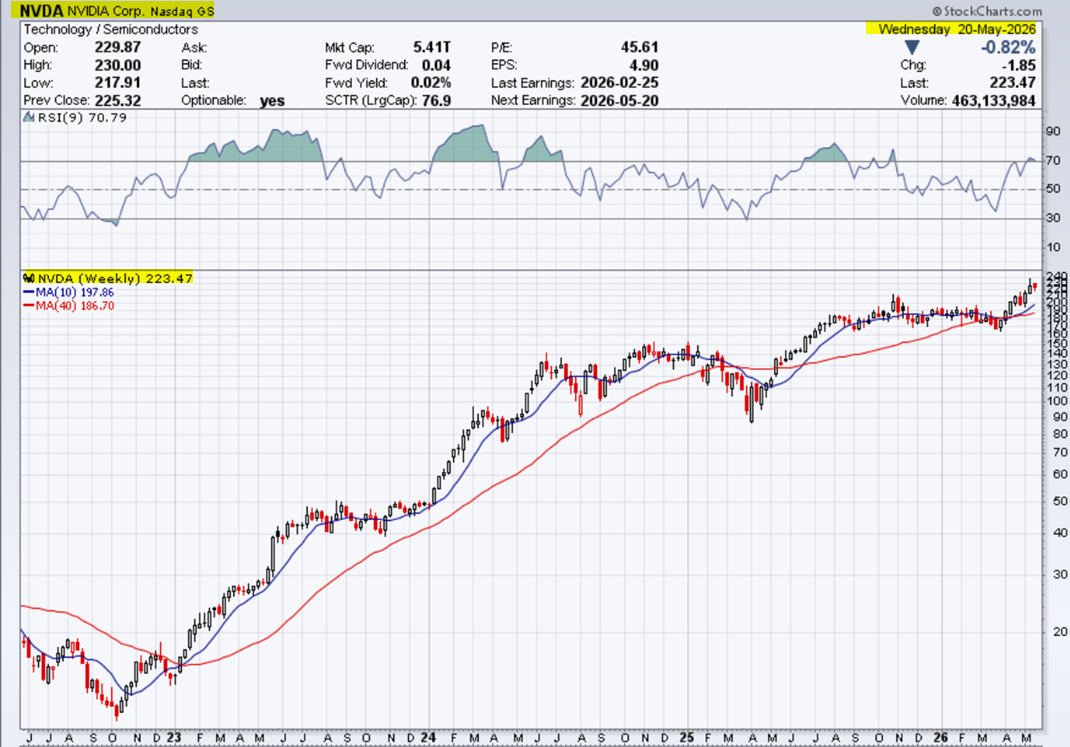
Nvidia 4-year weekly chart

2. Historical Context: The “Compression” Story

NVIDIA is currently trading below its own long-term historical valuation averages.

  • Its 3-year average P/E sits at ~53x.
  • Its 5-year average P/E sits at ~63x.
  • Its 10-year historical average sits at ~64x.

Even before the generative AI boom, the market always commanded a premium for NVIDIA due to its gaming and crypto tailwinds. At ~42x trailing earnings today, the stock is being priced more like a mature, high-quality growth business rather than a speculative momentum trade.


3. Other Critical Valuation Metrics

Gross & Net Profit Margins (The Moat)

What prevents NVIDIA’s P/E from skyrocketing alongside its stock price is its unprecedented profitability.

  • Gross Margins: Sustaining at an incredible ~75%.
  • Net Profit Margins: Reached an extraordinary 71% in the most recent Q1 earnings report (Net Income of $58 billion on $82 billion in revenue).

PEG Ratio (Price/Earnings-to-Growth): ~0.6x – 1.0x

When factoring in growth, NVIDIA looks remarkably inexpensive. A PEG ratio below 1.0 traditionally indicates that a stock is undervalued relative to its growth rate. With Wall Street projecting aggregate earnings growth of over 70% for NVIDIA this fiscal year, its PEG ratio remains highly attractive.

Price-to-Sales (P/S) Ratio: ~22x

This remains NVIDIA’s most expensive metric. A P/S ratio above 20x is historically risky for hardware companies, but it reflects the absolute monopoly NVIDIA currently maintains over tier-one AI data center deployments (Blackwell and upcoming Rubin architectures).


4. The Valuation Debate: Hardware vs. “Tokenomics”

The primary disconnect between structural bulls and bears comes down to how you define NVIDIA’s business model:

The Bear Case (Hardware Cycle): Hardware multiples eventually mean-revert. Hyperscaler (Microsoft, Google, AWS) capex will eventually plateau, enterprise hardware cycles will turn, and competitive pressure from AMD or custom in-house silicon will erode those 75% gross margins.

The Bull Case (“Tokenomics” Factory): CEO Jensen Huang argues that framing NVIDIA as a “chip company” is structurally incorrect. In his view, modern AI data centers are not IT costs; they are manufacturing equipment. Instead of consuming power to run software, they are factories producing a highly valuable commodity: Tokens (text, code, synthetic data, and video).

5. What is Capping the Multiples?

If earnings are beating expectations (Q1 revenue grew 85% YoY), why are the multiples compressing?

  1. The China Hole: Direct export curbs have driven NVIDIA’s China data center revenue from $17.1 billion down to effectively zero, creating an onboarding headwind that the rest of the world has had to absorb.
  2. Macro Geopolitics: Broad market anxiety surrounding Middle East energy shocks and sustained inflation has kept a lid on broad tech multiple expansions, preventing NVDA from re-testing its historical 60x+ valuation heights.

https://investor.nvidia.com/financial-info/financial-reports/default.aspx

————-

Technical Analysis is about trading with the trend

Note: This technical analysis is for educational purposes. Please conduct your own analysis or consult a financial advisor before making investment decisions. The author of this article may hold long or short positions in the featured stocks or indexes. The article was written with the help of AI and was reviewed by an editor.

© 2026 TradeOnline.ca InvestOnline.ca ChartAnalysis.ca
Will AI decimate these software stocks?

In early 2026, the software sector entered what analysts have dubbed the “SaaS-pocalypse.” The primary driver is a shift from “SaaS” (Software as a Service) to “AaaS” (Agents as a Service), where autonomous AI agents perform tasks that previously required human users to log into a dashboard.

This shift has created a “Seat Compression” crisis: if AI can do the work of five people, companies no longer need to pay for five software “seats” or licenses.


1. Customer Relationship Management (CRM) & Sales

These companies are at the center of the “seat compression” narrative because AI can now autonomously draft emails, update records, and qualify leads.

  • Salesforce (CRM): Despite launching Agentforce, Salesforce hit 52-week lows in February 2026. Investors fear that “AI Agents” will eventually eliminate the need for the thousands of human sales reps who currently use the platform.
  • HubSpot (HUBS): Similar to Salesforce, HubSpot has seen its valuation reset. While they have pivoted to a “usage-based” model to combat seat loss, the market remains skeptical that AI “credits” will fully replace the high margins of per-user subscriptions.
  • Zendesk (Private/Competitor): Though private, Zendesk is frequently cited in analyst notes as a “canary in the coal mine,” as AI chatbots now resolve over 70–80% of customer tickets without a human agent.

2. Creative & Design Software

The concern here is that generative AI allows non-experts to create professional-grade content, threatening the “pro-tool” moat.

  • Adobe (ADBE): Adobe hit a fresh 52-week low in April 2026. Despite its Firefly AI, investors are worried that specialized AI video tools (like OpenAI’s Sora or Luma) and “one-click” design platforms will erode Adobe’s dominance among creative professionals.
  • Unity (U): Facing competition from AI-driven game engines that can generate 3D environments from text, reducing the need for specialized developers and complex seat-based tooling.

3. Enterprise Workflow & IT Service Management (ITSM)

These platforms manage the “plumbing” of a company. AI is now “self-healing” many IT issues before a ticket is even created.

  • ServiceNow (NOW): Recently downgraded by major firms like UBS in April 2026. The threat is twofold: Salesforce’s Agentforce is directly attacking their IT service niche, and AI automation is reducing the human “troubleshooters” who use the platform.
  • Atlassian (TEAM): As mentioned in your earlier review, Atlassian faces “channel friction” as AI agents begin to automate project management and coding tasks (Jira/Confluence), potentially lowering the total headcount of developer teams.

4. Cybersecurity & Data Governance

AI has made “low-cost coding” possible, allowing startups to replicate complex security features that previously took years to build.

  • Varonis Systems (VRNS): Saw a significant stock drop in April 2026. Analysts are concerned that autonomous AI security systems could replace traditional data governance tools by managing permissions and threats in real-time without human intervention.
  • Okta (OKTA): Fears that AI-driven identity management will become a feature of the “operating system” or the cloud provider (Google/Microsoft), rather than a standalone software subscription.

5. Education Technology (EdTech)

This was the first sector to be hit by the “AI Replacement” concern.

  • Chegg (CHGG): After a brutal 2024 and 2025, Chegg is attempting to restructure into a “skilling” company. However, it continues to struggle as students turn to LLMs for instant, free tutoring rather than paying for Chegg’s proprietary database.
  • Duolingo (DUOL): Shares tumbled 24% in early April 2026 after the company projected lower-than-expected bookings. The concern is that AI-powered real-time translation (like Apple Intelligence or Google Translate) makes the long-term goal of “learning a language” less essential for many travelers.

Summary of the “2026 Bear Case”

Threat LevelIndustryPrimary Stock ImpactedThe AI “Replacement” Logic
CriticalEdTechChegg, DuolingoFree AI models replace paid proprietary content.
HighCRM / SalesSalesforce, HubSpotAI agents do the work, reducing “seat” counts.
MediumCreativeAdobeGenAI lowers the skill floor, commoditizing pro tools.
EmergingWorkflowServiceNow, AtlassianAutonomous IT “self-healing” reduces service tickets.

The Bottom Line: For these stocks to recover, they must prove they can monetize AI Outcomes (e.g., charging for a successfully resolved support ticket) rather than Human Access (charging per user login).

While the “SaaS-pocalypse” of early 2026 has decimated many mid-tier software companies, a clear group of “survivors” has emerged. These companies aren’t just weathering the storm; they are thriving by successfully decoupling their revenue from “human seats” and tethering it to AI outcomes.

Here are the software survivors and the strategies they used to outrun the replacement narrative.


1. The “Infrastructure Backbone”: Microsoft (MSFT)

Microsoft is the ultimate survivor because they own the “gas” that every other AI agent needs to run.

  • The Strategy: While their seat-based Office 365 revenue is vulnerable to compression, they have pivoted to Azure AI. For every customer that fires a human and hires an AI agent, Microsoft still wins through the massive compute power required to run that agent.
  • Key Stat: In FY26 Q1, Azure revenue grew 40%, significantly outpacing the market as the “World’s AI Supercomputer.”

2. The “Back-Office Orchestrator”: ServiceNow (NOW)

ServiceNow has avoided the “seat-loss” trap by focusing on operational efficiency rather than just user headcount.

  • The Strategy: Their “Now Assist” AI doesn’t just help people do work; it “self-heals” IT systems. Instead of selling 10 seats to an IT desk, they sell a platform that reduces incident resolution time by 50%.
  • The Survivor Logic: They have successfully shifted toward “Outcome-Based Pricing,” where companies pay for the value of the resolved issue, not the number of IT staff logged in.

3. The “Creative Currency” Leader: Adobe (ADBE)

After a brutal 2025, Adobe staged a massive comeback in early 2026 by reinventing how they charge for their tools.

  • The Strategy: They introduced “Generative Credits” as a new form of currency. Even if a design team shrinks, the remaining members (and their AI assistants) use exponentially more credits to generate high-resolution video and 3D assets via Firefly.
  • The Results: In Q1 2026, Adobe reported that AI-first ARR (Annual Recurring Revenue) more than tripled year-over-year.

4. The “Data Fortress”: Palantir (PLTR)

Palantir is widely considered the strongest “pure-play” survivor because they never relied on a per-seat model to begin with.

  • The Strategy: Their AIP (AI Platform) acts as a “private AI factory” for government and large enterprises. They solve the “hallucination” and “security” problems that prevent companies from using raw LLMs.
  • The Moat: Because they integrate deep into a company’s private data, the switching costs are astronomical. They are the “brains” of the enterprise, making them irreplaceable by generic AI agents.

5. The “Usage-Based” Pioneer: HubSpot (HUBS)

While still volatile, HubSpot is being labeled a survivor because they “cannibalized themselves” before the market could.

  • The Strategy: In 2025, they moved to a Usage + Seat hybrid model. They aggressively launched “AI Agents” that can work alongside humans. By making the platform the home for all customer data, they ensure that even if a sales team gets smaller, the value of the data in HubSpot gets larger.
  • Zacks Rank: As of April 2026, it holds a Rank #1 (Strong Buy) based on its resilience in moving “upmarket.”

Comparison of Survival Strategies

The “Safe Haven” Sector: Cybersecurity

Stocks like CrowdStrike (CRWD) and Palo Alto Networks (PANW) are being viewed as “structural survivors.”

The Logic: AI has made cyberattacks faster and more frequent. You cannot fight an AI-driven attack with a human-driven defense. This has created an inelastic demand for AI-native security software, protecting their business models from seat-count volatility.

Which of these “survival” tactics do you think is most sustainable for the long term: the “tax on compute” (Microsoft) or the “success-based fees” (Salesforce)?

Thomson Reuters leans on proprietary data in AI race as disruption fears mount

Published in The Globe and Mail on February 24, 2026

Thomson Reuters Corp. TRI-T  is betting on the value to professionals of artificial intelligence agents that can carry out complex tasks accurately and on their own, seeking to tamp down fears of disruption that have hung over the software sector in recent weeks.

As AI-based products flood the market, Toronto-based Thomson Reuters is seeking to draw a contrast. On one side is its own software, trained using a vast trove of content spanning the legal, tax and corporate sectors. And on the other, new plug-in tools brought to market by AI giants, which are directly challenging incumbents.

To highlight the difference, Thomson Reuters is making the case that its AI-based software is already taking hold at law firms as well as tax practices, as lawyers and accounting professionals seek to speed up their work and automate laborious tasks.

The company announced Tuesday that its AI-enabled CoCounsel technology now has one million users in more than 100 countries and territories.

Chief product officer David Wong predicts a turning point this year for businesses’ relationship with AI. He expects professional companies will focus more on the return they’re getting from AI investments.

“We are actually in a bit of an ROI crisis,” Mr. Wong told reporters. “Businesses have been experimenting with AI. They bought licences. They’ve run pilots. They’ve told their boards, ‘we’re investing in AI transformation.’ But they’re struggling to show results.”

Slumping tech stocks revive concerns about AI-fuelled disruption

Software and data providers such as Thomson Reuters have watched their share prices plunge lately, not for that reason, but in response to new tools for lawyers released by Anthropic, a leading AI company that makes the Claude large language models.

For some investors, that raised the risk that established software companies could be disrupted, and muddied the outlook about who will win or lose in the race to deploy AI for professionals.

In response, Thomson Reuters chief executive officer Steve Hasker said the market reaction “represents anxiety and not fundamentals.”

Woodbridge Co. Ltd., the Thomson family holding company and controlling shareholder of Thomson Reuters, also owns The Globe and Mail.

Although some investors interpreted Anthropic’s new tools as a direct threat to software providers, Thomson Reuters chief technology officer Joel Hron said the company has “developed a particularly deep collaboration” with Anthropic, which includes collaboration on engineering and research.

Thomson Reuters worked closely with Anthropic for the past year, using Claude as a foundation to develop the newest version of CoCounsel, which is billed as an autonomous legal assistant that can do its own research and deliver human-calibre output. A lawyer then reviews and validates what the agent drafts.

“This is not a black box,” Mr. Hron said. “It is meant to be a human collaborator.”

One Thomson Reuters tax product features an AI agent that helps prepare multiple tax returns for companies collecting sales tax in many jurisdictions, then flags items that need human review. The product’s first version cut the total amount of time spent on the process, which is typically very manual, by 60 to 70 per cent, Mr. Wong said.

Thomson Reuters has also been privately working on a project to develop a proprietary model, trained on a more concentrated set of data that draws on Thomson Reuters’s expertise in professional services. The company has worked closely with academics on the project.

Early benchmarking tests highlighted by Thomson Reuters suggest that its own model outperformed prominent rivals such as OpenAI’s GPT-5 and Anthropic’s Claude Opus 4.5 on tests of reasoning and factuality, document review, summarization and AI-assisted research.

Some products present well in demonstrations but stumble when it comes to accuracy and verification, said Prof. Jonathan Richard Schwarz, head of AI research at Thomson Reuters and a visiting professor at Imperial College London.

On “correctness” and an emphasis on evidence, “the models are really struggling,” he said. “Rather than throwing more hardware and more compute at the same sort of approach, really you should try and bring in this domain expertise into the training process.”

Thomson Reuters leans on proprietary data in AI race as disruption fears mount – The Globe and Mail

Alphabet (GOOG) could be a buy at the $150 level

Published April 10, 2025 and last updated April 24, 2025

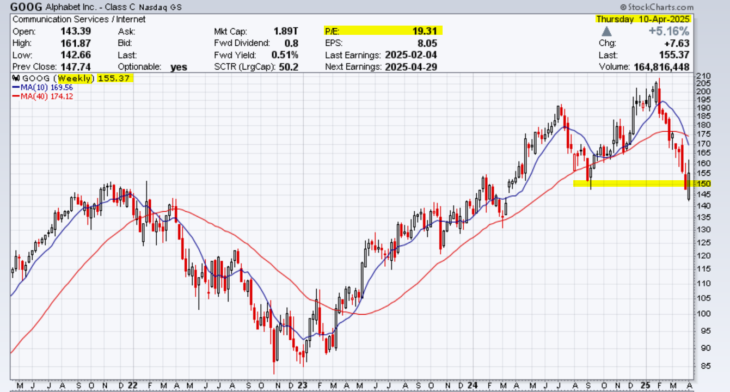
Alphabet is down around 30% from the high. It has a solid advertising and cloud business for top-line growth and performs on the bottom-line. Reference my spreadsheet analysis below this chart.

This is a screenshot of a 4-year weekly chart for Alphabet.

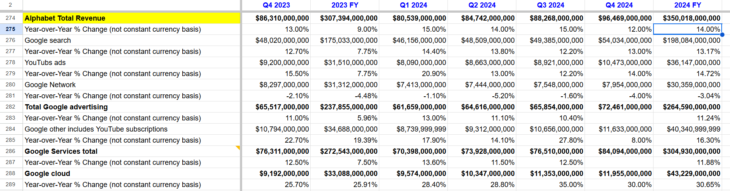
The following are the top-line numbers for Google from 2023 to 2024:

This is screenshot of my analysis for the Alphabet financials.

Investor Updates – Alphabet Investor Relations

Updated April 24, 2025:

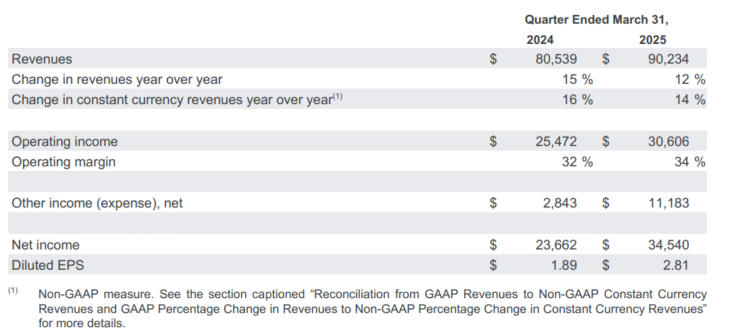
MOUNTAIN VIEW, Calif. – April 24, 2025 – Alphabet Inc. (NASDAQ: GOOG, GOOGL) today announced financial results for the quarter ended March 31, 2025.

  • Consolidated Alphabet revenues in Q1 2025 increased 12%, or 14% in constant currency, year over year to $90.2 billion reflecting robust momentum across the business, with Google Search & other, YouTube ads, Google subscriptions, platforms, and devices, and Google Cloud each delivering double-digit growth rates.
  • Google Services revenues increased 10% to $77.3 billion, reflecting strong performance across Google
    Search & other, Google subscriptions, platforms, and devices, and YouTube ads.
  • Google Cloud revenues increased 28% to $12.3 billion, led by growth in Google Cloud Platform (GCP)
    across core GCP products, AI Infrastructure, and Generative AI Solutions.
  • Total operating income increased 20% and operating margin expanded by 2 percentage points to 34%.
  • Net income increased 46% and EPS increased 49% to $2.81.
  • The company announced a 5% increase to the dividend, resulting in a quarterly cash dividend of $0.21.
Alphabet (GOOG) Q1 2025 income statement

Links for a deeper dive:

GOOG Exhibit 99.1 Q1 2025

Q1 2025 Earnings Slides

_____________

Technical Analysis is about trading with the trend

Note: This technical analysis is for educational purposes. Please conduct your own analysis or consult a financial advisor before making investment decisions. The author of this article may hold long or short positions in the featured stocks or indexes.

© 2025 TradeOnline.ca