Published May 20, 2026
As NVIDIA (NVDA) hovers around a $5.5 trillion market cap—trading in the $220 to $225 range—its valuation presents a fascinating paradox. While it remains one of the most valuable companies in the world, its valuation multiples have quietly compressed to near-historical lows relative to its massive earnings power.
1. Price-to-Earnings (P/E) Metrics
NVIDIA’s valuation looks drastically different depending on whether you look backward or forward.
- Trailing P/E (LTM): ~42x – 45x Based on trailing twelve-month earnings, NVIDIA trades at roughly 43 times earnings. While this is a premium compared to the broader S&P 500 (average ~20x), it represents a monumental drop from the peak AI euphoria of 2023, when its trailing P/E routinely cleared 140x to 240x.
- Forward P/E (NTM): ~25x – 27x Looking at expected earnings over the next 12 months, the multiple drops significantly. A forward P/E in the mid-20s places NVIDIA in line with—or even cheaper than—large-cap tech peers like Microsoft and Apple, and vastly cheaper than direct semiconductor rivals like AMD (which trades at a much higher trailing multiple due to lower absolute earnings).
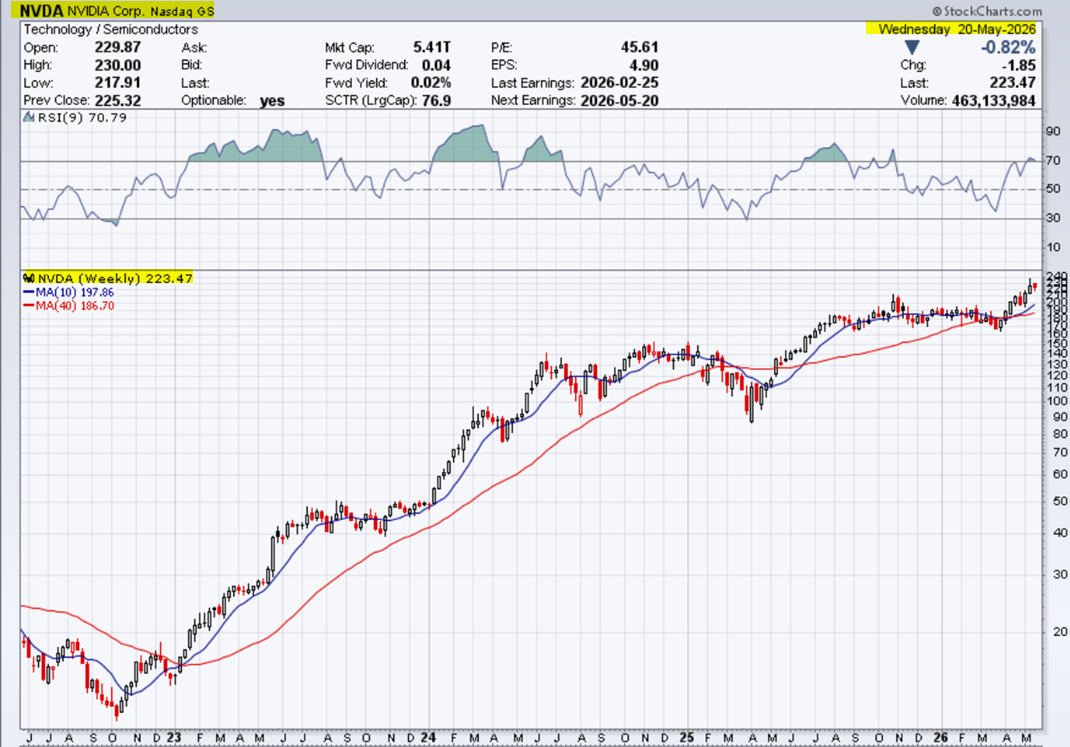
2. Historical Context: The “Compression” Story
NVIDIA is currently trading below its own long-term historical valuation averages.
- Its 3-year average P/E sits at ~53x.
- Its 5-year average P/E sits at ~63x.
- Its 10-year historical average sits at ~64x.
Even before the generative AI boom, the market always commanded a premium for NVIDIA due to its gaming and crypto tailwinds. At ~42x trailing earnings today, the stock is being priced more like a mature, high-quality growth business rather than a speculative momentum trade.
3. Other Critical Valuation Metrics
Gross & Net Profit Margins (The Moat)
What prevents NVIDIA’s P/E from skyrocketing alongside its stock price is its unprecedented profitability.
- Gross Margins: Sustaining at an incredible ~75%.
- Net Profit Margins: Reached an extraordinary 71% in the most recent Q1 earnings report (Net Income of $58 billion on $82 billion in revenue).
PEG Ratio (Price/Earnings-to-Growth): ~0.6x – 1.0x
When factoring in growth, NVIDIA looks remarkably inexpensive. A PEG ratio below 1.0 traditionally indicates that a stock is undervalued relative to its growth rate. With Wall Street projecting aggregate earnings growth of over 70% for NVIDIA this fiscal year, its PEG ratio remains highly attractive.
Price-to-Sales (P/S) Ratio: ~22x
This remains NVIDIA’s most expensive metric. A P/S ratio above 20x is historically risky for hardware companies, but it reflects the absolute monopoly NVIDIA currently maintains over tier-one AI data center deployments (Blackwell and upcoming Rubin architectures).
4. The Valuation Debate: Hardware vs. “Tokenomics”
The primary disconnect between structural bulls and bears comes down to how you define NVIDIA’s business model:
The Bear Case (Hardware Cycle): Hardware multiples eventually mean-revert. Hyperscaler (Microsoft, Google, AWS) capex will eventually plateau, enterprise hardware cycles will turn, and competitive pressure from AMD or custom in-house silicon will erode those 75% gross margins.
The Bull Case (“Tokenomics” Factory): CEO Jensen Huang argues that framing NVIDIA as a “chip company” is structurally incorrect. In his view, modern AI data centers are not IT costs; they are manufacturing equipment. Instead of consuming power to run software, they are factories producing a highly valuable commodity: Tokens (text, code, synthetic data, and video).
5. What is Capping the Multiples?
If earnings are beating expectations (Q1 revenue grew 85% YoY), why are the multiples compressing?
- The China Hole: Direct export curbs have driven NVIDIA’s China data center revenue from $17.1 billion down to effectively zero, creating an onboarding headwind that the rest of the world has had to absorb.
- Macro Geopolitics: Broad market anxiety surrounding Middle East energy shocks and sustained inflation has kept a lid on broad tech multiple expansions, preventing NVDA from re-testing its historical 60x+ valuation heights.
https://investor.nvidia.com/financial-info/financial-reports/default.aspx
————-
Technical Analysis is about trading with the trend
Note: This technical analysis is for educational purposes. Please conduct your own analysis or consult a financial advisor before making investment decisions. The author of this article may hold long or short positions in the featured stocks or indexes. The article was written with the help of AI and was reviewed by an editor.
© 2026 TradeOnline.ca InvestOnline.ca ChartAnalysis.ca