Category Archives: TSX Index

The Dot-Com crash (2000–2002) was not a sudden “flash crash” like 1987 or 2020; it was a slow, painful “bleed” that lasted 2.5 years.

Published January 15, 2026

The magnitude of the drop depended entirely on which index you were holding.

1. The Epicenter: NASDAQ (Tech Stocks)

This is where the bubble actually was. The crash here was catastrophic.

  • The Drop: -78%
  • The Numbers: It fell from a peak of 5,048 (March 10, 2000) to a low of 1,114 (October 9, 2002).
  • The Recovery: It took 15 years (until 2015) for the NASDAQ to return to its year 2000 peak.

2. The Broader Market: S&P 500

Because the S&P 500 contained both tech stocks and regular companies (Banks, Oil, Retail), it fell less, but was still cut in half.

  • The Drop: -49%
  • The Timeline: It peaked in March 2000 and didn’t hit bottom until October 2002.

3. The “Safety” Trade: Dow Jones Industrial Average

The Dow held up the best because it was filled with “boring” old-economy companies (like Caterpillar, 3M, General Electric) that investors fled to for safety.

  • The Drop: -38%

The “Wealth Destruction” in Specific Stocks

To understand the pain, you have to look at the individual giants, not just the index. Many companies that survived still lost almost all their value:

  • Amazon: Dropped -94% (From $107 to $6).
  • Cisco: Dropped -86% (It was the most valuable company in the world in 2000; it still has not returned to its 2000 highs in inflation-adjusted terms).
  • MicroStrategy: Dropped -99% (From $3,330 to $4).

Why this matters for 2026: We are currently seeing a similar “split” market. The S&P 500 is highly concentrated in AI tech (NVIDIA, Microsoft), much like the NASDAQ was in 2000. If the “AI Bubble” were to burst, you would likely see a similar dynamic: a massive 70%+ drop in the pure-play AI stocks, while the broader “Old Economy” stocks (like the Canadian banks or Energy names we discussed) might only drop 30–40%.


The TSX (then called the TSE 300) suffered a massive drop of approximately 50%, essentially cutting the value of the entire Canadian stock market in half.

However, the “Canadian Crash” was unique because it was driven almost entirely by the collapse of one single company.

Here is the breakdown of the TSX drop compared to the U.S. markets.

1. The Numbers

  • The Peak: On September 5, 2000, the index hit an all-time high of 11,423.
    • Note: The TSX peaked 6 months later than the U.S. markets because our tech giant (Nortel) kept rallying even after the NASDAQ cracked in March.
  • The Bottom: By October 9, 2002, the index had crashed to 5,695.
  • The Total Drop: -50.1%

2. The Villain: The “Nortel Effect”

You cannot talk about the 2000 crash in Canada without talking about Nortel Networks.

  • The Concentration: At its peak in 2000, Nortel alone made up 33% to 35% of the entire TSE 300 index.2
  • The Implosion: Nortel stock fell from $124 to eventually pennies (and bankruptcy).
  • The Result: Because Nortel was 1/3rd of the index, its collapse mathematically dragged the index down 30% by itself.
  • The “Other” TSX: If you excluded Nortel, the rest of the Canadian market (Banks, Oil, Rail) actually performed reasonably well during that period, dropping far less than the headline number suggested.

3. Comparison to US Markets

The TSX performed “in the middle” of the U.S. indices.

IndexDrop (2000–2002)Primary Victim
NASDAQ-78%Pure Tech (Amazon, Cisco, Pets.com)
TSX (Canada)-50%Nortel (plus JDS Uniphase, BlackBerry)
S&P 500-49%Broad US Economy
Dow Jones-38%Old Economy (Caterpillar, 3M, GE)

Relevance for 2026

This history is critical for you right now because of the XEG ETF we discussed earlier.

  • Then: Nortel was 33% of the TSX.
  • Now: Canadian Natural Resources (CNQ) and Suncor (SU) are 50% of the XEG ETF.
  • The Lesson: When an index is that concentrated, a problem with one company becomes a crash for the entire fund. If CNQ were to have a major regulatory or operational disaster, XEG would suffer a “Nortel-like” drag, even if oil prices stayed high.
As of January 2026, the landscape for “Inverse ETFs” in Canada has changed significantly due to the massive rebranding of Horizons ETFs to Global X

Published January 13, 2026

If you are looking for the famous “H-Series” tickers (like HXD, HIX, or HQD), many of them have been renamed and given new ticker symbols.

Here are the most popular Inverse Canadian ETFs, organized by sector and updated with their new 2026 tickers.

1. Betting Against the Canadian Market (TSX 60)

These are the standard tools for shorting the broad Canadian economy (Banks, Energy, Rail).

StrategyNew TickerOld TickerFund Name
-1x InverseCNDI(HIX)BetaPro S&P/TSX 60 Daily Inverse ETF
-2x BearCNDD(HXD)BetaPro S&P/TSX 60 -2x Daily Bear ETF
  • Use Case: You believe the general Canadian economy is entering a recession.
  • Note: CNDD provides double leverage (if TSX falls 1%, CNDD rises 2%).

2. Betting Against Canadian Energy

You have two distinct options here: betting against the Oil Companies (Stocks) or betting against the Price of Oil (Commodity).

StrategyNew TickerOld TickerFund Name
Short Oil STOCKSNRGD(HED)BetaPro S&P/TSX Capped Energy -2x Daily Bear
Short Oil PRICEHOD(Kept Ticker)BetaPro Crude Oil Inverse Leveraged Daily Bear
Short Nat GasHND(Kept Ticker)BetaPro Natural Gas Inverse Leveraged Daily Bear
  • Crucial Distinction:
    • Buy NRGD if you think Suncor/CNQ stocks will fall.
    • Buy HOD if you think the WTI Oil Price will fall. (HOD is extremely volatile and suffers from “decay” if held long-term).

3. Betting Against Canadian Banks

With the mortgage renewal cliff in 2026, this is a popular trade for those bearish on the housing market.

StrategyNew TickerOld TickerFund Name
-2x Bank BearCFOD(HFD)BetaPro S&P/TSX Capped Financials -2x Daily Bear

4. Betting Against US Tech (TSX Listed)

Many Canadians use their CAD accounts to short the US market without converting currency.

StrategyNew TickerOld TickerFund Name
Short S&P 500SPXD(HSD)BetaPro S&P 500 -2x Daily Bear ETF
Short NASDAQQQD(HQD)BetaPro NASDAQ-100 -2x Daily Bear ETF

⚠️ Critical Warning: The “Daily Reset” Trap

These ETFs are not long-term investments.1 They are designed for 1-day trades.

  • The Decay: Because they reset their leverage every single day, holding them for weeks or months will erode your value, even if the market goes in your direction.2
  • Example: If the market is flat but volatile (up 2% one day, down 2% the next), you will lose money in both the Bull (+2x) and Bear (-2x) funds over time.
  • Rule of Thumb: Do not hold these tickers (especially the -2x ones like CNDD or HOD) for longer than a few days unless you are actively managing the position.

Yes, CNDI (BetaPro S&P/TSX 60 Daily Inverse ETF) does decay.

Even though it is only -1x (Single Inverse) and not -2x like the riskier funds, it still suffers from “Volatility Drag” because of its daily reset mechanism.

If you hold CNDI for more than one day in a choppy market, you are mathematically guaranteed to lose value over time, even if the TSX 60 ends up flat.

The Math: How the “Daily Reset” Eats Your Money

To understand why it decays, look at this simple 2-day scenario where the market goes Up one day and Down the next, ending back where it started.

Scenario: The “Choppy” Market

Imagine the TSX 60 Index starts at $100.

  • Day 1: The Market goes UP 10%.
  • Day 2: The Market goes DOWN 9.09% (this brings it exactly back to $100).

Here is what happens to your CNDI shares:

DayMarket ActionCNDI Action (Inverse)Your CNDI Value
StartIndex at $100Buy at $100$100.00
Day 1Market +10% (to $110)CNDI -10%$90.00
Day 2Market -9.09% (back to $100)CNDI +9.09%$98.18
ResultMarket is FLAT ($0 change)You LOST ~$1.82-1.8% Loss

The Decay: The market did nothing (returned to zero), but you lost nearly 2% of your money. This is because losing 10% hurts you more than gaining 9% helps you. You are trying to recover from a smaller base ($90 instead of $100).

Why CNDI Decays Slower than CNDD (-2x)

While CNDI decays, it is much safer than the -2x leveraged version (CNDD). Decay essentially “squares” with leverage.

  • CNDI (-1x): Moderate Decay (Dangerous over months).
  • CNDD (-2x): Rapid Decay (Dangerous over weeks).

Summary Rule

  • Use CNDI for: A trade lasting 1 day to 2 weeks when you are confident the market will drop in a straight line.
  • Do NOT use CNDI for: A long-term “hedge” against a recession. If the market grinds sideways for 6 months before crashing, your CNDI shares will have already decayed significantly, and you won’t get the full protection you expected.

Better Hedge: If you need protection for 6+ months, it is often cheaper to buy Put Options on the TSX 60 (XIU) rather than holding an inverse ETF that bleeds value daily.

_____________

Technical Analysis is about trading with the trend

Note: This technical analysis is for educational purposes. Please conduct your own analysis or consult a financial advisor before making investment decisions. The author of this article may hold long or short positions in the featured stocks or indexes. The article was written with the help of AI and was reviewed by an editor.

© 2026 TradeOnline.ca InvestOnline.ca ChartAnalysis.ca

Contact[email protected]

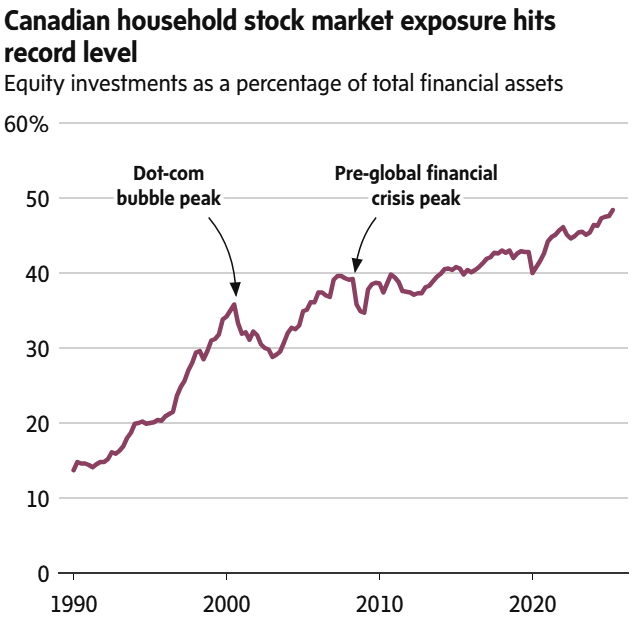
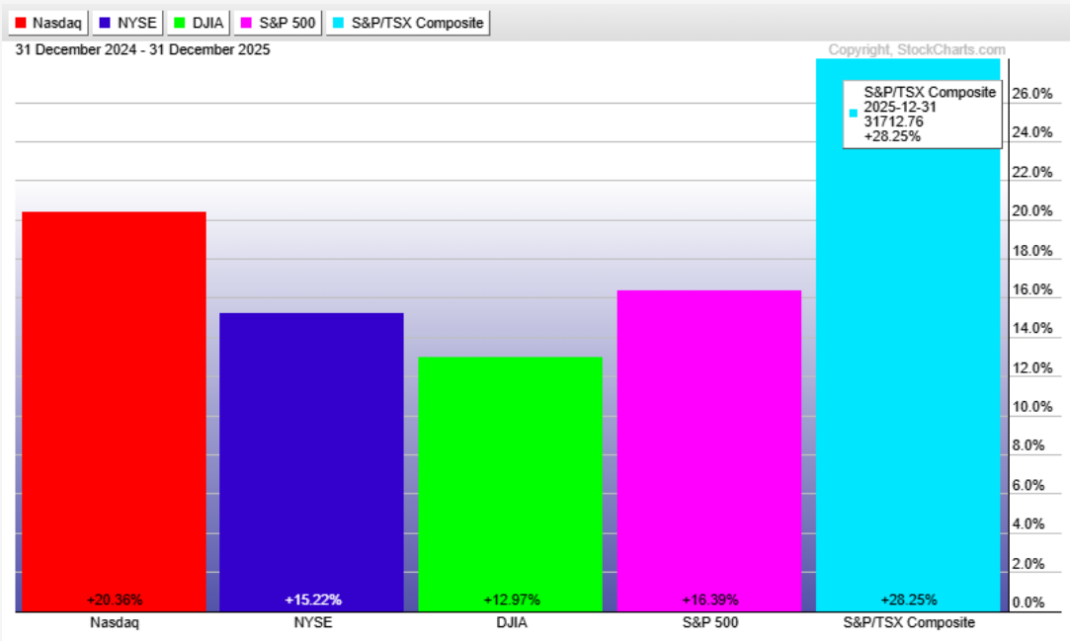
Performance of the major North American indexes in 2025

Published December 31, 2025

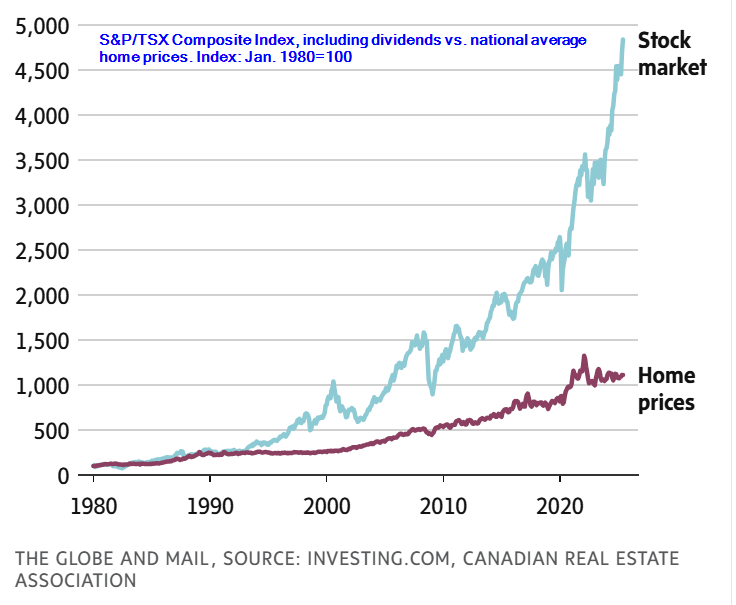
2025 was a historic, record-breaking year for the Canadian stock market. The S&P/TSX Composite Index ended the year with a gain of 28.25%, marking its best annual performance since 2009.

Performance of the TSX index in 2025

_____________

Technical Analysis is about trading with the trend

Note: This technical analysis is for educational purposes. Please conduct your own analysis or consult a financial advisor before making investment decisions. The author of this article may hold long or short positions in the featured stocks or indexes.

© 2025 TradeOnline.ca InvestOnline.ca ChartAnalysis.ca

Contact[email protected]

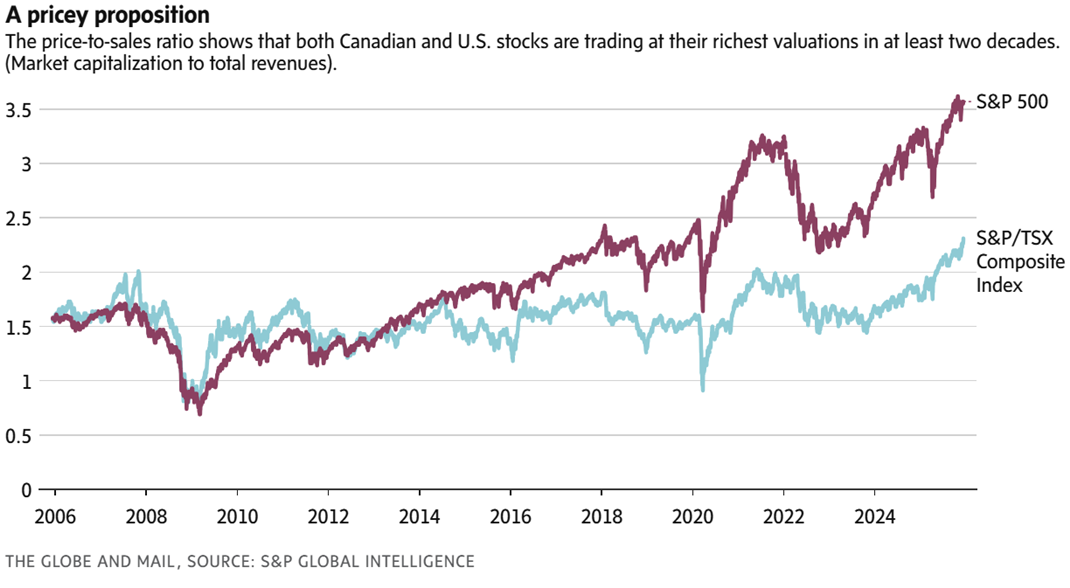
Price-to-Sales (P/S) Ratio for S&P 500 and TSX

Published December 12, 2025

Analysis: This was published in the The Globe and Mail. One of the metrics that shows the relative overvaluation of the two indexes.

Price to sales ratio for the S&P 500 and the TSX indexes

This was the year when everyone, everywhere, made money. In fact, if you had celebrated New Year’s Day 2025 by downing a few cocktails, throwing darts at a map of the world and then buying stocks wherever they landed, chances are you would have done magnificently.

This year was easy for investors. Don’t expect a replay in 2026 – The Globe and Mail

TSX Index at all-time high

Published Friday, August 29, 2025

Analysis: Here is a 4-year candlestick chart for the index. It is overextended and due for consolidation or a pull back. But at this stage; the major trend is up, the intermediate trend is up and the the near-term trend is up.

TSX index at all-time high

The S&P/TSX Composite Index is a key benchmark for the Canadian stock market, representing a diverse range of sectors. As of August 2025, the index includes the following major sectors and their approximate weightings:

SectorApproximate Weighting
Financials32%
Energy16%
Materials12%
Industrials10%
Consumer Discretionary8%
Technology7%
Real Estate6%
Utilities5%
Healthcare4%

Sector Breakdown

Financials

The financial sector is the largest component of the TSX, driven by major banks like the Royal Bank of Canada (RBC) and Toronto-Dominion Bank (TD). This sector has seen strong performance due to robust earnings and lower loan loss provisions.

Energy

The energy sector benefits from rising oil prices and accounts for a significant portion of the index. Companies in this sector are influenced by global demand and geopolitical factors.

Materials

The materials sector includes mining and resource companies, which are sensitive to commodity prices. This sector has been performing well, reflecting the demand for natural resources.

Industrials

The industrials sector encompasses a variety of companies involved in manufacturing, transportation, and infrastructure. It has shown steady growth, supported by infrastructure investments.

Consumer Discretionary

The consumer discretionary sector includes retail and consumer goods companies. This sector has gained traction due to expectations of economic recovery and consumer spending.

Technology

The technology sector has emerged as a growth driver, particularly with advancements in AI and digital transformation. Companies like Shopify are leading this charge.

Real Estate

The real estate sector focuses on property management and development, with a growing emphasis on ESG (Environmental, Social, and Governance) criteria.

Utilities

The utilities sector provides essential services and tends to be more stable, making it a defensive investment during market volatility.

Healthcare

The healthcare sector includes pharmaceutical and biotechnology companies. It remains resilient, particularly with innovations in treatments and medical technologies.

This diverse sector composition reflects the overall health and dynamics of the Canadian economy, with various sectors contributing to the index’s performance.

Written with the help of AI and reviewed by an editor.

_____________

Technical Analysis is about trading with the trend

Note: This technical analysis is for educational purposes. Please conduct your own analysis or consult a financial advisor before making investment decisions. The author of this article may hold long or short positions in the featured stocks or indexes.

© 2025 TradeOnline.ca InvestOnline.ca ChartAnalysis.ca

Contact[email protected]

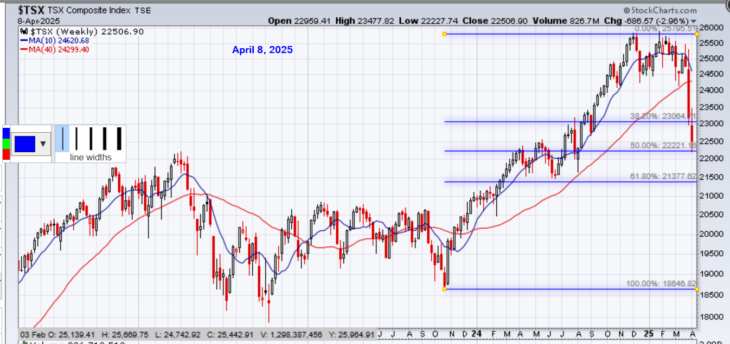
TSX Index attempting to hold the 50% retracement level

Posted April 8, 2024

_____________

Technical Analysis is about trading with the trend

Note: This technical analysis is for educational purposes. Please conduct your own analysis or consult a financial advisor before making investment decisions. The author of this article may hold long or short positions in the featured stocks or indexes.

© 2025 TradeOnline.ca

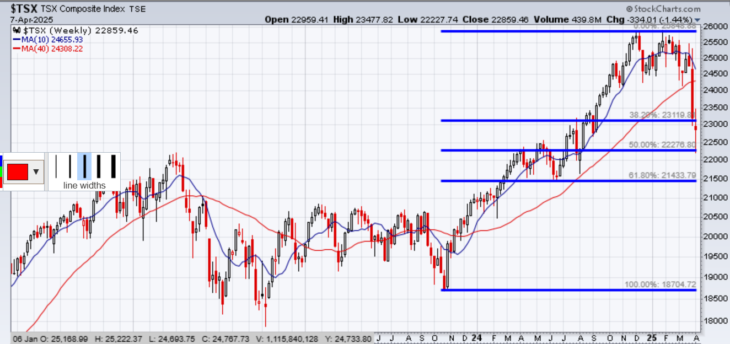
TSX Index Fibonacci retracement levels for April 7, 2025

The TSX Index is trading below the 200-day simple moving average. The 50-day is above the 200-day which is a positive. It closed about 12% down from the high. It is looks better than the S&P 500 or the Nasdaq. It looks like the TSX Index is attempting to hold support around the 50% retracement level. At this stage, if you have not sold, it is recommended to hold your positions in the Canadian index. With the Trump tariffs, we have an undefined headwind. Be vigilant and adjust as needed.

_____________

Technical Analysis is about trading with the trend

Note: This technical analysis is for educational purposes. Please conduct your own analysis or consult a financial advisor before making investment decisions. The author of this article may hold long or short positions in the featured stocks or indexes.

© 2025 TradeOnline.ca