Tag Archives: S&P 500

It’s obvious Mr. Trump is leveraging the presidency for immense financial gain

Published in The Globe and Mail on May 25, 2026

Here is an excerpt from the article.

His first year back in office was the most profitable of his life, bestowing US$3-billion in wealth on the family fortune, according to Forbes.

Mr. Trump’s self-enrichment campaign comes at a cost to us all. It rips off those on the other side of those trades. And it undermines the fairness of the public markets.

In March, more than US$800-million worth of oil futures changed hands just minutes before Mr. Trump announced on Truth Social that strikes on Iran’s infrastructure would be postponed, according to the Wall Street Journal.

Same thing a couple weeks ago, as detailed by the influential market commentator The Kobeissi Letter. In the early hours of May 6, someone bet nearly US$1-billion on crude oil shorts, which pay off if the price of oil drops. About an hour later, Axios reported that a deal to end the war in Iran was in the works. Oil prices quickly dove by 12 per cent, and those shorts netted a cool US$125-million.

Donald Trump cashes in on power, and investors pay the price – The Globe and Mail

What is the average annual return for the S&P 500 Index?

While “10%” is the common shorthand answer, the truth depends entirely on your timeframe and whether you count dividends.

As of February 25, 2026, the S&P 500 has just come off a historic “triple-peat,” finishing 2025 up 17.9%, following gains of 25% in 2024 and 26.3% in 2023.

Historical Average Annual Returns

TimeframeAverage Annual ReturnInflation-Adjusted (Real)
Last 10 Years (2016–2026)~12.2%~8.5%
Last 30 Years (1996–2026)~10.1%~7.2%
Since 1957 Inception~10.2%~6.5%
Since 1926 (Historical Data)~9.8%~6.2%

Three Essential Nuances for Investors

1. The “Dividend Engine”

Price appreciation is only half the story. Dividends have historically accounted for roughly 31% to 34% of the S&P 500’s total return.

  • Without reinvesting dividends, $10,000 invested in 1930 would have grown to roughly $278,000 today.
  • With dividends reinvested, that same $10,000 would be worth over $9.5 Million.

2. The “Average” Year is Rare

The stock market almost never actually returns exactly 10% in a single year. Since 1871, the annual return has landed between 8% and 12% in less than 10% of years. The market usually “overshoots” (up 20%+) or “undershoots” (down 10%+).

3. The 20-Year “Safety Net”

If you have a short-term horizon, your odds of a positive return are basically a coin toss (59% monthly). However, looking at every rolling 20-year period since 1928, the S&P 500 has produced a positive total return 100% of the time.

Current Context (Early 2026)

With the S&P 500 currently trading near record highs (approx. 6,915), many analysts are predicting a “valuation reset.” Goldman Sachs forecasts a 12% total return for the full year of 2026, driven more by earnings growth from AI adoption than by the “multiple expansion” (stocks getting more expensive) we saw in 2024.


Based on a 7% conservative “real” return (which accounts for inflation), here is how a $10,000 investment would grow over the next decade:

The 10-Year Projection

  • Initial Investment: $10,000.00
  • Time Horizon: 10 Years
  • Annual Return: 7%
  • Total Future Value: $19,671.51

Key Takeaways

  1. The “Double” Rule: At a 7% return, your money effectively doubles every 10 years. You will have gained $9,671.51 in pure profit without adding another cent to the account.
  2. The Power of Compounding: Notice that your gain in Year 1 is only $700, but by Year 10, your investment is growing by over $1,280 per year. This “snowball effect” is why time in the market is more important than timing the market.
  3. Real vs. Nominal: Because we used a 7% “real” rate, that $19,671 represents today’s purchasing power. In actual dollars (nominal), the number might look like $26,000 or more, but it would buy the same amount of “stuff” that ~$19.6k buys today.

What if you added a small monthly contribution?

If you invested just $200 a month on top of that initial $10,000, your 10-year total would jump to **$53,308.83**.


Here is a compound interest calculator:

https://www.thecalculatorsite.com/finance/calculators/compoundinterestcalculator.php

The Dot-Com crash (2000–2002) was not a sudden “flash crash” like 1987 or 2020; it was a slow, painful “bleed” that lasted 2.5 years.

Published January 15, 2026

The magnitude of the drop depended entirely on which index you were holding.

1. The Epicenter: NASDAQ (Tech Stocks)

This is where the bubble actually was. The crash here was catastrophic.

  • The Drop: -78%
  • The Numbers: It fell from a peak of 5,048 (March 10, 2000) to a low of 1,114 (October 9, 2002).
  • The Recovery: It took 15 years (until 2015) for the NASDAQ to return to its year 2000 peak.

2. The Broader Market: S&P 500

Because the S&P 500 contained both tech stocks and regular companies (Banks, Oil, Retail), it fell less, but was still cut in half.

  • The Drop: -49%
  • The Timeline: It peaked in March 2000 and didn’t hit bottom until October 2002.

3. The “Safety” Trade: Dow Jones Industrial Average

The Dow held up the best because it was filled with “boring” old-economy companies (like Caterpillar, 3M, General Electric) that investors fled to for safety.

  • The Drop: -38%

The “Wealth Destruction” in Specific Stocks

To understand the pain, you have to look at the individual giants, not just the index. Many companies that survived still lost almost all their value:

  • Amazon: Dropped -94% (From $107 to $6).
  • Cisco: Dropped -86% (It was the most valuable company in the world in 2000; it still has not returned to its 2000 highs in inflation-adjusted terms).
  • MicroStrategy: Dropped -99% (From $3,330 to $4).

Why this matters for 2026: We are currently seeing a similar “split” market. The S&P 500 is highly concentrated in AI tech (NVIDIA, Microsoft), much like the NASDAQ was in 2000. If the “AI Bubble” were to burst, you would likely see a similar dynamic: a massive 70%+ drop in the pure-play AI stocks, while the broader “Old Economy” stocks (like the Canadian banks or Energy names we discussed) might only drop 30–40%.


The TSX (then called the TSE 300) suffered a massive drop of approximately 50%, essentially cutting the value of the entire Canadian stock market in half.

However, the “Canadian Crash” was unique because it was driven almost entirely by the collapse of one single company.

Here is the breakdown of the TSX drop compared to the U.S. markets.

1. The Numbers

  • The Peak: On September 5, 2000, the index hit an all-time high of 11,423.
    • Note: The TSX peaked 6 months later than the U.S. markets because our tech giant (Nortel) kept rallying even after the NASDAQ cracked in March.
  • The Bottom: By October 9, 2002, the index had crashed to 5,695.
  • The Total Drop: -50.1%

2. The Villain: The “Nortel Effect”

You cannot talk about the 2000 crash in Canada without talking about Nortel Networks.

  • The Concentration: At its peak in 2000, Nortel alone made up 33% to 35% of the entire TSE 300 index.2
  • The Implosion: Nortel stock fell from $124 to eventually pennies (and bankruptcy).
  • The Result: Because Nortel was 1/3rd of the index, its collapse mathematically dragged the index down 30% by itself.
  • The “Other” TSX: If you excluded Nortel, the rest of the Canadian market (Banks, Oil, Rail) actually performed reasonably well during that period, dropping far less than the headline number suggested.

3. Comparison to US Markets

The TSX performed “in the middle” of the U.S. indices.

IndexDrop (2000–2002)Primary Victim
NASDAQ-78%Pure Tech (Amazon, Cisco, Pets.com)
TSX (Canada)-50%Nortel (plus JDS Uniphase, BlackBerry)
S&P 500-49%Broad US Economy
Dow Jones-38%Old Economy (Caterpillar, 3M, GE)

Relevance for 2026

This history is critical for you right now because of the XEG ETF we discussed earlier.

  • Then: Nortel was 33% of the TSX.
  • Now: Canadian Natural Resources (CNQ) and Suncor (SU) are 50% of the XEG ETF.
  • The Lesson: When an index is that concentrated, a problem with one company becomes a crash for the entire fund. If CNQ were to have a major regulatory or operational disaster, XEG would suffer a “Nortel-like” drag, even if oil prices stayed high.

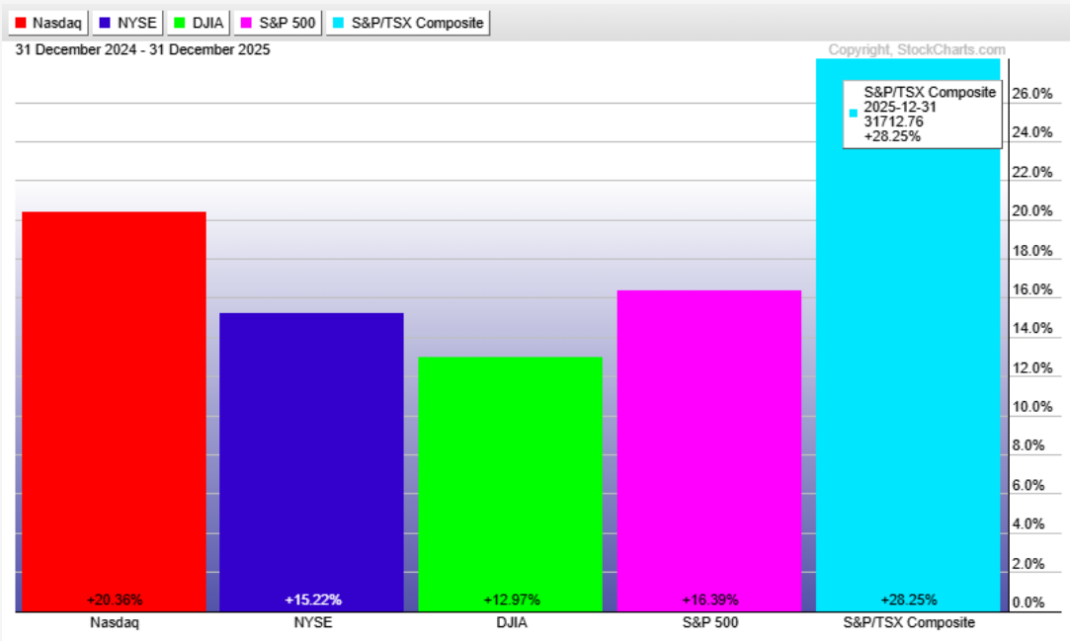
Performance of the major North American indexes in 2025

Published December 31, 2025

2025 was a historic, record-breaking year for the Canadian stock market. The S&P/TSX Composite Index ended the year with a gain of 28.25%, marking its best annual performance since 2009.

Performance of the TSX index in 2025

_____________

Technical Analysis is about trading with the trend

Note: This technical analysis is for educational purposes. Please conduct your own analysis or consult a financial advisor before making investment decisions. The author of this article may hold long or short positions in the featured stocks or indexes.

© 2025 TradeOnline.ca InvestOnline.ca ChartAnalysis.ca
Contact[email protected]

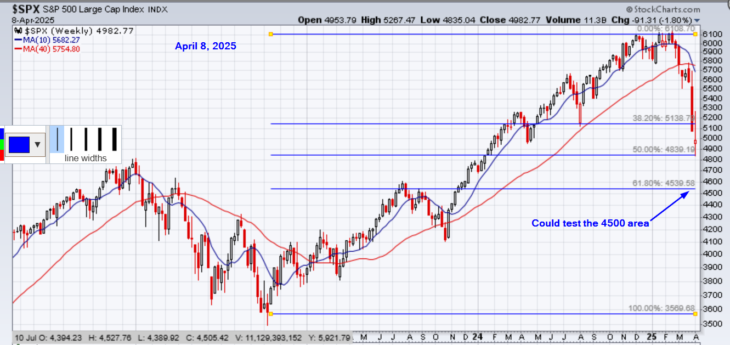
S&P 500 could test the 61.80% retracement level around 4500

_____________

Technical Analysis is about trading with the trend

Note: This technical analysis is for educational purposes. Please conduct your own analysis or consult a financial advisor before making investment decisions. The author of this article may hold long or short positions in the featured stocks or indexes.

© 2025 TradeOnline.ca

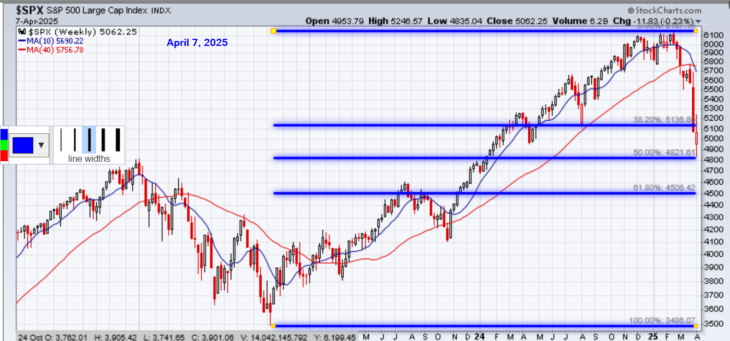
S&P 500 Index weekly chart with the 50-day moving below the 200-day

The SP 500 Index is down around 18% from the high. It is attempting to hold support around the 50% retracement level. If it breaks the 50% retracement level, the S&P 500 will test support around 4500 and be firmly in bear territory. We can see the death cross as the 50 day is trading below the 200 day simple moving average. The overall appearance of this chart is negative.

https://www.investopedia.com/terms/d/deathcross.asp

_____________

Technical Analysis is about trading with the trend

Note: This technical analysis is for educational purposes. Please conduct your own analysis or consult a financial advisor before making investment decisions. The author of this article may hold long or short positions in the featured stocks or indexes.

© 2025 TradeOnline.ca