Category Archives: Economy

According to advance estimates from Statistics Canada, Canada’s real GDP was essentially flat in the second quarter of 2025 (April-June), a notable slowdown from the 2.2% annualized growth seen in the first quarter.

Published August 28, 2025

Canada’s economy saw a contraction in the second quarter of 2025, following a period of modest growth earlier in the year. The latest data and forecasts point to a challenging economic environment driven by global trade uncertainty.

Recent GDP Data (Q2 2025)

  • Real GDP Growth Rate: According to advance estimates from Statistics Canada, real GDP was essentially unchanged in the second quarter of 2025 after a sharp increase in the first quarter. Monthly data showed a decline in GDP in both April and May, followed by a slight rebound in June.
  • Key Factors: The contraction was primarily driven by a sharp drop in exports, particularly to the United States. This was a direct result of trade activity being pulled forward into the first quarter to front-load shipments in anticipation of new tariffs. Sectors like manufacturing and mining, quarrying, and oil and gas extraction saw a decline, while services were largely flat.

Outlook and Forecast

The outlook for the remainder of 2025 and into 2026 is cautious, with many economists predicting a period of very slow growth or even a mild recession.

  • Bank of Canada: The Bank of Canada, in its July 2025 Monetary Policy Report, noted that while the economy has shown some resilience, GDP is estimated to have contracted in the second quarter. The Bank’s forecast is for modest growth in the second half of 2025, but it acknowledges that the unpredictable nature of global trade policy poses a significant risk.
  • Fiscal Forecasts: The Parliamentary Budget Officer’s June 2025 report anticipated that real GDP would be flat in the second quarter, largely due to the impact of tariffs.
  • General Consensus: The general consensus among major Canadian banks and other forecasters is that the economy will continue to face headwinds. A survey by the Bank of Canada found that a significant portion of market participants believe there is a notable probability of a recession in the next 12 months.

Canada’s economic performance has been a mixed bag recently, with the latest data and forecasts pointing to a period of slow or flat growth after a surprisingly strong start to the year.

Recent GDP Data

  • Real GDP Growth Rate: According to advance estimates from Statistics Canada, Canada’s real GDP was essentially flat in the second quarter of 2025 (April-June), a notable slowdown from the 2.2% annualized growth seen in the first quarter.
  • Monthly Breakdown: The flat quarterly result was a combination of monthly declines in April and May, followed by a small rebound in June. This indicates a loss of momentum in the middle of the year.

Key Factors and Industry Performance

  • Exports and Trade: The slowdown in the second quarter was largely a result of trade-related issues. Exports, particularly to the United States, fell sharply after a pre-tariff-related surge in the first quarter. This was a key drag on the economy.
  • Goods vs. Services: The goods-producing sector, including manufacturing and mining, saw declines, while the services sector remained relatively flat.
  • Household Spending: Consumer spending has held up better than expected, and residential investment has shown some signs of bouncing back. However, the overall consumer environment is seen as cautious.

Outlook and Forecast

The outlook for the Canadian economy remains uncertain, with a wide range of forecasts from different institutions.

  • Bank of Canada: The Bank of Canada has noted the volatility and uncertainty surrounding global trade. In its recent reports, the Bank acknowledges the slowdown in economic activity but continues to project a gradual path to recovery, assuming trade tensions do not escalate significantly.
  • Private Sector Forecasts: Many economists are forecasting a period of weak growth for the rest of 2025. Some anticipate growth of less than 1% for the year as a whole, while others see a risk of a mild recession, defined as two consecutive quarters of negative growth. The primary risks to the outlook are a further increase in global trade tensions and a weaker-than-expected U.S. economy, as the U.S. is Canada’s largest trading partner.
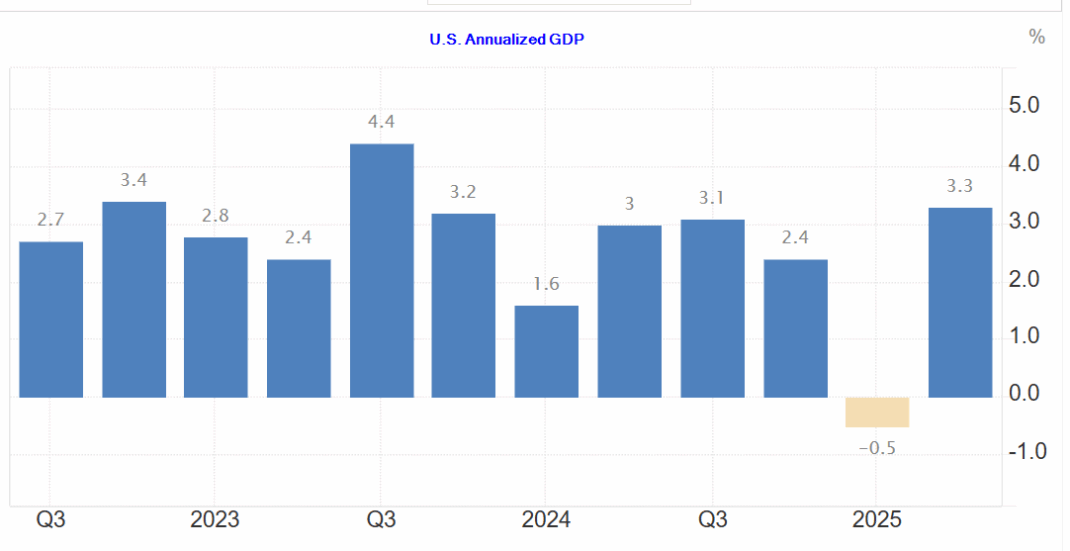
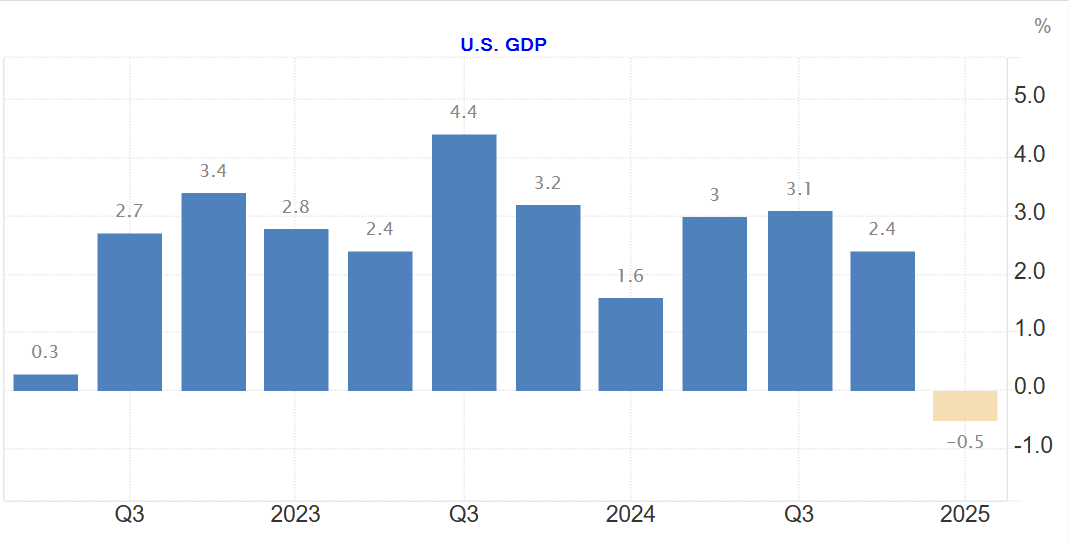
The U.S. real GDP increased at an annual rate of 3.3% in the second quarter of 2025 (April, May, and June)

Published August 28, 2025

The most recent data from the U.S. Bureau of Economic Analysis (BEA) shows that the U.S. economy’s real Gross Domestic Product (GDP) grew at a strong rate in the second quarter of 2025.

Key Figures (Q2 2025)

  • Real GDP Growth Rate: The U.S. real GDP increased at an annual rate of 3.3% in the second quarter of 2025 (April, May, and June). This was an upward revision from the initial estimate of 3.0% and represents a significant rebound from the 0.5% decrease in the first quarter of the year.
  • Nominal GDP: The nominal, or current-dollar, GDP for the second quarter was $30.33 trillion.

Key Drivers of Growth

The increase in real GDP in the second quarter primarily reflected:

  • Increased Consumer Spending: An acceleration in personal consumption expenditures was a major factor, with Americans spending more on both goods and services.
  • Decreased Imports: A notable downturn in imports contributed to the GDP increase, as imports are a subtraction in the GDP calculation. This was partly a result of businesses and consumers having stockpiled goods in the first quarter in anticipation of new tariffs.

Outlook and Forecast

While the second quarter saw robust growth, the outlook for the rest of 2025 and 2026 is somewhat mixed, with many forecasters predicting a slowdown.

  • Forecasts: According to forecasts from organizations like the Federal Reserve Bank of Philadelphia and EY, real GDP growth is expected to decelerate in the second half of 2025 and into 2026. This is largely due to the anticipated impact of trade barriers and a cautious consumer environment.
  • GDPNow: The Atlanta Fed’s GDPNow model currently projects a slower growth rate for the third quarter of 2025, with an estimate of 2.2%. This forecast is updated regularly based on incoming economic data.

The US economy contracted at an annualized rate of 0.5% in Q1 2025

Published June 26, 2025

Analysis: First-quarter growth sank under a surge of imports as companies in the United States rushed to bring in foreign goods before Trump could impose tariffs on them. Trade deficits reduce GDP. But that’s just a matter of mathematics. GDP is supposed to count only what’s produced domestically, not stuff that comes in from abroad. So imports – which show up in the GDP report as consumer spending or business investment – have to be subtracted out to keep them from artificially inflating domestic production.

The first-quarter import influx likely won’t be repeated in the April-June quarter and therefore shouldn’t weigh on GDP. In fact, economists expect second-quarter growth to bounce back to 3 per cent in the second quarter, according to a survey of forecasters by the data firm FactSet.

Chart for US GDP

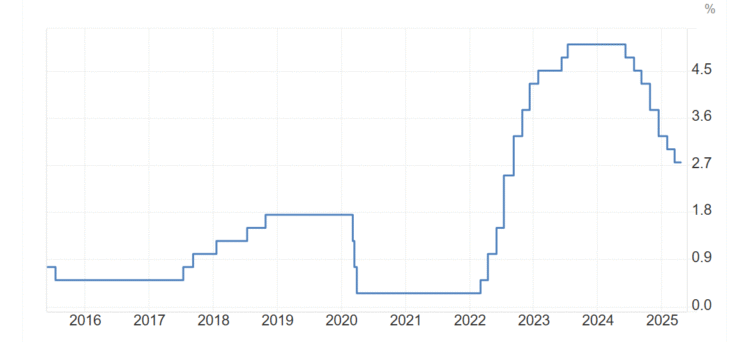
Bank of Canada holds key interest rate at 2.75%, cites ‘unusual uncertainty’

Published June 4, 2025

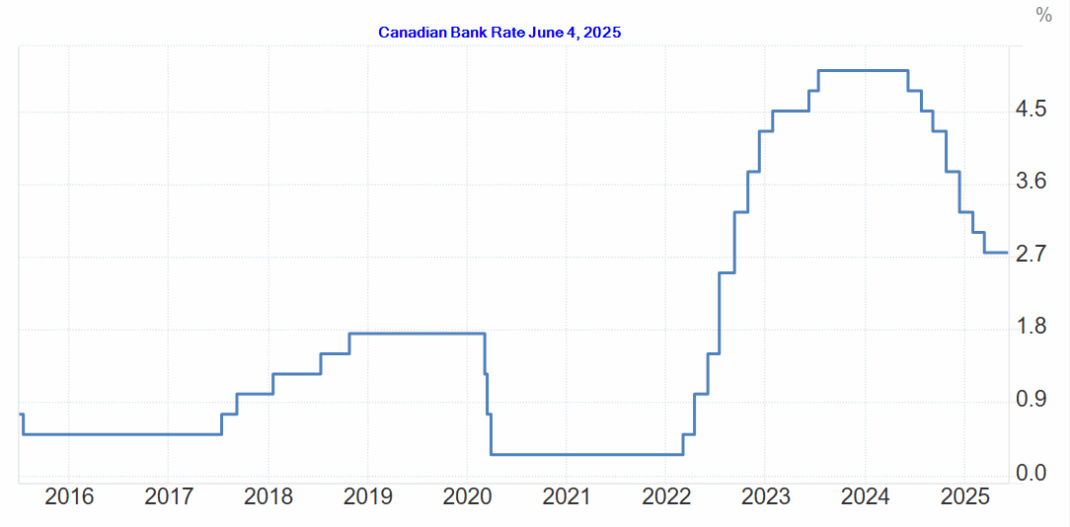
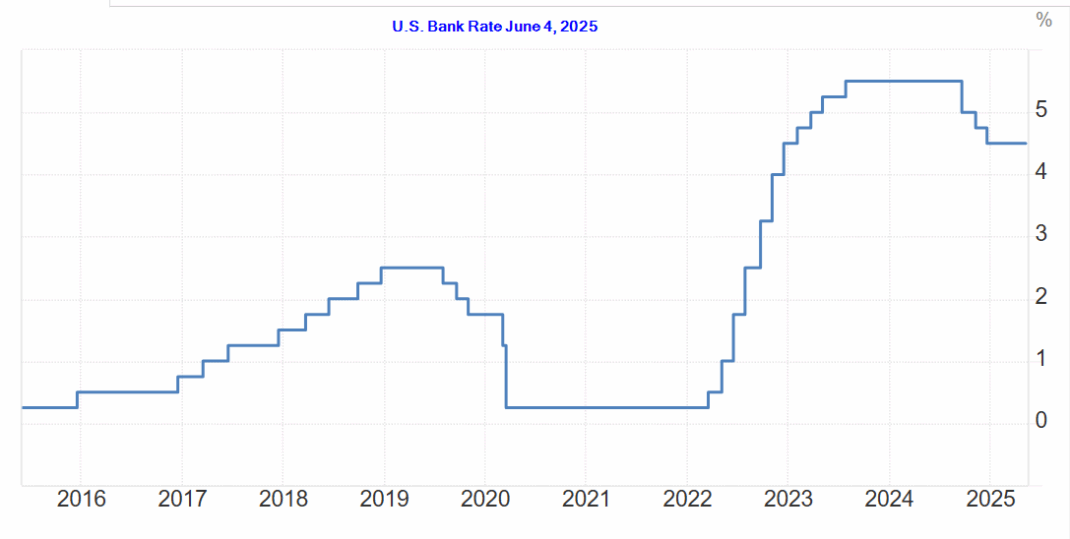
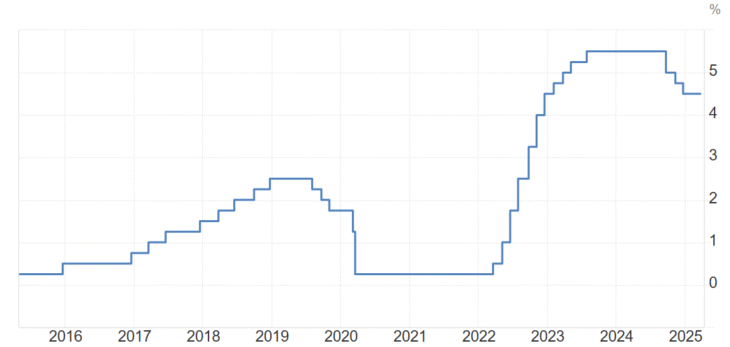
Analysis: This marks the second hold following 2.25 percentage points of cuts in seven consecutive decisions. The Canadian rate is 1.75% below the US rate which puts pressure on the value of the Canadian dollar. The prime rate charged to consumers and businesses is about 2.00% above the bank rate.

Here is a 10-year chart of the Canadian bank rate:

Canadian bank rate

Here is the 10-year chart for the US bank rate which stands at 4.50% and represents a differential of 1.75% compared to the Canadian bank rate:

U.S. Bank rate

Bank of Canada holds policy rate at 2¾% – Bank of Canada

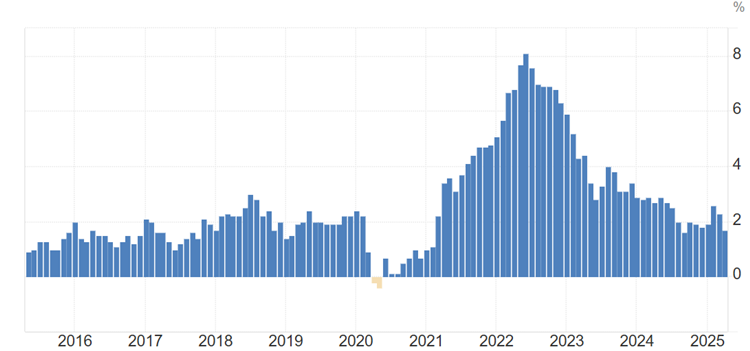
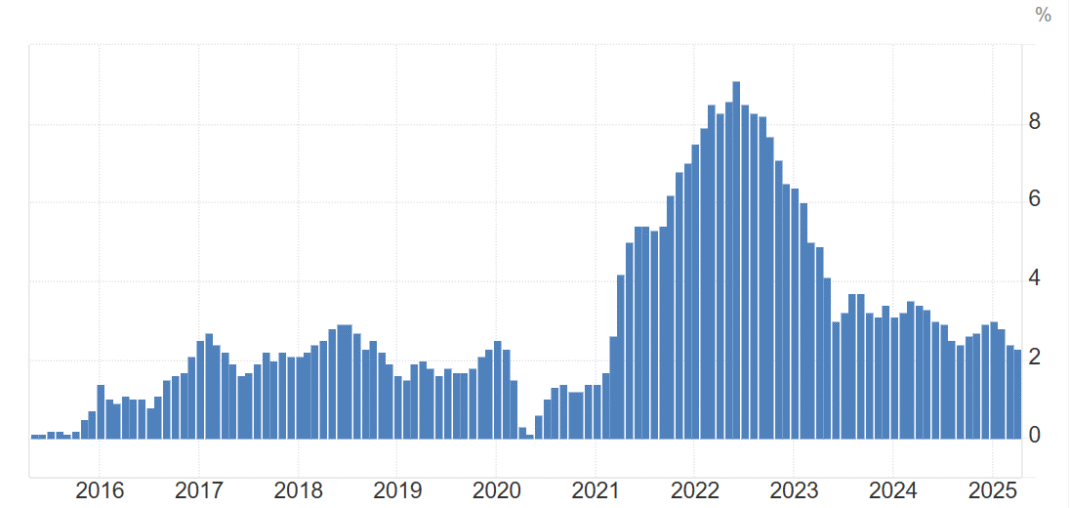
The annual inflation rate in Canada fell to 1.7% in April of 2025 from 2.3% in the previous month, slightly above market expectations of 1.6%, but still reflecting the softest increase in consumer prices in seven months.

Published May 20, 2025

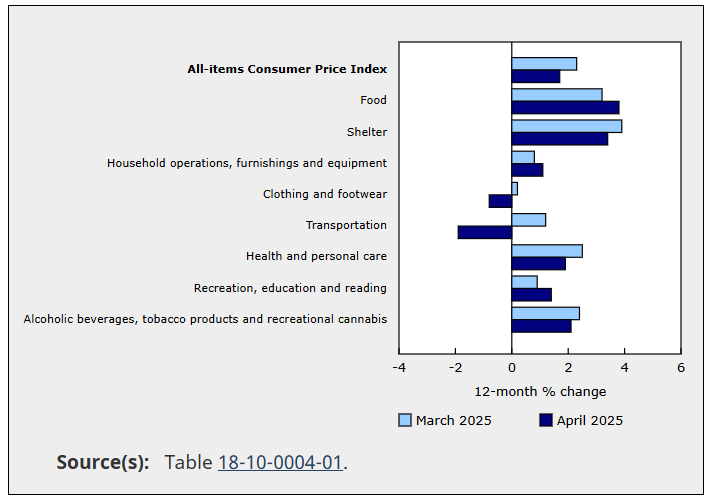
Analysis: The target rate set by BOC is 2.0% so the rate is within the target range. The slowdown was driven by a decline in energy prices (-1.7% vs -0.3% in March) as the removal of the consumer carbon tax magnified the impact that OPEC oil output hikes had on energy prices. Consequently, prices fell for gasoline (-18.1% vs -1.6%) and natural gas (-14.1% vs 6.4%), lowering costs for transportation (-1.9% vs 1.2%).

Here is a a 10-year inflation chart: 

Canadian 10-year inflation chart
Canadian inflation by category

https://www150.statcan.gc.ca/n1/daily-quotidien/250520/dq250520a-eng.htm?HPA=1

Bank of Canada holds policy rate at 2¾%

Published April 16, 2025

Here is a 10-year chart for the Canadian bank rate:

Ten year chart of the Canadian bank rate

Bank of Canada holds policy rate at 2¾% – Bank of Canada

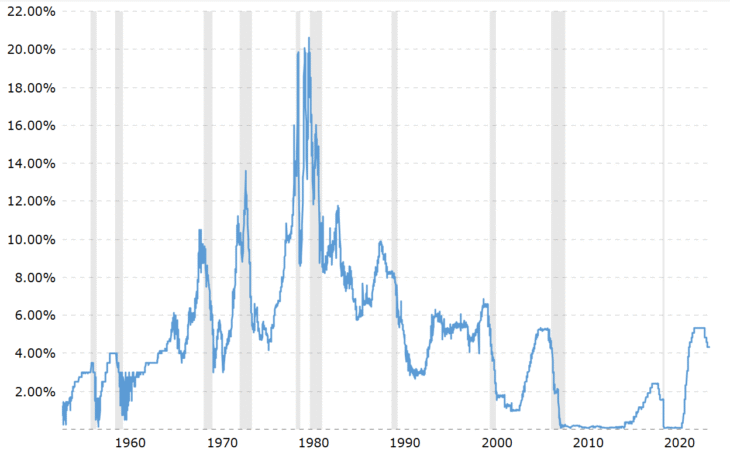
The current U.S. federal funds rate is between 4.25% and 4.50%. This rate is set by the Federal Reserve and influences other interest rates in the economy.

Here is a 10-year chart of United States Fed Funds Interest Rate:

Here is a 10-year chart of United States Fed Funds Interest Rate

Federal Funds Rate – 62 Year Historical Chart

Federal Funds Rate 62-year long-term chart

https://www.federalreserve.gov

U.S. Federal Reserve can wait on any interest rate moves, Powell says – The Globe and Mail

https://www.macrotrends.net/2015/fed-funds-rate-historical-chart

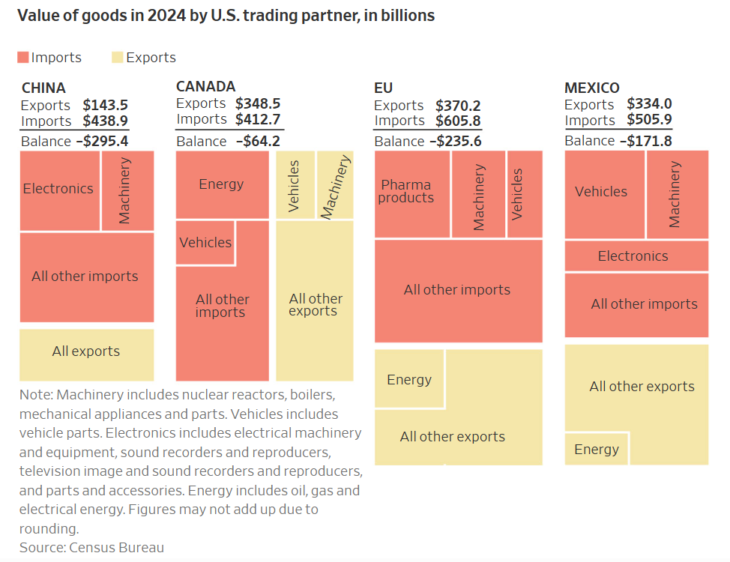
In total, the U.S. bought $3.3 trillion worth of goods from countries around the world in 2024

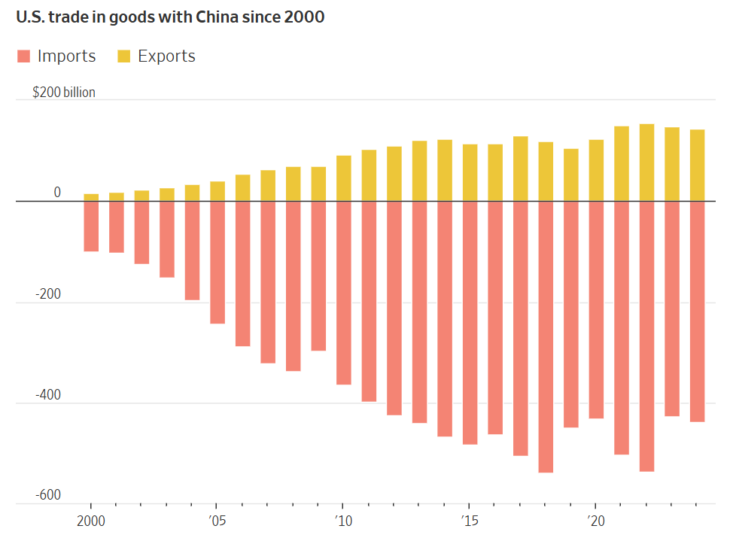
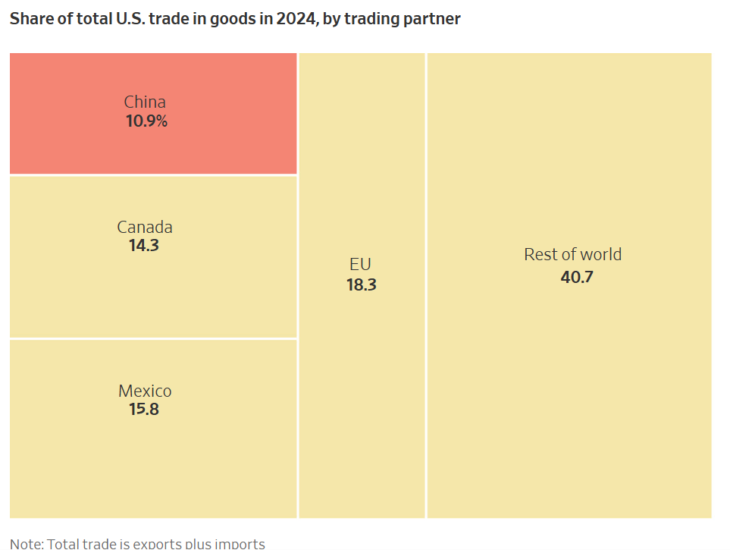
Goods from China represented 13.3% of total U.S. imports, making China the third-largest supplier of goods to the U.S. Products such as smartphones, computers, toys and videogame consoles accounted for 55.5% of U.S. imports from China.

Value of goods by U.S. trading partner, in billions
U.S. trade in goods with China since 2000
Share of total U.S. trade in goods in 2024, by tradeing partner

https://www.wsj.com/economy/trade/the-u-s-and-china-are-still-in-a-trade-war-heres-how-much-business-they-do-41d1f321?st=8NJ8sc&reflink=article_email_share