Silver is seeing a significant sell-off the morning of March 3, 2026

Published March 3, 2026

Here is a 6-month silver chart:
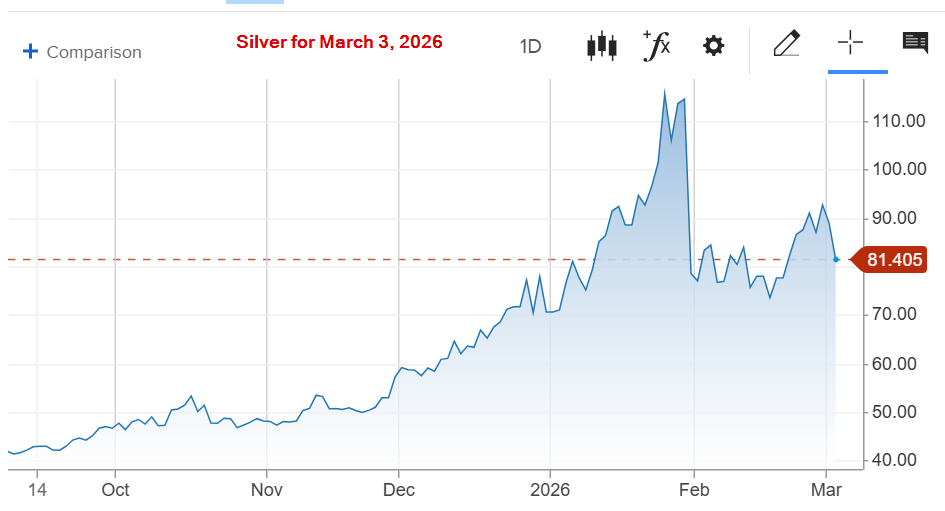
Silver six month chart

Silver is seeing a significant sell-off this morning, Tuesday, March 3, 2026, primarily because the initial “geopolitical shock” that drove prices to record highs over the weekend is beginning to fade, leading to aggressive profit-taking.

While gold is holding up better as a pure safe-haven, silver (the “restless cousin”) is down sharply—dropping as much as 7-8% in early trading to move back toward the $82–$84/oz range.

Here are the three specific factors driving the move:

1. The “Safe-Haven” Rotation to the US Dollar

While silver often benefits from geopolitical tension (like the current conflict involving the US, Israel, and Iran), the US Dollar Index (DXY) has surged to a 5-week high (near 98.5). In times of extreme uncertainty, global capital often flows into the dollar and US Treasuries rather than metals. Since silver is priced in dollars, a stronger greenback makes it more expensive for international buyers, creating immediate downward pressure.

2. Shifting Fed Expectations (The “September” Delay)

Stronger-than-expected US manufacturing and inflation data (ISM Prices Paid hitting a 3.5-year high) have changed the math for interest rates.

  • The News: Markets have pushed back the expected timing for the next Federal Reserve rate cut from July to September 2026.
  • The Impact: Silver provides no yield (interest). When interest rates are expected to stay “higher for longer,” the opportunity cost of holding silver increases, causing traders to dump positions in favor of bonds.

3. Technical Profit-Taking & “Stop-Hunting”

Silver had an “explosive surge” reaching near $95–$96/oz on Sunday/Monday.

  • Overbought: The Relative Strength Index (RSI) hit extreme levels (above 70), signaling the market was overextended.
  • The Cascade: Once silver failed to hold the $95 “make-or-break” resistance level this morning, it triggered a wave of “stop-loss” orders, accelerating the slide as short-term momentum traders exited their positions simultaneously.

Summary Table: Silver’s Morning Slide

MetricStatus (Mar 3, 2026)
Current Spot Price~$84.20/oz
Daily Change-7.2% to -8.5%
Key Support$82.00 / $81.50
Main CatalystStrengthening USD + Delayed Fed Rate Cuts

_____________

Technical Analysis is about trading with the trend

Note: This technical analysis is for educational purposes. Please conduct your own analysis or consult a financial advisor before making investment decisions. The author of this article may hold long or short positions in the featured stocks or indexes. The article was written with the help of AI and was reviewed by an editor.

© 2026 TradeOnline.ca InvestOnline.ca ChartAnalysis.ca

Top 10 Countries by Oil Reserves

Published March 1, 2026

Based on data from the OPEC Annual Statistical Bulletin 2025 and the Energy Institute Statistical Review.

RankCountryReserves (Billion Barrels)World Share (%)
1Venezuela303.217.2%
2Saudi Arabia267.215.1%
3Iran208.611.8%
4Canada163.19.2%
5Iraq145.08.2%
6United Arab Emirates113.06.4%
7Kuwait101.55.8%
8Russia80.04.5%
9Libya48.42.7%
10United States45.02.5%

Key Market Observations

  • OPEC Dominance: Members of the Organization of the Petroleum Exporting Countries (OPEC) control roughly 79% of the world’s proven reserves.
  • The Venezuela Paradox: While Venezuela holds the largest reserves, much of its oil is “extra-heavy” crude, which is expensive to extract and refine. Consequently, its actual production often lags far behind countries like the U.S. or Saudi Arabia.
  • Canadian Oil Sands: Canada’s high ranking is largely due to the oil sands in Alberta. Like Venezuela, these are more difficult and costly to process than the “light sweet” crude found in the Middle East.
  • Production vs. Reserves: The United States is currently the world’s leading oil producer, yet it ranks 10th in reserves. This highlights how quickly a country can extract its resources versus how much it has left in the ground.

Emerging Regions

Keep an eye on Guyana, which has seen a meteoric rise in proven reserves (now over 11 billion barrels) following massive offshore discoveries. It is currently one of the fastest-growing oil provinces in the world.

Note: “Proven reserves” are those that can be recovered with “reasonable certainty” under current economic and operating conditions. These numbers change as new technology makes extraction cheaper or as new fields are discovered.


Canada’s oil reserves can be ranked by type and location. Here’s a breakdown of the major categories, along with their approximate reserves:


RankCategoryLocationEstimated Reserves
1Oil SandsAlbertaApprox. 167 billion barrels (over 97% of Canada’s total reserves)
2Conventional OilSaskatchewanApprox. 7 billion barrels
3Conventional OilNewfoundland and LabradorApprox. 1.6 billion barrels
4Tight Oil (Shale Oil)Alberta and SaskatchewanApprox. 1 billion barrels (estimates vary)

Additional Notes

  • Oil Sands: The vast majority of Canada’s oil is found in the oil sands of Alberta, where it is extracted using surface mining and in-situ techniques.
  • Conventional Oil: While smaller in comparison to oil sands, conventional oil reserves are significant in provinces like Saskatchewan and Newfoundland.
  • Tight Oil: Tight oil, extracted from shale formations, is increasingly becoming a part of Canada’s oil output, although it remains a smaller portion of total reserves.

Note: Published with the assistance of AI and reviewed by an editor

What is the average annual return for the S&P 500 Index?

While “10%” is the common shorthand answer, the truth depends entirely on your timeframe and whether you count dividends.

As of February 25, 2026, the S&P 500 has just come off a historic “triple-peat,” finishing 2025 up 17.9%, following gains of 25% in 2024 and 26.3% in 2023.

Historical Average Annual Returns

TimeframeAverage Annual ReturnInflation-Adjusted (Real)
Last 10 Years (2016–2026)~12.2%~8.5%
Last 30 Years (1996–2026)~10.1%~7.2%
Since 1957 Inception~10.2%~6.5%
Since 1926 (Historical Data)~9.8%~6.2%

Three Essential Nuances for Investors

1. The “Dividend Engine”

Price appreciation is only half the story. Dividends have historically accounted for roughly 31% to 34% of the S&P 500’s total return.

  • Without reinvesting dividends, $10,000 invested in 1930 would have grown to roughly $278,000 today.
  • With dividends reinvested, that same $10,000 would be worth over $9.5 Million.

2. The “Average” Year is Rare

The stock market almost never actually returns exactly 10% in a single year. Since 1871, the annual return has landed between 8% and 12% in less than 10% of years. The market usually “overshoots” (up 20%+) or “undershoots” (down 10%+).

3. The 20-Year “Safety Net”

If you have a short-term horizon, your odds of a positive return are basically a coin toss (59% monthly). However, looking at every rolling 20-year period since 1928, the S&P 500 has produced a positive total return 100% of the time.

Current Context (Early 2026)

With the S&P 500 currently trading near record highs (approx. 6,915), many analysts are predicting a “valuation reset.” Goldman Sachs forecasts a 12% total return for the full year of 2026, driven more by earnings growth from AI adoption than by the “multiple expansion” (stocks getting more expensive) we saw in 2024.


Based on a 7% conservative “real” return (which accounts for inflation), here is how a $10,000 investment would grow over the next decade:

The 10-Year Projection

  • Initial Investment: $10,000.00
  • Time Horizon: 10 Years
  • Annual Return: 7%
  • Total Future Value: $19,671.51

Key Takeaways

  1. The “Double” Rule: At a 7% return, your money effectively doubles every 10 years. You will have gained $9,671.51 in pure profit without adding another cent to the account.
  2. The Power of Compounding: Notice that your gain in Year 1 is only $700, but by Year 10, your investment is growing by over $1,280 per year. This “snowball effect” is why time in the market is more important than timing the market.
  3. Real vs. Nominal: Because we used a 7% “real” rate, that $19,671 represents today’s purchasing power. In actual dollars (nominal), the number might look like $26,000 or more, but it would buy the same amount of “stuff” that ~$19.6k buys today.

What if you added a small monthly contribution?

If you invested just $200 a month on top of that initial $10,000, your 10-year total would jump to **$53,308.83**.


Here is a compound interest calculator:

https://www.thecalculatorsite.com/finance/calculators/compoundinterestcalculator.php

Thomson Reuters leans on proprietary data in AI race as disruption fears mount

Published in The Globe and Mail on February 24, 2026

Thomson Reuters Corp. TRI-T  is betting on the value to professionals of artificial intelligence agents that can carry out complex tasks accurately and on their own, seeking to tamp down fears of disruption that have hung over the software sector in recent weeks.

As AI-based products flood the market, Toronto-based Thomson Reuters is seeking to draw a contrast. On one side is its own software, trained using a vast trove of content spanning the legal, tax and corporate sectors. And on the other, new plug-in tools brought to market by AI giants, which are directly challenging incumbents.

To highlight the difference, Thomson Reuters is making the case that its AI-based software is already taking hold at law firms as well as tax practices, as lawyers and accounting professionals seek to speed up their work and automate laborious tasks.

The company announced Tuesday that its AI-enabled CoCounsel technology now has one million users in more than 100 countries and territories.

Chief product officer David Wong predicts a turning point this year for businesses’ relationship with AI. He expects professional companies will focus more on the return they’re getting from AI investments.

“We are actually in a bit of an ROI crisis,” Mr. Wong told reporters. “Businesses have been experimenting with AI. They bought licences. They’ve run pilots. They’ve told their boards, ‘we’re investing in AI transformation.’ But they’re struggling to show results.”

Slumping tech stocks revive concerns about AI-fuelled disruption

Software and data providers such as Thomson Reuters have watched their share prices plunge lately, not for that reason, but in response to new tools for lawyers released by Anthropic, a leading AI company that makes the Claude large language models.

For some investors, that raised the risk that established software companies could be disrupted, and muddied the outlook about who will win or lose in the race to deploy AI for professionals.

In response, Thomson Reuters chief executive officer Steve Hasker said the market reaction “represents anxiety and not fundamentals.”

Woodbridge Co. Ltd., the Thomson family holding company and controlling shareholder of Thomson Reuters, also owns The Globe and Mail.

Although some investors interpreted Anthropic’s new tools as a direct threat to software providers, Thomson Reuters chief technology officer Joel Hron said the company has “developed a particularly deep collaboration” with Anthropic, which includes collaboration on engineering and research.

Thomson Reuters worked closely with Anthropic for the past year, using Claude as a foundation to develop the newest version of CoCounsel, which is billed as an autonomous legal assistant that can do its own research and deliver human-calibre output. A lawyer then reviews and validates what the agent drafts.

“This is not a black box,” Mr. Hron said. “It is meant to be a human collaborator.”

One Thomson Reuters tax product features an AI agent that helps prepare multiple tax returns for companies collecting sales tax in many jurisdictions, then flags items that need human review. The product’s first version cut the total amount of time spent on the process, which is typically very manual, by 60 to 70 per cent, Mr. Wong said.

Thomson Reuters has also been privately working on a project to develop a proprietary model, trained on a more concentrated set of data that draws on Thomson Reuters’s expertise in professional services. The company has worked closely with academics on the project.

Early benchmarking tests highlighted by Thomson Reuters suggest that its own model outperformed prominent rivals such as OpenAI’s GPT-5 and Anthropic’s Claude Opus 4.5 on tests of reasoning and factuality, document review, summarization and AI-assisted research.

Some products present well in demonstrations but stumble when it comes to accuracy and verification, said Prof. Jonathan Richard Schwarz, head of AI research at Thomson Reuters and a visiting professor at Imperial College London.

On “correctness” and an emphasis on evidence, “the models are really struggling,” he said. “Rather than throwing more hardware and more compute at the same sort of approach, really you should try and bring in this domain expertise into the training process.”

Thomson Reuters leans on proprietary data in AI race as disruption fears mount – The Globe and Mail

Ontario is proposing a new class of mutual funds. Investor advocates warn the risk may not be worth the reward.

Published February 7, 2026

The following article was published in The Globe and Mail on February 7, 2026. It is well written and worth the read.


Ontario’s securities market regulator has faced pressure from Premier Doug Ford’s government to authorize a new class of mutual funds aimed at retail investors that can hold higher-risk private assets such as real estate.

The initiative is being touted as a way to give ordinary investors access to the burgeoning world of privately owned companies and assets, which are mostly only directly available to institutions and sophisticated, wealthy accredited investors.

But investor advocates say private asset investing is riskier and typically more expensive than traditional mutual funds – especially for small investors – and the advocates warn that the plan to create new private asset mutual funds could lead to investors’ money being locked up for years in long-term real estate or infrastructure projects that have extremely complex fee structures.

Doug Ford’s government is pushing regulators to authorize a new class of mutual funds aimed at retail investors that can hold higher-risk private assets such as real estate.Chris Young/The Canadian Press

Three people familiar with the process said the Ford government pushed the Ontario Securities Commission to launch the proposal as a way of raising money for big infrastructure projects. The OSC was urged to prepare a consultation paper unusually quickly, the people said, with the published result containing very little research or industry input.

The Globe and Mail has agreed not to identify the people as they are not authorized to discuss the matter publicly.

Scott Blodgett, a spokesperson for Ontario’s Ministry of Finance, said in an e-mail that while the government discusses capital‑formation initiatives with the OSC and receives updates, it “does not direct or expedite regulatory work.”

“Decisions about long‑term asset fund design, timing and investor safeguards rest solely with the OSC,” Mr. Blodgett said.

OSC spokesperson Julia Mackenzie said the commission’s proposal to launch retail private assets “dates back” to a 2021 report published by the Capital Markets Modernization Taskforce – another regulatory initiative by the Ford government.

At that time, the task force recommended the OSC write a formal proposal on retail private equity investment funds, and then seek public input. The task force said the funds could help close a “funding gap” for smaller companies. Three years later, in the fall of 2024, the OSC launched a consultation paper on retail investors’ access to long-term assets that mentioned the funds could also increase opportunities for additional funding for government infrastructure projects.

“The OSC believes it is important to be open to new and innovative financial products that can enable capital formation and provide new opportunities for investors, with appropriate oversight, disclosure and investor protections,” Ms. Mackenzie told The Globe in an e-mail.


Here is the link to read the rest of this article: Ontario is proposing a new class of mutual funds. Investor advocates warn the risk may not be worth the reward – The Globe and Mail

Bearish Divergence flashing on the SVR (and general silver) charts as of late January 2026

Published January 25, 2026

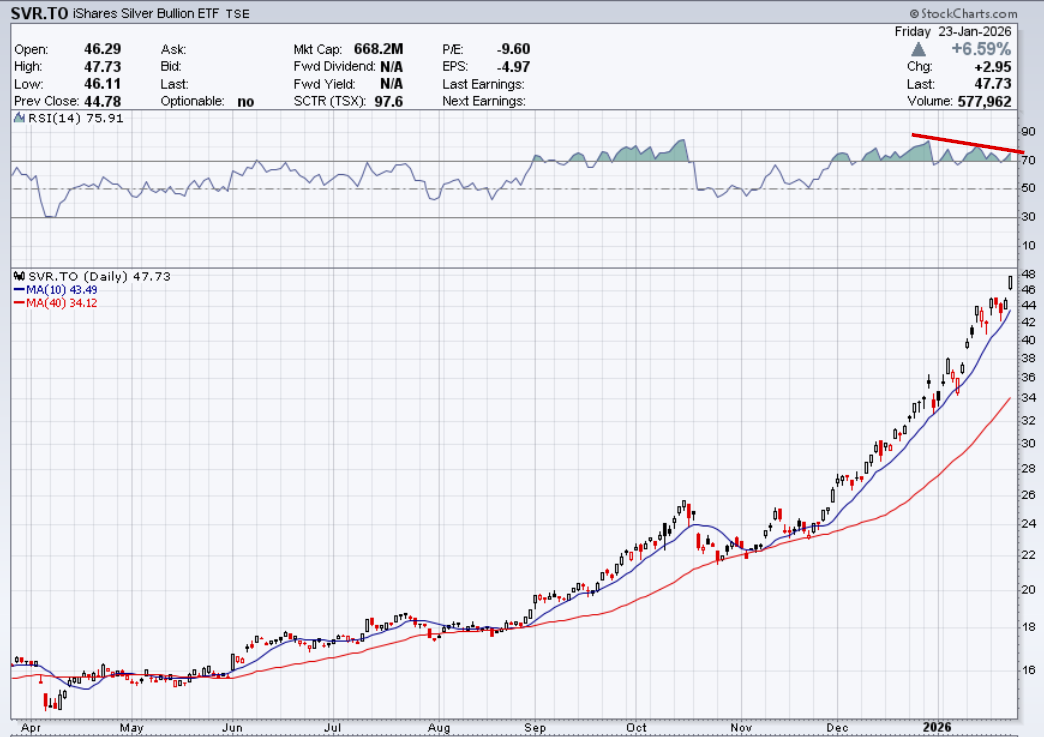
Silver (SVR.TO) daily chart showing divergence with the RSI momentum indicator.

While the price of SVR has hit record highs (around $47.73), the underlying momentum indicators are telling a different story. This is a classic technical “red flag” that often precedes a price correction.

1. RSI Bearish Divergence (The Momentum Gap)

The most prominent divergence is between the Price and the Relative Strength Index (RSI):

  • The Price: SVR has made “Higher Highs” throughout January, climbing from $33 to over $47.
  • The RSI: The RSI momentum indicator peaked in mid-January (reaching an extreme overbought level above 85) and has since been making “Lower Highs.”
  • What this means: Even though the price is still going up, the strength of the buying pressure is weakening. It’s like a car still rolling uphill but with its engine losing power.

2. Premium Divergence (The “Retail Fever”)

There is also a divergence between the ETF Price and the Physical Silver Value:

  • As we noted, SVR is trading at a 3.67% premium to its Net Asset Value (NAV).3
  • Normally, this premium stays near 0%. When it “diverges” and stays high while silver hits $100, it indicates that retail panic-buying is driving the ticker more than the actual value of the silver bars in the vault.
  • The Danger: If the rally pauses, this premium often evaporates instantly, causing the ETF to drop significantly faster than the spot price of silver.

Summary of Technical Signals (Jan 25, 2026)

IndicatorSignalInterpretation
Price ActionBullishSVR is comfortably above its 50-day ($30.76) and 200-day ($21.56) averages.
RSI (14-day)Bearish DivergencePrice is making new highs; RSI is making lower highs (currently ~73).
Premium/NAVBearish+3.67% premium is historically unsustainable and suggests “froth.”
CandlesticksCautionRecent “long-wick” candles near $48 suggest sellers are starting to overpower buyers at these levels.

Technical Strategy

In 2026, many traders are using the $44.00 level as their “line in the sand.”

  • If SVR stays above $44.00, the “parabolic” trend is still alive.
  • If it closes below $44.00 on high volume, the bearish divergence is officially “confirmed,” and the first target for a correction would likely be the 20-day moving average, currently near $38.00.

_____________

Technical Analysis is about trading with the trend

Note: This technical analysis is for educational purposes. Please conduct your own analysis or consult a financial advisor before making investment decisions. The author of this article may hold long or short positions in the featured stocks or indexes. The article was written with the help of AI and was reviewed by an editor.

© 2026 TradeOnline.ca InvestOnline.ca ChartAnalysis.ca

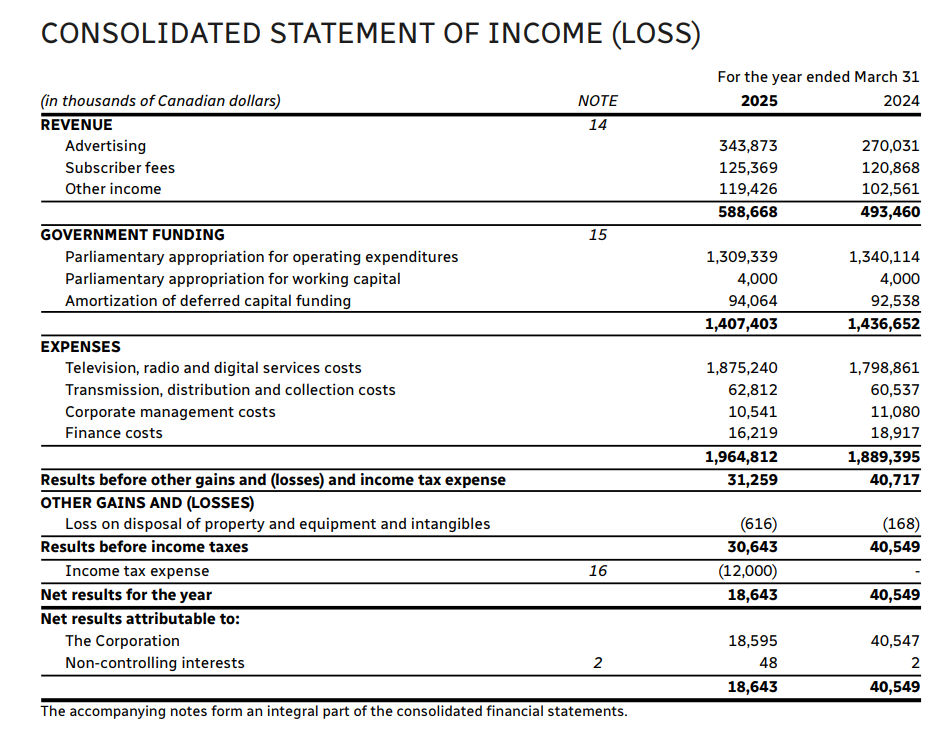
As of early 2026, here is an overview of the CBC (Canadian Broadcasting Corporation), including its funding, headcount, and revenue model

Published January 24, 2026

Executive Summary

The CBC is a federal Crown corporation that operates as Canada’s national public broadcaster. While it generates some of its own money, it is heavily dependent on public subsidies, which cover approximately 70-75% of its operating costs.

1. Headcount: How many people work there?

  • Total Employees: Approximately 7,500 to 8,000 permanent, full-time equivalent employees.
  • Recent Stability: In late 2023, the CBC announced plans to cut roughly 600–800 jobs (about 10% of its workforce) due to a projected budget shortfall. However, in the April 2024 Federal Budget, the government injected an additional $42 million specifically to prevent these layoffs. As of 2025/2026, the workforce has stabilized near historical levels, though attrition (not replacing people who retire) remains a tool for managing costs.

2. Public Subsidy: How much tax money do they get?

The CBC receives an annual “Parliamentary Appropriation” (taxpayer funding) voted on by the federal government.

  • Annual Public Subsidy: Approximately $1.4 Billion CAD per year.
    • Breakdown: This works out to roughly $33–$35 per Canadian per year.
    • Trend: The funding has increased slightly in nominal terms to cover inflation and salary increases, but the broadcaster argues that in “real dollars” (inflation-adjusted), its funding has declined over the last decade.
  • Recent Top-Up: The $42 million added in 2024 was a “stop-gap” measure to handle rising production costs and declining ad revenue, signalling the government’s intent to keep the current size of the organization intact for now.

3. Revenue Streams: Do they make their own money?

Yes. The CBC is not 100% publicly funded. It operates a “hybrid” model where it competes for advertising dollars against private companies (like Bell/CTV, Rogers/Citytv) and tech giants (Google/Meta).

  • Self-Generated Revenue: Approximately $400 Million – $500 Million per year.
    • This accounts for roughly 25–30% of their total budget.
  • Where the money comes from:
    1. Advertising (TV & Digital): This is the largest chunk. They run commercials on CBC Television, CBC News Network, and their websites. Note: CBC Radio does not run commercial advertisements (except for limited sponsorships).
    2. Subscription Fees: Revenue from discretionary channels (like CBC News Network) that are part of cable packages, as well as monthly subscriptions for the premium version of CBC Gem (their streaming service).
    3. Content Licensing: Selling shows (like Schitt’s Creek or Murdoch Mysteries) to other broadcasters or streamers internationally.
  • The Problem: Their “self-generated” revenue is shrinking. Traditional TV advertising is collapsing across the entire industry as money moves to digital platforms (Google/Facebook), and the CBC is struggling to replace those lost TV ad dollars with digital ones.

Summary Table (2025/2026 Estimates)

CategoryApproximate AmountNotes
Public Funding (Subsidy)~$1.4 BillionThe core grant from Parliament.
Self-Generated Revenue~$450 MillionAds, subscriptions, licensing.
Total Annual Budget~$1.85 BillionCombined operating power.
Headcount~7,800Stabilized after 2024 funding injection.

Why is this controversial?

The “Revenue Stream” is a major point of friction. Private broadcasters (like Global and CTV) argue that it is unfair for the CBC to receive $1.4 billion in tax money and compete against them for scarce advertising dollars. They argue this subsidized competition makes it harder for private Canadian news outlets to survive. The CBC counters that ad revenue is essential because the public subsidy alone is not enough to maintain its current level of services across TV, Radio, and Digital in both English and French.

CBC audience
CBC television market share
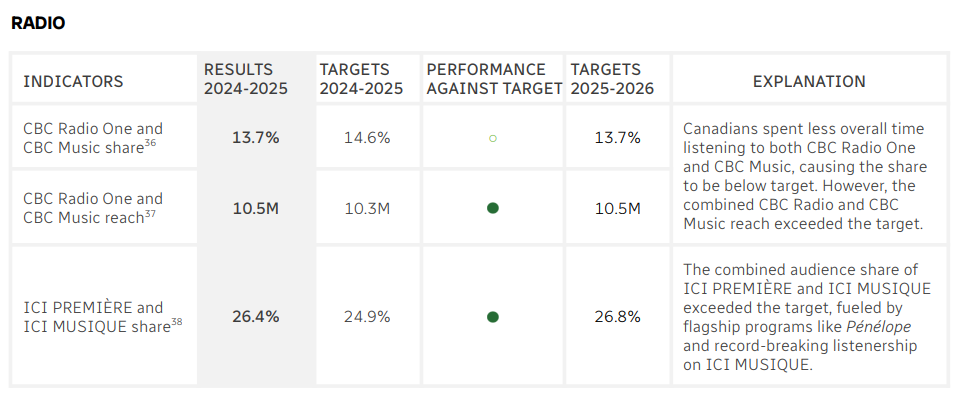
CBC radio market share
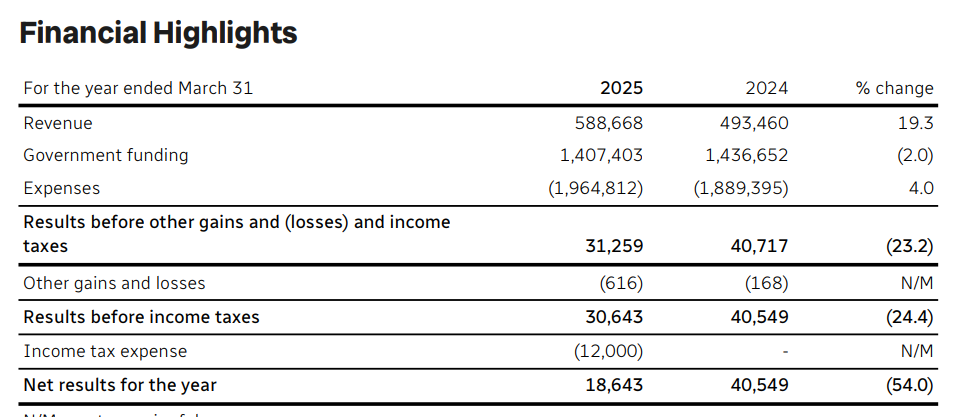
CBC financial summary
CBC income statement 2025-2024

https://cbc.radio-canada.ca/en/impact-and-accountability

https://site-cbc.radio-canada.ca/documents/impact-and-accountability/finances/2025/2024-2025-annual-report.pdf

Updated link February 11, 2026: I agree that the amount and placement of advertising was awful and disrespectable to the opening ceremonies CBC shouldn’t brush off the over 1,000 complaints it received about ads during Olympics opening ceremony – The Globe and Mail

As of January 21, 2026, GoDaddy (NYSE: GDDY) is in a precarious position

Published January 21, 2026

The stock is currently in the middle of a severe correction, trading near 52-week lows despite posting what looked like solid financial numbers in Q3 2025.

GDDY

Here is a a 3-year weekly chart showing the major downtrend:

GoDaddy 3-year weekly chart

Here is a screenshot of my spreadsheet for GoDaddy:

GoDaddy financials

_____________

Here is the “Executive Summary” of the situation: Wall Street is punishing the stock because it views GoDaddy as a “Legacy” tech company falling behind in the AI race, even though its current cash flow remains strong.

1. Stock Performance Snapshot (Jan 2026)

The stock chart is ugly right now. GoDaddy has been one of the poorer performers in the tech sector to start 2026.

  • Current Price: ~$104.00 – $105.00 USD
  • Trend: Aggressive Downtrend. The stock is down roughly 14–16% year-to-date (Jan 1–21) and has nearly cut in half from its 2025 highs of ~$216.
  • Market Cap: ~$14.8 Billion
  • 52-Week Range: $104.03 (Low) – $216.00 (High)
  • Recent Catalyst: In the first two weeks of January, multiple analysts (Morgan Stanley, Jefferies, Cantor Fitzgerald) cut their price targets, citing concerns that GoDaddy’s “Airo” AI product isn’t generating revenue fast enough to offset slowing domain growth.

2. Financial Health (The “Disconnect”)

This is the confusing part for many investors. If you look only at the income statement, the company looks fine. The sell-off is driven by sentiment and future growth fears, not current bankruptcy risk.

  • Revenue (Q3 2025):$1.32 Billion (+10% Year-over-Year).
    • Status: Growing, but “boring” single-digit to low-double-digit growth.
  • Profitability (EPS): $1.51 per share (Beat expectations of $1.48).
  • Free Cash Flow:$440.5 Million (+21% YoY).
    • Critical Stat: GoDaddy is a cash-generating machine. They are generating over $1.2 Billion in free cash flow annually.
  • Valuation:
    • P/E Ratio: ~15x – 18x (This is considered “cheap” for tech, suggesting it is trading like a utility company rather than a growth stock).

3. The “Bear Case” (Why is it crashing?)

Investors are fleeing the stock for three specific reasons in 2026:

  1. The “AI Loser” Narrative: The market fears that Generative AI (like ChatGPT or heavily funded startups) will make it too easy for people to build websites without GoDaddy. GoDaddy launched its own AI tool (GoDaddy Airo) to fight this, but early 2026 data suggests adoption hasn’t been the “game changer” investors wanted.
  2. Insider Selling: In early January 2026, key executives (including the Chief Strategy Officer) sold shares. While often routine, doing so during a stock slide spooked retail investors.
  3. Domain Saturation: The “Core Platform” (selling domain names) is a mature, low-growth business. Investors are looking for 20%+ growth, and GoDaddy is giving them 7–8%.

4. Upcoming Catalyst: Q4 Earnings

  • Estimated Date: Late February 2026 (Likely around Feb 13–15).
  • What to Watch:
    • Guidance for 2026: This is the only thing that matters. If they guide for revenue growth below 6%, the stock could break under $100.
    • Share Buybacks: Because the stock is so “cheap” (low P/E), management has been aggressively buying back their own stock. Watch to see if they announce a new, massive buyback authorization to defend the stock price.

Summary Strategy

  • The Bull View: You are buying a cash-cow monopoly at a discount (~$104). The fear is overblown, and their cash flow will fund massive buybacks that force the stock up eventually.
  • The Bear View: This is a “Value Trap.” It looks cheap, but revenue growth is permanently slowing because AI is making their core business model (selling website templates) obsolete.

As of January 21, 2026, the competitive landscape has thinned out significantly. The most important update for your comparison is that Squarespace is gone from the public markets, leaving GoDaddy and Wix as the last two major standalone “Website Builder” stocks.

Here is how GoDaddy stacks up against its primary rival (Wix) and the premium e-commerce giant (Shopify) in this current market correction.

1. The “Missing” Competitor: Squarespace (SQSP)

  • Status: Private / Delisted.
  • What happened: Squarespace was acquired by the private equity firm Permira in late 2024 for roughly $7.2 billion.
  • Implication: You can no longer buy Squarespace stock. This actually helps GoDaddy’s “scarcity value”—if an investor wants exposure to the “Do-It-Yourself Website” sector, they essentially have to choose between GoDaddy and Wix.

2. Head-to-Head: GoDaddy (GDDY) vs. Wix (WIX)

This is the main battle. Both stocks are currently down, but for different reasons.

FeatureGoDaddy (GDDY)Wix.com (WIX)
Stock Price~$104 USD~$76 – $80 USD
Valuation (P/E)~15x – 16x (Value Stock)~30x – 34x (Growth Stock)
The “Vibe”“The Cash Cow”“The Fallen Star”
Why it’s downFear of AI obsolescence; slow growth.Valuation compression; losing premium status.
Cash FlowMassive (~$1.2B/year).Growing, but less stable than GDDY.

The Analysis:

  • GoDaddy is the “Safe” Play: It trades at half the valuation of Wix (15x vs 30x). Wall Street treats it like a utility company—boring, reliable cash flow, low growth.
  • Wix is the “High Beta” Play: Wix is trading at a much higher premium because it historically grew faster. However, its stock has crashed harder recently (down significantly from its 52-week highs of ~$230) as investors question if it deserves that premium in an AI world.

3. The “Premium” Alternative: Shopify (SHOP)

While not a direct competitor for “simple” websites, Shopify is often grouped in the same basket.

  • Price: ~$167 USD
  • Status: The clear leader. While GoDaddy and Wix fight for the “small local business” market (Pizza shops, Plumbers), Shopify owns the “Online Retail” market.
  • Valuation: Extremely expensive compared to GDDY. You pay a massive premium for Shopify because its growth is structurally higher.

Summary Comparison Table (Jan 2026)

CompanyStatusValuation RiskPrimary Investor Fear
GoDaddyPublicLow (Cheap at 15x P/E)“Will AI replace domain names?”
WixPublicHigh (Expensive at 30x P/E)“Can they justify this premium?”
SquarespacePrivateN/ATaken private to fix issues away from public eye.
ShopifyPublicMedium (Priced for perfection)“Consumer spending recession.”

Strategic Conclusion

  • If you want “Value”: GoDaddy is arguably the safest bet. Even if it doesn’t grow fast, the massive share buybacks (funded by that $1.2B cash flow) put a “floor” under the stock price around $95–$100.
  • If you want “Rebound Potential”: Wix has fallen so far that a simple earnings beat could send it up 20% in a day. It is the riskier, higher-reward trade.

As of January 2026, the short interest data for GoDaddy (GDDY) tells a very specific story: This is NOT a “hated” stock.

Despite the ugly stock chart, hedge funds are not aggressively betting on GoDaddy’s collapse. The selling pressure you are seeing is likely coming from “Long Only” funds selling their shares (profit-taking or rotation), rather than short sellers piling in.

Here is the breakdown of the data found for mid-January 2026.

1. The “Headline” Number

  • Short Interest (% of Float): ~4.2%
  • The Verdict:Low / Normal.
    • Context: A “Crowded Short” (like GameStop in 2021 or a failing bank) typically has short interest above 20%.
    • Peer Comparison: GoDaddy is actually shorted less than its peer group average (which hovers around ~8–9%). This means Wall Street sees GoDaddy as safer than many other mid-cap tech stocks.

2. The “Squeeze” Indicator (Days to Cover)

  • Days to Cover: ~4.1 to 4.5 Days
  • What this means: If all the short sellers decided to cover (buy back) their shares at once, it would take them roughly 4.5 days of normal trading volume to do it.
  • Analysis: This is moderately elevated.
    • Usually, anything over 5 days is considered “Squeeze Territory.”
    • While not extreme, a 4.5 ratio means that if GoDaddy releases a surprise positive earnings report in February, the stock could “pop” 10–15% very quickly because those short sellers would scramble to get out.

3. Institutional Ownership (The “Smart Money”)

  • Ownership: >90% (Very High).
  • The Player: The biggest holders are the “Big Three” (Vanguard, BlackRock, State Street).
  • The Signal: When institutional ownership is this high, it confirms that the stock is widely held in pension funds and ETFs. The recent price drop is likely due to ETF rebalancing or sector rotation (funds selling “Tech” to buy “Energy” or “Defense”), rather than a loss of faith in the company itself.

Summary Table

MetricCurrent LevelSentiment
Short % of Float4.2%Neutral/Safe (Not a target).
Days to Cover4.5Moderate (Minor squeeze potential).
TrendDecliningShorts are actually closing positions, not adding new ones.

Strategic Takeaway

Since the Short Interest is low (4%), you cannot rely on a “Short Squeeze” to save the stock. It has to rise on fundamental merit (Earnings).

  • Bull Case: The sellers are exhausted. With shorts not adding pressure, any good news will lift the stock easily.
  • Bear Case: There is no “guaranteed buyer” (short cover) waiting in the wings. If earnings are bad, the stock will drift lower naturally.

The date you need to circle on your calendar is Thursday, February 12, 2026.

While GoDaddy has not yet issued the official press release confirming the exact minute, historical patterns and analyst consensus point to this date.

The Event Details

  • Date: Thursday, Feb 12, 2026 (Estimated)
  • Time: After Market Close (approx. 4:05 PM ET)
  • The Report: Q4 2025 Earnings & Full Year 2026 Guidance

Why this specific date matters

This is the “Show Me” quarter. The stock has drifted down for three weeks because investors are nervous about the 2026 outlook. This report will resolve that anxiety one way or the other.

The “Pass/Fail” Metrics: The algorithms will react instantly to three specific numbers. You can write these down to grade the report yourself when it drops:

  1. Revenue Growth: Wall Street expects ~$1.27 Billion.
    • The Danger Zone: If they miss this number, it confirms the “AI is killing their business” narrative.
  2. Profit (EPS): Consensus is $1.58 per share.
    • The Bull Signal: GoDaddy has beaten earnings estimates in 3 of the last 4 quarters. If they post something like $1.65+, it proves their cost-cutting is working better than expected.
  3. The “Wild Card”: Buyback Authorization
    • With the stock near 52-week lows, watch for a sentence in the press release saying: “Board authorizes a new $1 Billion share repurchase program.” That single line would likely send the stock up 10% immediately.

Recommendation: Do not buy “Call Options” for this event unless you are willing to lose 100% of the premium. The “Implied Volatility” will be expensive. If you like the stock, the safer play is to simply hold the shares or sell “Put Options” at the $95 strike to buy it cheaper if it crashes.

GoDaddy Inc. – Investors for the latest financials.

_____________

Technical Analysis is about trading with the trend

Note: This technical analysis is for educational purposes. Please conduct your own analysis or consult a financial advisor before making investment decisions. The author of this article may hold long or short positions in the featured stocks or indexes. The article was written with the help of AI and was reviewed by an editor.

© 2026 TradeOnline.ca InvestOnline.ca ChartAnalysis.ca

As of 2026, standard asset allocation rules have shifted

Published January 16, 2026

As of 2026, standard asset allocation rules have shifted. Because people are living longer and inflation remains a long-term threat, the old “safe” rules are now considered risky because they often result in running out of money.

The traditional rule of “100 minus your age” (meaning a 30-year-old holds 70% stocks) is widely viewed by modern financial planners as too conservative. The new standard is closer to “110 or 120 minus your age.”

Here is the breakdown of asset allocation by age group for the current market environment.

The Master Allocation Table (2026 Standard)

This table assumes a “Moderate to Growth” mindset, which is the default for most Target Date Retirement Funds (like Vanguard or BlackRock).

Age GroupStocks (Equities)Bonds/Fixed IncomeCash/ReservesPrimary Goal
20s90% – 100%0% – 10%< 5%Aggressive Growth (Max compounding)
30s80% – 90%10% – 20%~5%Growth (Buying houses/kids, but stay invested)
40s70% – 80%20% – 30%5% – 10%Balanced Growth (Peak earning years)
50s60% – 70%30% – 40%10%Transition (Reducing volatility risk)
60s (Early)50% – 60%40% – 50%10% – 15%Preservation + Growth (Must beat inflation)
70s+30% – 40%50% – 60%10% – 20%Income & Distribution (Drawing down)

Detailed Breakdown by Decade

1. The Accumulators (Ages 20–35)

  • The Strategy: Maximum exposure to the stock market.
  • Why: You have the greatest asset of all: Time. If the market crashes 30% (like in 2020 or 2008), it is actually good for you because you are buying cheaper shares with your paycheck contributions.
  • Common Mistake: Holding too much cash. Many Gen Z investors currently hold 30%+ in cash because they fear a crash. This is a mathematical error known as “Cash Drag” that kills long-term wealth.
  • Allocation: 100% Equities (S&P 500 or Total World Stock ETFs).

2. The Builders (Ages 35–50)

  • The Strategy: High growth, but slight diversification.
  • Why: You likely have “real” liabilities now (Mortgage, RESPs for kids). You can’t afford a 100% loss, but you still need 20 years of growth before retirement.
  • Allocation: 80% Stocks / 20% Bonds.
    • Note: In 2026, with interest rates stabilized, bonds actually pay a decent yield again (unlike 2010–2021), so the 20% bond chunk finally generates income.

3. The Pre-Retirees (Ages 50–60)

  • The Strategy: The “Red Zone.”
  • Why: This is the most dangerous decade. If a massive crash happens 2 years before you retire (Sequence of Returns Risk), it can permanently delay your retirement. You must begin adding bonds to dampen the volatility.
  • Allocation: 60% Stocks / 40% Bonds.
  • The Shift: You stop asking “How much can I make?” and start asking “How much can I lose?”

4. The Retirees (Ages 60–75)

  • The Strategy: Income harvesting.
  • Why: You no longer have a paycheck. Your portfolio is the paycheck. You need safe assets (Bonds/Cash/GICs) to pay for groceries for 5–7 years so that if the stock market crashes, you don’t have to sell stocks at the bottom to eat.
  • The “Bucket” Strategy:
    • Bucket 1 (Cash/GIC): 2 years of living expenses.
    • Bucket 2 (Bonds): 5 years of living expenses.
    • Bucket 3 (Stocks): Everything else (for growth 10+ years out).

The “Rule of 120” (The Modern Formula)

If you want a quick math formula, use 120 – Age = Equity %.2

  • Example: You are 40 years old.
  • 120 – 40 = 80% Stocks. (The other 20% is bonds/cash).

Why 120 and not 100?

Because you are likely to live to 90. If you follow the old “100 minus age” rule, you would have 0% stocks at age 100. In reality, a 65-year-old retiree still needs their portfolio to grow for another 25–30 years to fight inflation.

The Dot-Com crash (2000–2002) was not a sudden “flash crash” like 1987 or 2020; it was a slow, painful “bleed” that lasted 2.5 years.

Published January 15, 2026

The magnitude of the drop depended entirely on which index you were holding.

1. The Epicenter: NASDAQ (Tech Stocks)

This is where the bubble actually was. The crash here was catastrophic.

  • The Drop: -78%
  • The Numbers: It fell from a peak of 5,048 (March 10, 2000) to a low of 1,114 (October 9, 2002).
  • The Recovery: It took 15 years (until 2015) for the NASDAQ to return to its year 2000 peak.

2. The Broader Market: S&P 500

Because the S&P 500 contained both tech stocks and regular companies (Banks, Oil, Retail), it fell less, but was still cut in half.

  • The Drop: -49%
  • The Timeline: It peaked in March 2000 and didn’t hit bottom until October 2002.

3. The “Safety” Trade: Dow Jones Industrial Average

The Dow held up the best because it was filled with “boring” old-economy companies (like Caterpillar, 3M, General Electric) that investors fled to for safety.

  • The Drop: -38%

The “Wealth Destruction” in Specific Stocks

To understand the pain, you have to look at the individual giants, not just the index. Many companies that survived still lost almost all their value:

  • Amazon: Dropped -94% (From $107 to $6).
  • Cisco: Dropped -86% (It was the most valuable company in the world in 2000; it still has not returned to its 2000 highs in inflation-adjusted terms).
  • MicroStrategy: Dropped -99% (From $3,330 to $4).

Why this matters for 2026: We are currently seeing a similar “split” market. The S&P 500 is highly concentrated in AI tech (NVIDIA, Microsoft), much like the NASDAQ was in 2000. If the “AI Bubble” were to burst, you would likely see a similar dynamic: a massive 70%+ drop in the pure-play AI stocks, while the broader “Old Economy” stocks (like the Canadian banks or Energy names we discussed) might only drop 30–40%.


The TSX (then called the TSE 300) suffered a massive drop of approximately 50%, essentially cutting the value of the entire Canadian stock market in half.

However, the “Canadian Crash” was unique because it was driven almost entirely by the collapse of one single company.

Here is the breakdown of the TSX drop compared to the U.S. markets.

1. The Numbers

  • The Peak: On September 5, 2000, the index hit an all-time high of 11,423.
    • Note: The TSX peaked 6 months later than the U.S. markets because our tech giant (Nortel) kept rallying even after the NASDAQ cracked in March.
  • The Bottom: By October 9, 2002, the index had crashed to 5,695.
  • The Total Drop: -50.1%

2. The Villain: The “Nortel Effect”

You cannot talk about the 2000 crash in Canada without talking about Nortel Networks.

  • The Concentration: At its peak in 2000, Nortel alone made up 33% to 35% of the entire TSE 300 index.2
  • The Implosion: Nortel stock fell from $124 to eventually pennies (and bankruptcy).
  • The Result: Because Nortel was 1/3rd of the index, its collapse mathematically dragged the index down 30% by itself.
  • The “Other” TSX: If you excluded Nortel, the rest of the Canadian market (Banks, Oil, Rail) actually performed reasonably well during that period, dropping far less than the headline number suggested.

3. Comparison to US Markets

The TSX performed “in the middle” of the U.S. indices.

IndexDrop (2000–2002)Primary Victim
NASDAQ-78%Pure Tech (Amazon, Cisco, Pets.com)
TSX (Canada)-50%Nortel (plus JDS Uniphase, BlackBerry)
S&P 500-49%Broad US Economy
Dow Jones-38%Old Economy (Caterpillar, 3M, GE)

Relevance for 2026

This history is critical for you right now because of the XEG ETF we discussed earlier.

  • Then: Nortel was 33% of the TSX.
  • Now: Canadian Natural Resources (CNQ) and Suncor (SU) are 50% of the XEG ETF.
  • The Lesson: When an index is that concentrated, a problem with one company becomes a crash for the entire fund. If CNQ were to have a major regulatory or operational disaster, XEG would suffer a “Nortel-like” drag, even if oil prices stayed high.